
 6 hours ago
6
6 hours ago
6
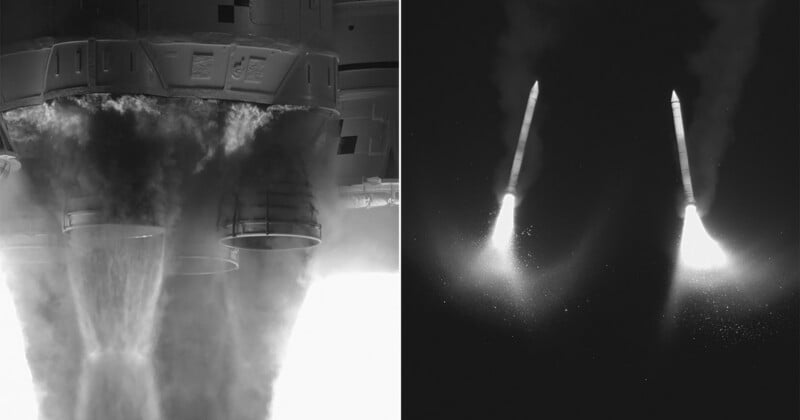
NASA continues to upload more media from its exciting Artemis II launch last week and ongoing lunar mission. Part of the latest batch of images is infrared still frames and videos from the Artemis II launch, which not only provide useful data for scientists but look spectacular for everyone else.
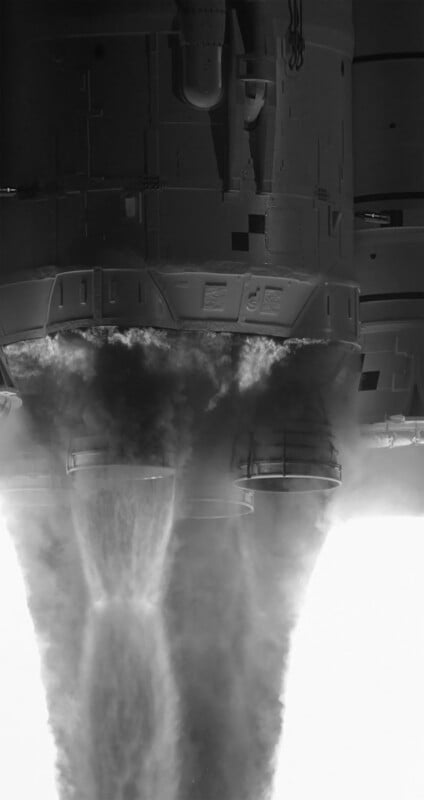
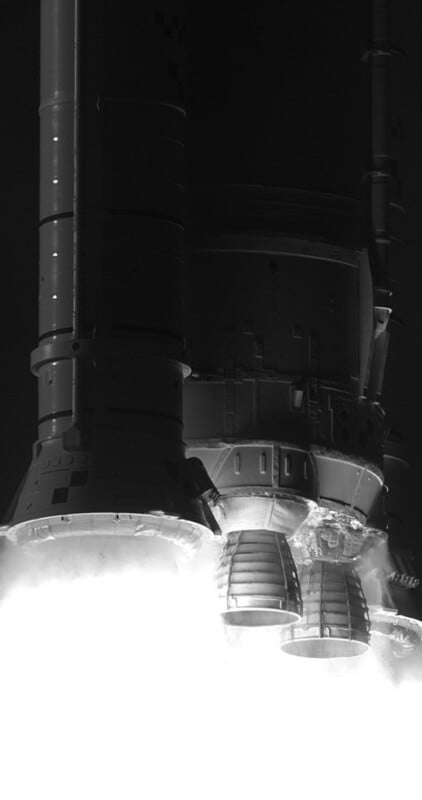
The black and white infrared images capture details that visible light cameras cannot, especially when looking at the rocket thrusters and initial liftoff. The Artemis II launch occurred in the early evening at 6:35 PM EDT in Florida. The weather was clear, and the sky was still quite bright and blue, making certain details difficult to pick out in visible light.
However, when shooting in infrared, the sky appears much darker. The atmosphere scatters significantly less infrared light than visible light. Consider one of the photos below that shows the two solid rocket boosters from NASA’s Space Launch System (SLS) rocket after they separated from the Orion spacecraft carrying Artemis II astronauts Commander Reid Wiseman, Pilot Victor Glover, and Mission Specialists Christina Koch and Jeremy Hansen into space. In this image, the blue sky is nearly black, making it easier to see the materials spewing from the pair of rocket boosters.
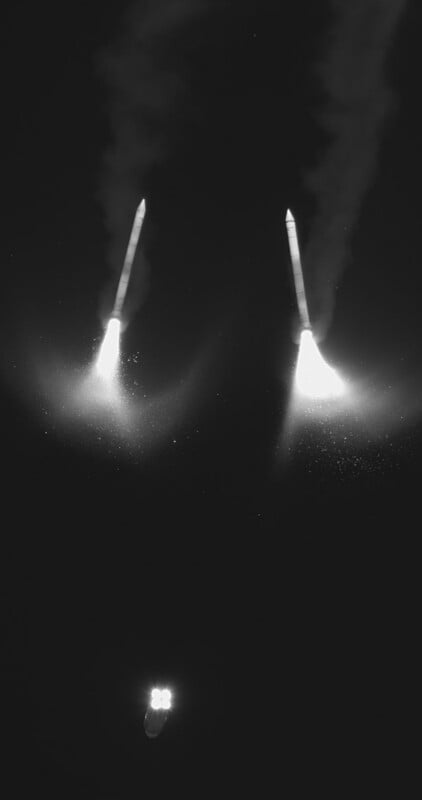 In this black and white infrared image, two solid rocket boosters from NASA’s SLS (Space Launch System) rocket separate from the core stage and Orion spacecraft carrying Artemis II Commander Reid Wiseman, Pilot Victor Glover, and Mission Specialist Christina Koch from NASA, along with Mission Specialist Jeremy Hansen from the CSA (Canadian Space Agency) following liftoff at 6:35 p.m. EDT on Wednesday, April 1, 2026, from Launch Complex 39B at NASA’s Kennedy Space Center in Florida. The Artemis II test flight will take the crew members on a 10-day journey around the Moon and back. | Credit: NASA
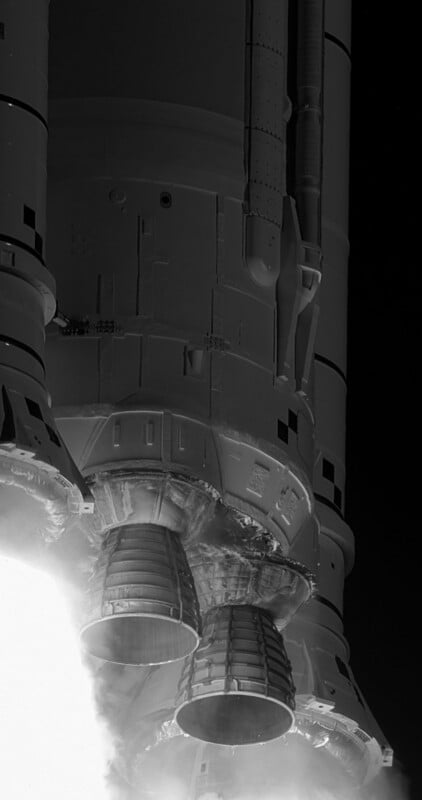 In this black and white infrared image, NASA’s SLS (Space Launch System) rocket with the Orion spacecraft carrying Artemis II Commander Reid Wiseman, Pilot Victor Glover, and Mission Specialist Christina Koch from NASA, along with Mission Specialist Jeremy Hansen from the CSA (Canadian Space Agency), lifts off at 6:35 p.m. EDT on Wednesday, April 1, 2026, from Launch Complex 39B at NASA’s Kennedy Space Center in Florida. The Artemis II test flight will take the crew members on a 10-day journey around the Moon and back. | Credit: NASA
 Credit: NASA
 Credit: NASA
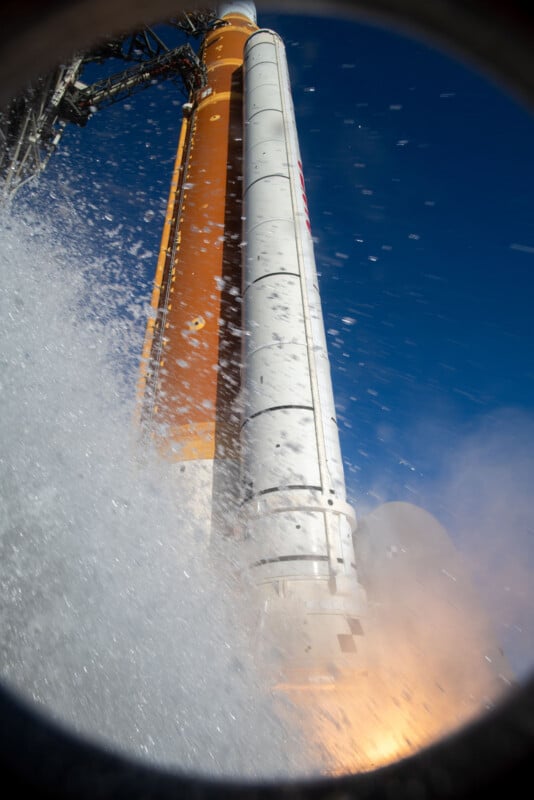
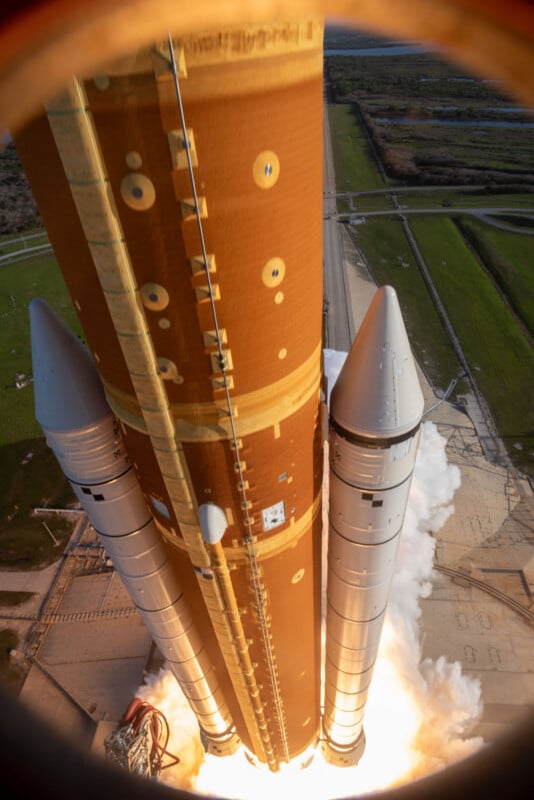
NASA also shared new images from a much more traditional Nikon D850 DSLR cameras positioned at the launch site. As expected, given the proximity to the launch site, the cameras were placed inside special housings. This means that with the Nikkor AF-S 20mm f/1.8G lenses NASA used, part of the view is obscured by protective materials. Needs must, as it gets awfully hot at the launch site.
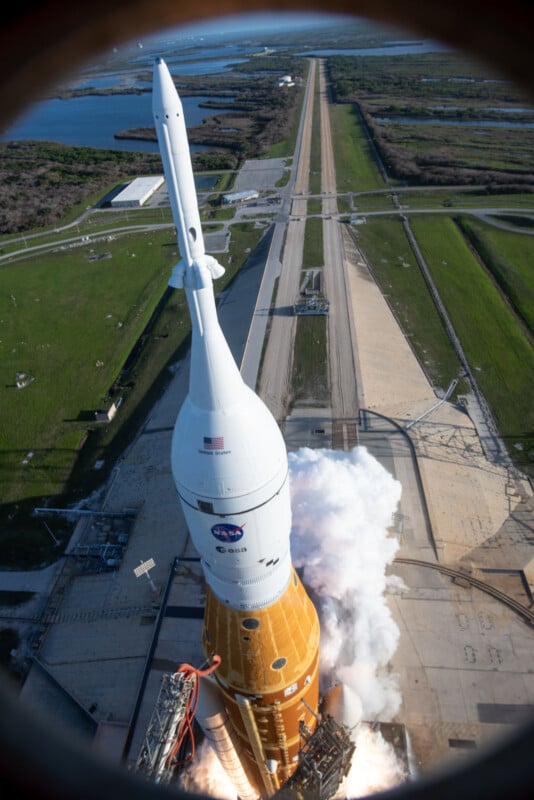 In this photograph looking down, NASA’s SLS (Space Launch System) rocket with the Orion spacecraft carrying Artemis II Commander Reid Wiseman, Pilot Victor Glover, and Mission Specialist Christina Koch from NASA, along with Mission Specialist Jeremy Hansen from the CSA (Canadian Space Agency), lifts off at 6:35 p.m. EDT on Wednesday, April 1, 2026, from Launch Complex 39B at NASA’s Kennedy Space Center I Florida. | Credit: NASA
 Credit: NASA
 Credit: NASA
One of the photos above shows NASA’s water deluge system in action. This system releases approximately 450,000 gallons of water across the mobile launcher and flame deflector system to reduce the extreme temperatures generated by the rocket at liftoff. The rocket’s exhaust engines generate heat around 6,000 degrees Fahrenheit (3,315 degrees Celsius) during the launch.
PetaPixel featured photographer Steven Madow’s fantastic remote camera photos from the Artemis II launch last week, but NASA was, understandably, able to put its own cameras even closer to the rocket.
Image credits: NASA. Nikon D850 photos by Kevin Davis, Doug Sperling, and Jacob Robertson






 English (US) ·