
 1 hour ago
5
1 hour ago
5
Inkle Studios narrative director Jon Ingold is a storyteller. There's a good reason he reminds me of that when I ask about the background info spun up for his latest game, the brilliant TR-49. With details such as hidden lockboxes, family secrets, homemade elevators, indistinct photos of a mysterious great uncle who might've worked for Britain's codebreaking unit during World War II, it has all the makings of an excellent spy drama.
"Wouldn't it be great if that story was true?" Ingold laughs. "I'm very happy to tell the story, but I wouldn't want anyone to print anything that suggests that they believe something to be 100% true which is not necessarily 100% true."
Ingold might not have a great uncle who worked at Bletchley Park, but the fictional background is anchored in a morsel of truth, just a slightly less glamorous one. In 2014, Ingold was acting as a math consultant for Morten Tyldum's The Imitation Game, a biography of actual World War II codebreaker Alan Turing. While waiting around during filming one day, he saw a photograph of a group of people, including the indistinct features of a tall man who would become the made-up great uncle of TR-49's backstory. Tucked away in the photo's corner was the code "TR-49." ("This is entirely true," Ingold stops to clarify. "You can look it up on IMDb.")
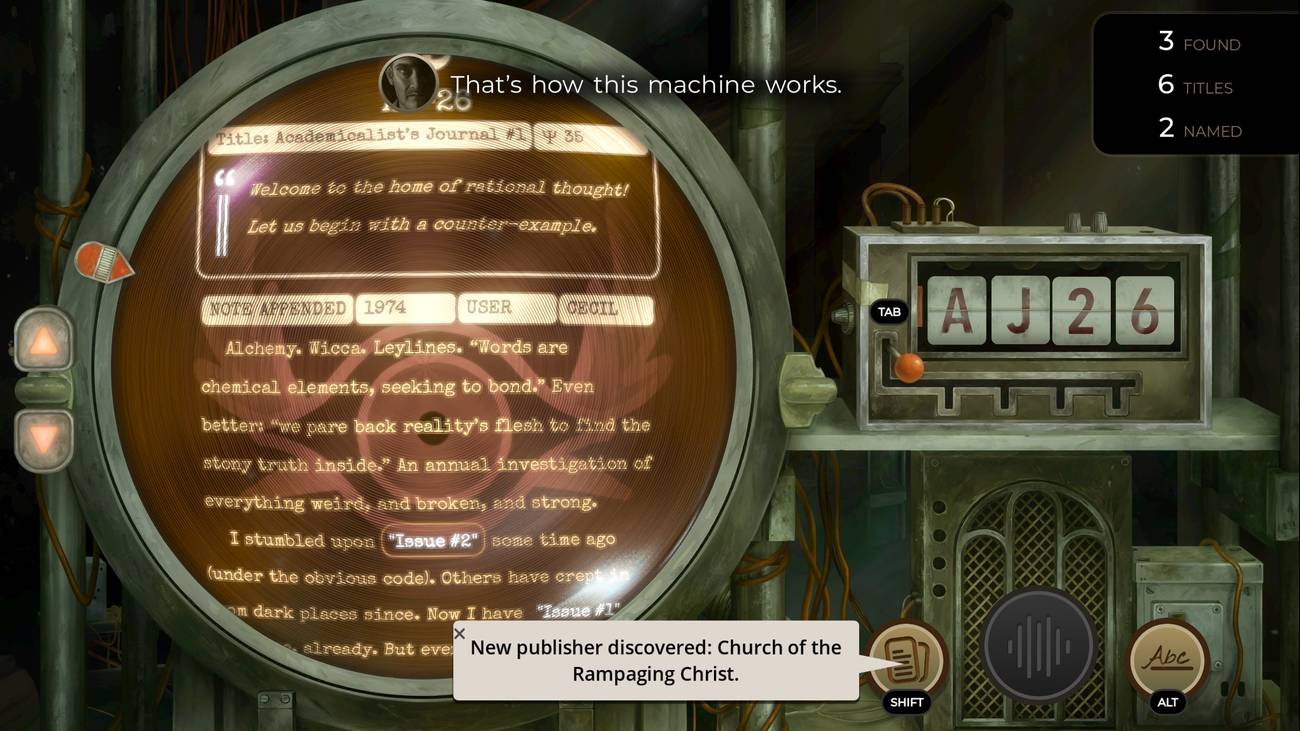 Image: Inkle via Polygon
But none of this was on Ingold's mind when he first set out to make TR-49. The code faded into memory, and Ingold and Inkle went on to make Heaven's Vault, A Highland Song, Overboard, and Expelled before the tall man and enigmatic code resurfaced unexpectedly. Ingold says the idea of a code-based puzzle game initially wandered into his mind after he'd been playing deduction games and thinking about combination locks. He stumbled on William Rous' Itch.io game Type Help, a mystery you solve by typing codes that all have some meaning to the story, and came up with a concept. What if players used cards from an old-fashioned library rolodex to track down a stolen book? It intrigued him, so he started building a prototype in Ink, Inkle's narrative scripting language, to get an idea of what the game's flow might look like.
Ingold says the team prototypes any idea they like in Ink, whether they end up turning it into a full game or not. By this point, the stolen book puzzle was just an experiment that Ingold had no intention of selling, and it wasn't even intended to become a video game. Instead, Ingold envisioned the project as a physical game with actual cards for people to handle. But the experiment kept growing, and he started to see possibilities beyond that initial glimmer of promise.
"I was playing this thing and just enjoying the flow of it, and going, 'Oh, I could have a puzzle like this, or a puzzle like that,'" Ingold says. "And then I thought, how are we going to set the story up, and finish it off?"
 Image: Inkle via Polygon
"So I just sketched out a quick conversation with someone at the beginning and a quick ending. Then I realized that when you're doing a deduction game, normally it's all about what happened in the past, but it's not about what's happening right now. And as a storyteller, I'm interested in what's happening right now."
The basic premise involved a young woman tasked with finding a book by piecing together clues from other books. But Ingold couldn't see a way to combine the story of the books and the story of the person looking for them without obstructing one or the other.
"I love scripted podcast dramas, like the Magnus Archives, and at one point I thought, 'hang on, if we make these people you speak to, if we make them voices you can hear, if we make it audio, then we've got this whole channel we can do the storytelling on that doesn't get in the way of the channel of the gameplay.'"
Ingold showed the build to Joseph Humfrey, Inkle's other co-founder. Humfrey was not impressed.
"He played it for a bit, and said, "it's a bit boring, to be honest.' And I was like "Yeah… It's just books, isn't it?"
What the prototype needed was something you could get your hands on, an interface that added soul to the routine task of inputting codes and solving puzzles. Ingold says he'd been toying with the idea of an "odd machine" for a while, and had even made a prototype for a game about such a device a year earlier. That concept was shelved, but now seemed like the right time to dust it off again. The team turned that curious machine into the game's central interactive element and figured it made a good test case for building a game in Godot, a development engine Ingold says the team was eager to learn anyway. With a story, gameplay, and puzzles, it resembled more of what consumers would expect from a video game. But, Ingold says, they planned to put it out for free. It was still just an experiment, after all.
 Image: Inkle via Polygon
But TR-49 kept growing. Humfreys and Anastasia Wyatt, Inkle's artist, were determined to give life to the machine and make it as tactile as possible. It began as a holdover from Ingold's original idea of using physical rolodex cards. But Humfrey also just had fun making what amounted to a toy people could physically manipulate to get unexpected results. When it brings up a new book, it makes a sound like a microfilm machine you'd find in a library. There's a clunky lever you move to activate the control dial (whose grindy metal sounds Humfreys created by running a knife sharpener across a butter dish), cords running every which way, and a retro-style speaker to play the voices of the dead as you read their words.
The tactile element even extends to how the machine works. Though you never see it, you're told it literally eats books to record them, shredding pages and spines as it rips letters out and records them for posterity. That particular tidbit is less about giving life to the machine, though. Its roots stretch further into what Ingold wanted to explore. He was thinking about Christopher Nolan's Oppenheimer and started making connections to Inkle's odd machine.
"It's all about early quantum mechanics and Einstein and these people who discovered that the universe was much less easy to understand, much more opaque, than we all believed it to be in the early 19th century," Ingold says. "Science really ruined the idea of the physical universe, and that's just such a brilliant setting for a Lovecraftian story, this idea that it's not Cthulhu ruining reality. It's quantum mechanics."
That led him to thinking about what's ruining reality in modern culture. Ingold stuffed plenty of ideas into TR-49, from musings on authoritarian regimes to organized religion's frequently antagonistic stance toward new ideas. But the thing that binds them all together and keeps popping up as you dig further into the machine's archives, is revision. Not the normal kind of revising that happens when you swap sentences around or change a phrase. The kind that interested Ingold is fake news, the lies we see on TV and social media every day. Who gets the final say about what's true and how it's remembered is the soul of TR-49.
 Image: Inkle via Polygon
"The written word was historically the seal of truth," Ingold says. "If you got married, somebody wrote it down, and then it was true. If you sold some copper to another guy in Babylon, someone wrote it down, and that made it true. Writing was a kind of magic that locked the truth onto a piece of paper. That's why we have the word ‘spelling,’ because writing is magic. And now we have this machine that will write things to the point at which people don't believe what they read anymore, and we can't believe what we read anymore. It's very difficult to know what's true and what isn't. The world is much more what we believe it to be, and we are actively destroying that by this kind of revision process. And it matters. It really matters how fluid and flexible and cheap and easy writing is to produce now."
Through its exploration of truth and who gets to decide it, TR-49 had taken on a shape and purpose far different from its origins as a rolodex game. But Ingold still wasn't satisfied. He reviewed the text to see if he could figure out what was missing, then realized everyone speaking sounded just like him. So he took a day and rewrote everything, giving distinct voices to every author in the game. (The ones who needed a voice, anyway.) Ingold invented most of the authors and books in TR-49, though he also used snippets from real-life authors where he thought it was appropriate, including during the game’s earliest moments. TR-49 opens with a quote from Tennyson's Arthurian poem The Lady of Shalott, about a woman trapped in a tower who’s forced to observe life through a mirror: "She knows not what the curse may be/So she weaveth steadily/And little other care hath she."
"I was like, wait, he's talking about an iPhone!" Ingold laughs. "He's literally talking about doomscrolling on an iPhone. That was too good to be true. It had to go in."
The final touch was giving these authors audible voices. Ingold enlisted his family, neighbors, and anyone who agreed to read a few lines to record entries for the game's books.
 Image: Inkle
Despite how much work went into TR-49 — and how drastically the project evolved during its development cycle — the entire process, from conception to launch, took about nine months. Ingold still can't quite believe this unexpected amalgamation of disparate ideas ended up being the studio's most successful launch. But he's also not surprised that there’s an audience for games likeTR-49. For one thing, the team finalized the actual, playable component quite early in development — the rest of the time was largely spent making the experience even better.
There's also an appetite for deduction and adventure games — evident in the number of high-quality titles that launched last year — that mainstream studios just can't satisfy. Ingold should know. He worked at Sony Computer Entertainment of Europe for 20 years, and during his first concept pitch meeting, he asked why the company never considered making murder mystery video games. The genre was one of the most popular in TV and books, which surely, he thought, made it a strong candidate for interactive media.
"They said, 'Oh, they don't work because people get stuck and they can't do them,'" Ingold tells me. "'So we just don't even try.'"
The proliferation of online forums and game guides means getting stuck is never an issue anymore, though Ingold believes challenge was never really the reason why companies like Sony couldn't — and still can't — make games like TR-49.
"Sony can't make a murder mystery because a mystery is really an interface game. It's about paper and details and facts and organizing those facts together," he says. "And if you're making a big, AAA-budget game, you've got to have a character, you've got to have a world, you've got to have an art style. You've got to have all of that stuff just to sell the product and make it feel big-budget. But those things get in the way of the investigation."
"It's just like a piece of paper and you've got everything you need on it, and it's you versus the puzzle. And I don't think AAA games can do that, because they can't say 'that's what this game is' to the audience. But indies can."
The idea of what qualifies as a video game worth playing has changed drastically in the last 15 years. Ingold points to Gone Home and The Roottrees Are Dead as examples. Gone Home received praise for mimicking AAA concepts (such as having a main character) and visual direction on a budget. Meanwhile, The Roottrees has no main character to get in the way of the puzzle solving and, as Ingold says, looks basically like a website.
"There's no reason we couldn't have been making these in 2011 or even 2001, as the design is not new," Ingold says. "The new thing is actually that people can get excited about a game that doesn't have an avatar. The economy of games has suddenly afforded this lo-fi approach as feeling like a real game."








 English (US) ·