
 Image via Comedy Central

Published Apr 11, 2026, 5:41 PM EDT
Born with Autism (formerly classified as Asperger syndrome), Tyler B. Searle has been obsessed with storytelling since he was old enough to speak. He gravitated towards fairy tales, mythology, the fantasy genre, and animated movies and shows aimed at family audiences. When not writing, Tyler enjoys watching more cartoons and reading fantasy books in his home in Ontario, Canada.
Sign in to your Collider account
The 1990s were a golden age for animation, especially on TV. While the previous decade was dominated by cartoons made to sell toys with limited animation, the 1990s were an age of experimentation, brought to life with gorgeously detailed animation, much of which was done overseas. Disney and Nickelodeon began focusing on more Saturday morning cartoons, and they were soon joined by other program blocks like Cartoon Network, The Kids WB, and Fox Kids.
It would take a fair bit of time to go over all the acclaimed shows that came out during this decade. Instead, this list is going to focus on one show for each year of the decade.
10 'Tiny Toon Adventures' (1990–1992)
 Image via Warner Bros.
Within the peaceful community of Acme Acres is Acme Academy, a school run by the classic Looney Tunes characters like Bugs Bunny (Jeff Bergman), Daffy Duck (Joe Alaskey), and Porky Pig (Don Messick). Their lessons focus on teaching students the finer arts of comedic timing, joke-telling, and fourth-wall breaking. Among their students are the straight man/master impressionist duo of Buster (Charlie Adler and John Kassir) and Babs (Tress MacNeille) Bunny (no relations), the greedy and self-absorbed Plucky Duck (Joe Alaskey), and the animal-obsessed Elmyra Duff (Cree Summers).
Tiny Toon Adventures was the first of numerous shows created by Tom Ruegger, produced by Steven Spielberg, and featuring music by the late great Richard Stone. It introduced a new generation to the classic Looney Tunes style, with a great mix of slapstick comedy, clever wordplay, referential humor, and so much more, all told within a relatively short time span. Regarding the new cast of characters, they are all clearly inspired by the classic ones but have more than enough personality and dynamics to stand on their own.
9 'The Ren & Stimpy Show' (1991–1996)
 Image via Nickelodeon
Ren Höek (John Kricfalusi and Billy West) is a short-tempered and volatile chihuahua living with his polar opposite—the simple-minded and ever-optimistic Stimpy J. Cat (Billy West). Their lives see the two of them on many misadventures that bring them into contact with a wide array of strange characters. Oftentimes, Ren and Stimpy's friendship gets pushed to the limit—especially on Ren's side—but somehow, they always make it work.
The Ren & Stimpy Show is both one of the most influential cartoons of the 1990s and one of its weirdest. The show thrived on the most surreal, gross, and disturbing imagery that you could get away with on kids' shows, made even more apparent due to how radically the characters' designs could shift between scenes. Still, this gave the show a wholly unique and hilarious identity that laid the foundation for Nickelodeon's rise.
8 'Batman: The Animated Series' (1992–1995)
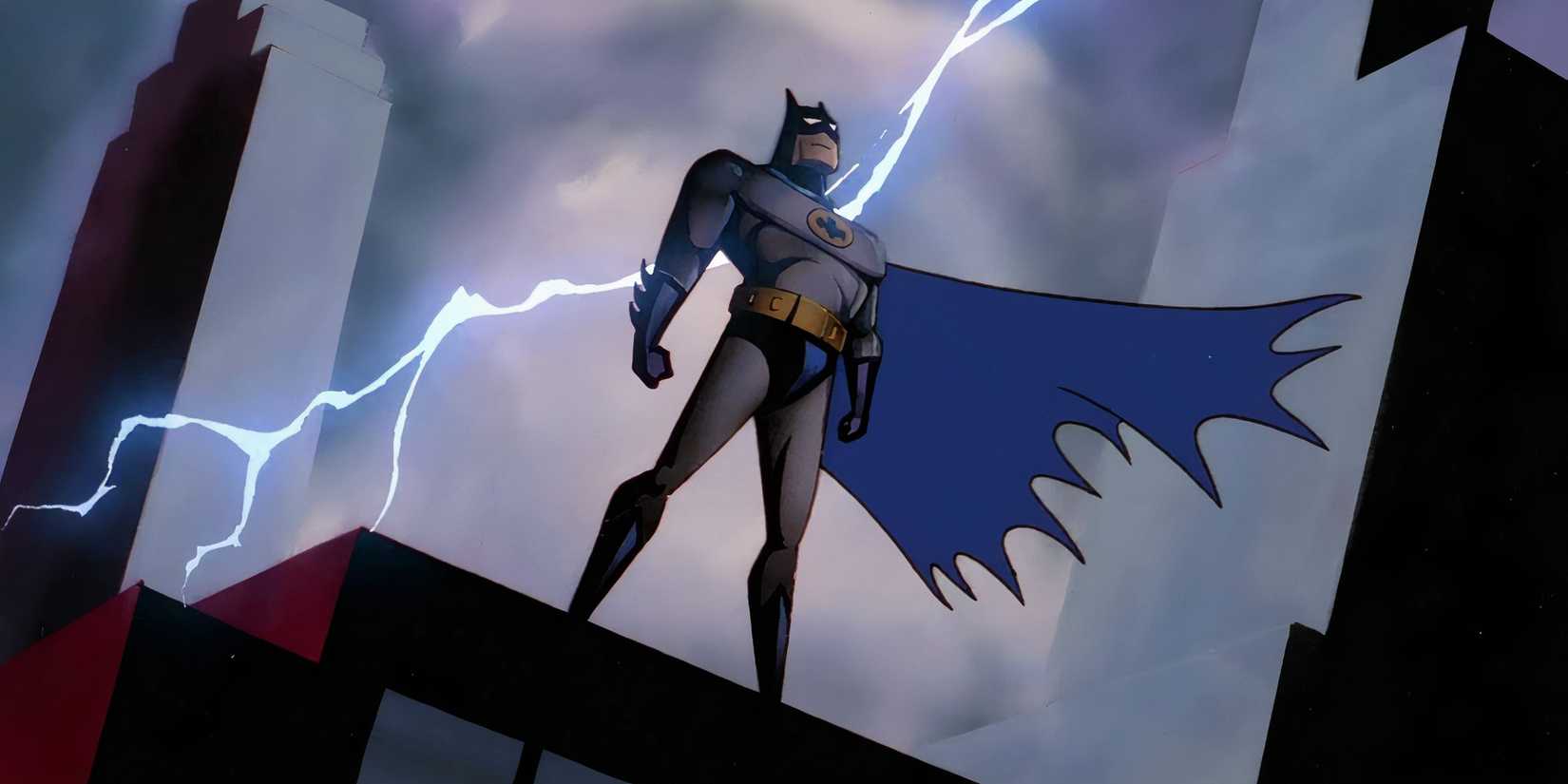 Image via Warner Bros. Animation
Gotham City is plagued by all sorts of terrors, from rampant corruption among politicians and corporations to rampant crime and dangerous supercriminals. Fortunately, the city is protected by its Dark Knight, Batman (Kevin Conroy), the alter-ego of local billionaire playboy Bruce Wayne. He is aided in his crusade by his faithful butler, Alfred Pennyworth (Clive Revill and Efrem Zimbalist Jr.), his adopted son Dick Grayson (Loren Lester), who aids him as Robin, and Commissioner James Gordon (Bob Hastings), who considers Batman a trusted ally.
Batman: The Animated Series is one of the most influential cartoons ever made, spawning an entire shared universe of DC cartoons and even seeing some of its creations, such as Harley Quinn (Arleen Sorkin), adopted by DC Comics. Even when looked at as an individual, the show stands tall thanks to its stylistic art design that makes Gotham City come to life like never before, and its mature writing that never talks down to the audience. Villains, heroes, and even side-characters were given plenty of respect through deep character studies, making them feel all the more human, and resulting in episodes that suck you in even when Batman is barely on-screen.
7 'Animaniacs' (1993–1998)
 Image via Warner Bros.
Within the water tower on the Warner Bros. studio lot live the Warner siblings: wisecracking older brother Yakko (Rob Paulsen), big eater and gag-loving young brother Wakko (Jess Harnell), and cute but violent little sister Dot (Tress MacNeille). The siblings regularly escape the tower and leave behind them a trail of mischief and mayhem, though it's usually directed at people who deserve it. Periodically, they take a break to let the camera focus on other characters, like the retired cartoon icon Slappy Squirrel (Sherri Stoner) and the duo of laboratory mice with plans for world domination, Pinky (Rob Paulsen) and the Brain (Maurice LaMarche).
Animaniacs took the foundation laid by Tiny Toon Adventures and perfected it, resulting in some of the most clever and hilarious writing of any children's show. The rewatchable '90s kid show blended classic cartoon slapstick with witty jokes, pop-culture references, and catchy songs, all told through a sketch comedy format with a wide cast of unforgettable characters. In fact, Pinky and the Brain proved so popular that it eventually split off to become its own show.
6 'Gargoyles' (1994–1997)
 Image via Buena Vista Television
In 994 AD, a clan of gargoyles is nearly wiped out while defending Castle Wyvern in Scotland from Viking raiders, and the survivors are magically turned to stone until the castle rises above the clouds. 1000 years later, the spell is broken when the castle is bought by billionaire David Xanatos (Jonathan Frakes) and transported atop his skyscraper in New York City, though the clan soon learns he is not to be trusted. They find an ally in the form of Detective Elisa Maza (Salli Richardson), who teaches them about this new time and helps the gargoyles fight against threats to the city, from petty crime to ancient magic.
Gargoyles was Disney's answer to Batman: The Animated Series, and is hands down the best cartoon that they've produced. It offered a strong blending of action, melodrama, and character study, creating a narrative where actions have consequences, ensuring no character remained static. Its world-building was also top-notch, presenting a world where science and sorcery come together in unexpected ways, various real-world myths were explored, and more mundane problems like organized crime still felt important compared to the fantastical stuff.
Collider Exclusive · Sci-Fi Survival Quiz Which Sci-Fi World Would You Survive? The Matrix · Mad Max · Blade Runner · Dune · Star Wars
Five universes. Five completely different ways the future went wrong — or sideways, or up in flames. Only one of them is the world your instincts were built for. Eight questions will figure out which dystopia, galaxy, or desert wasteland you'd actually make it out of alive.
💊The Matrix
🔥Mad Max
🌧️Blade Runner
🏜️Dune
🚀Star Wars
TEST YOUR SURVIVAL →
01
You sense something is deeply wrong with the world around you. What do you do? The first instinct is often the truest one.
APull on every thread until I understand the system — then figure out how to break it. BStop asking questions and start stockpiling — food, fuel, weapons. Questions don't keep you alive. CKeep my head down, observe carefully, and trust no one until I know who's pulling the strings. DStudy the patterns. Every system has a rhythm — learn it, and you learn how to survive it. EFind the people fighting back and join them. You can't fix a broken galaxy alone.
NEXT QUESTION →
02
In a world of scarcity, what resource do you guard most fiercely? What we protect reveals what we believe survival actually requires.
AKnowledge. If you understand the system, you don't need resources — you can generate them. BFuel. Everything else — movement, power, escape — runs on it. CTrust. In a world of fakes and informants, a truly reliable ally is rarer than any commodity. DWater. And after water, information — the two things empires are truly built on. EShips and credits. The galaxy is big — you survive it by being able to move through it freely.
NEXT QUESTION →
03
What kind of threat keeps you up at night? Fear is useful data — if you're honest about what you're actually afraid of.
AThat reality itself is a lie — that everything I experience has been constructed to keep me compliant. BA raid. No warning, no mercy — just the roar of engines and then nothing left. CBeing identified. Once someone with power decides you're a problem, you're already out of time. DBeing outmanoeuvred — losing a political game I didn't even know I was playing. EThe Empire tightening its grip until there's nowhere left to run.
NEXT QUESTION →
04
How do you deal with authority you don't trust? Every dystopia has a power structure. Your approach to it determines everything.
ASubvert it from the inside — learn its rules well enough to weaponise them against it. BIgnore it and stay out of its reach. The further from any power structure, the better. CAppear to comply while doing exactly what I need to do. Visibility is the enemy. DManoeuvre within it carefully. You can't beat a system you refuse to understand. EResist openly when I have to. Some things are worth the risk of being seen.
NEXT QUESTION →
05
Which environment could you actually endure long-term? Survival isn't just tactical — it's physical, psychological, and very much about where you are.
AUnderground bunkers and server rooms — cramped, artificial, but with access to everything that matters. BOpen wasteland — brutal sun, no shelter, constant movement. At least the threat is honest. CA dense, rain-soaked city where you can disappear into the crowd and nobody asks questions. DMerciless desert — extreme heat, no water, and something enormous living beneath the sand. EThe fringe — backwater planets and busy spaceports where the Empire's attention rarely reaches.
NEXT QUESTION →
06
Who do you want in your corner when things fall apart? The company you keep is the clearest signal of who you actually are.
AA tight crew of believers who've seen behind the curtain and have nothing left to lose. BOne or two people I'd trust with my life. Any more than that and someone talks. CNobody, ideally. Alliances are liabilities. I work alone unless I have no choice. DA community bound by shared hardship and mutual survival — people who need each other to last. EA ragtag team with wildly different skills and total commitment when it counts.
NEXT QUESTION →
07
Where do you draw the line — if you draw one at all? Every survivor eventually faces a moment that tests what they're actually made of.
AI won't harm the innocent — even the ones who'd report me without hesitation. BI do what I have to to protect the people I've chosen. Everything else is negotiable. CThe line shifts depending on who's asking and what's at stake. DI draw a long-term line — nothing that compromises my people's future, even if it'd help now. ESome lines, once crossed, can't be uncrossed. I know which ones they are.
NEXT QUESTION →
08
What would actually make survival worth it? Staying alive is one thing. Having a reason to is another.
AWaking others up — dismantling the illusion so no one else has to live inside it. BFinding somewhere — or someone — worth protecting. A reason to keep moving. CAnswers. Understanding what I am, what any of this means, before time runs out. DLegacy — shaping the future in a way that outlasts me by generations. EFreedom — for myself, for others, for every world still living under someone else's boot.
REVEAL MY WORLD →
Your Fate Has Been Calculated You'd Survive In…
Your answers point to the world your instincts were built for. This is the universe your temperament, your survival instincts, and your particular brand of stubbornness were made for.
The Matrix
You took the red pill a long time ago — probably before anyone offered it to you. You're a systems thinker who can't help but notice the seams in things.
- You're drawn to understanding how the system works before figuring out how to break it.
- You'd find the Resistance, or it would find you — your instinct for spotting constructed realities is the machines' worst nightmare.
- You function best when you have access to information and the freedom to act on it.
- The Matrix built an airtight prison. You'd be the one probing the walls for the door.
Mad Max
The wasteland doesn't reward the clever or the well-connected — it rewards those who are hard to kill and harder to break. That's you.
- You don't need comfort, community, or a cause larger than the next horizon.
- You need a vehicle, a clear threat, and enough fuel to outrun it — and you're good at all three.
- You are unsentimental enough to survive that world, and decent enough — just barely — to be something more than another raider.
- In the wasteland, that distinction is everything.
Blade Runner
You'd survive here because you know how to exist in moral grey areas without losing yourself completely.
- You read people accurately, keep your circle small, and ask the questions others prefer not to answer.
- In a city where humanity is a legal designation rather than a feeling, you hold onto something that keeps you functional.
- You're not a hero. But you're not lost, either.
- In Blade Runner's world, that distinction is everything.
Dune
Arrakis is the most hostile environment in the known universe — and you are precisely the kind of person it rewards.
- Patience, discipline, and political awareness are your core strengths — and on Arrakis, they're survival tools.
- You understand that the long game matters more than any single victory.
- Others come to Dune and are consumed by it. You'd learn its logic and earn its respect.
- In time, you wouldn't just survive Arrakis — you'd begin to reshape it.
Star Wars
The galaxy far, far away is vast, loud, and in a constant state of violent political upheaval — and you wouldn't have it any other way.
- You find meaning in being part of something larger than yourself — a cause, a crew, a rebellion.
- You'd gravitate toward the Rebellion, or the fringes, or whatever pocket of the galaxy still believes the Empire's grip can be broken.
- You fight — not because you have to, but because standing aside isn't something you're capable of.
- In Star Wars, that willingness is what makes all the difference.
↻ RETAKE THE QUIZ
5 'Freakazoid!' (1995–1997)
 Image via Warner Bros.
Dexter Douglas (David Kaufman) was a regular guy until he was accidentally merged with the internet and transformed into a superhero named Freakazoid (Paul Rugg). He gained access to superhuman speed, durability, and access to cartoon logic and Hammer space, but he also lost his mind and attention span, especially whenever his friend Sgt. Mike Cosgrove (Ed Asner) shows up. Thankfully, Freakazoid is able to remain focused long enough to stop whatever new threat rears its wicked head.
Freakazoid! isn't talked about as often as other Ruegger/Spielberg shows, which is a shame because it's one of the funniest and most unique examples of children's cartoons. The show's humor can best be described as physical internet memes: it's fast-paced, random, and relies heavily on cutaway gags, fourth wall breaks, and cartoon logic, ensuring that you'll be smiling by the end of it. Freakazoid himself is also a great protagonist, thanks to how innocent and lovable he is.
4 'Arthur' (1996–2022)
-Cropped.jpg?q=49&fit=crop&w=825&dpr=2) Image via PBS
Image via PBSArthur Reed is a young anthropomorphic aardvark living in Elwood City with his parents and younger sisters, Dora Winifred "D.W." and Kate. When not attending Lakewood Elementary School, he hangs out with his friends, clashes with D.W., and indulges in his hobbies like his favorite superhero, Bionic Bunny. He also spends a lot of time trying to make sense of the trials and tribulations of life, which seem to become more complex as he gets older.
Based on the books by Marc Brown, Arthur captivated children and their parents with its quality writing, which won the show four Daytime Emmy Awards. This is because it wasn't afraid to tackle all sorts of issues, from the universal anxieties of growing up and making friends that all kids go through, to more complex stuff like coping with trauma and showcasing individuals with dyslexia, autism, and cancer. Until SpongeBob SquarePants surpassed it in 2025, Arthur was the longest-running children's program from North America, which is a further testament to how well it succeeded in educating children about the world without talking down to them.
3 'South Park' (1997–Present)
 Image via Paramount+
In the town of South Park live a quartet of boys named Stan Marsh (Trey Parker), Kyle Broflovski (Matt Stone), Eric Cartman (Parker), and Kenny McCormick (Stone). Their daily routines involve attending school, interacting with their respective families, and somehow stumbling upon the most bizarre situations imaginable. Quite a few of these situations are similar to what is happening to the world at large.
South Park is up there with The Simpsons and Family Guy when it comes to long-running animated sitcoms aimed at adults, but its quick turnaround time allows it to pounce on contemporary news and events. One of the show's strongest qualities is that it picks no sides: everyone is a target of satire regardless of politics, ethnicity, religion, or anything else that could be considered controversial. This, naturally, has led to some criticism over how the show handles these topics, but it's also a testament to the writer's creativity that they're still going strong.
2 'The Powerpuff Girls' (1998–2005)
 Image via Cartoon Network
In The Powerpuff Girls, Professor Utonium (Tom Kane) decides to combine sugar, spice, and everything nice to create the perfect little girls. However, he accidentally adds Chemical X to the mixture, creating three superpowered girls: Blossom (Cathy Cavadini), the most mature of the three, Bubbles (Tara Strong), the most innocent and friendly, and Buttercup (E. G. Daily), the rough-and-tumble tomboy. Between going to kindergarten, the girls use their powers to protect the city of Townsville from all manner of monsters and dastardly villains that appear on The Powerpuff Girls.
The Powerpuff Girls became one of Cartoon Network's flagship shows, and is still a great watch thanks to its clever writing and simple but effective art style. The show is both an homage and a parody of the superhero genre, juxtaposing cute little girls doing heroics with copious amounts of violence and over-the-top fight sequences. It's not 100% action, though, and plenty of the show's most memorable moments come from the characters talking, from the sisters at play to the various villains having casual conversations with one another.
1 'SpongeBob SquarePants' (1999–Present)

SpongeBob SquarePants (Tom Kenny) is a sea sponge who lives in a pineapple in the underwater city of Bikini Bottom. Most days, he can be found either working as a fry cook at the Krusty Krab with his neighbor, Squidward Tentacles (Roger Bumpass), learning from Mrs. Puff (Mary Jo Catlett) so he can get his boating license, or hanging out with his best friend, Patrick Star (Bill Fagerbakke). Occasionally, he finds himself in more trouble than expected, such as having run-ins with the ghost of the Flying Dutchman (Brian Doyle Murphy), and preventing Sheldon J. Plankton (Mr. Lawrence) from stealing the Krabby Patty secret formula.
SpongeBob SquarePants is Nickelodeon's longest-running program, and its earliest seasons defined the humor of an entire generation. The show is a brilliant mix of juxtaposition and surrealist humor that uses Cartoon Logic to ensure maximum laughs, while also keeping audience interest thanks to how lovable the characters are. It's seen many ups and downs in terms of quality, but at its best, SpongeBob is a timeless show that is sure to keep providing nautical nonsense for years to come.

SpongeBob SquarePants
Release Date May 1, 1999
Network Nickelodeon
Showrunner Vincent Waller, Marc Ceccarelli
Directors Vincent Waller, Dave Cunningham, Stephen Hillenburg, Paul Tibbitt




 English (US) ·