
 3 weeks ago
40
3 weeks ago
40
Maybe don’t look up. If you’re in a Dolby Atmos theater, there are speakers directly above you on the ceiling. But there are also speakers everywhere, and writer/director Ian Tuason wrote “Undertone” — in a gigantic, almost 300 page word document stuffed with shot breakdowns and sound design notes — to take advantage of every single one.
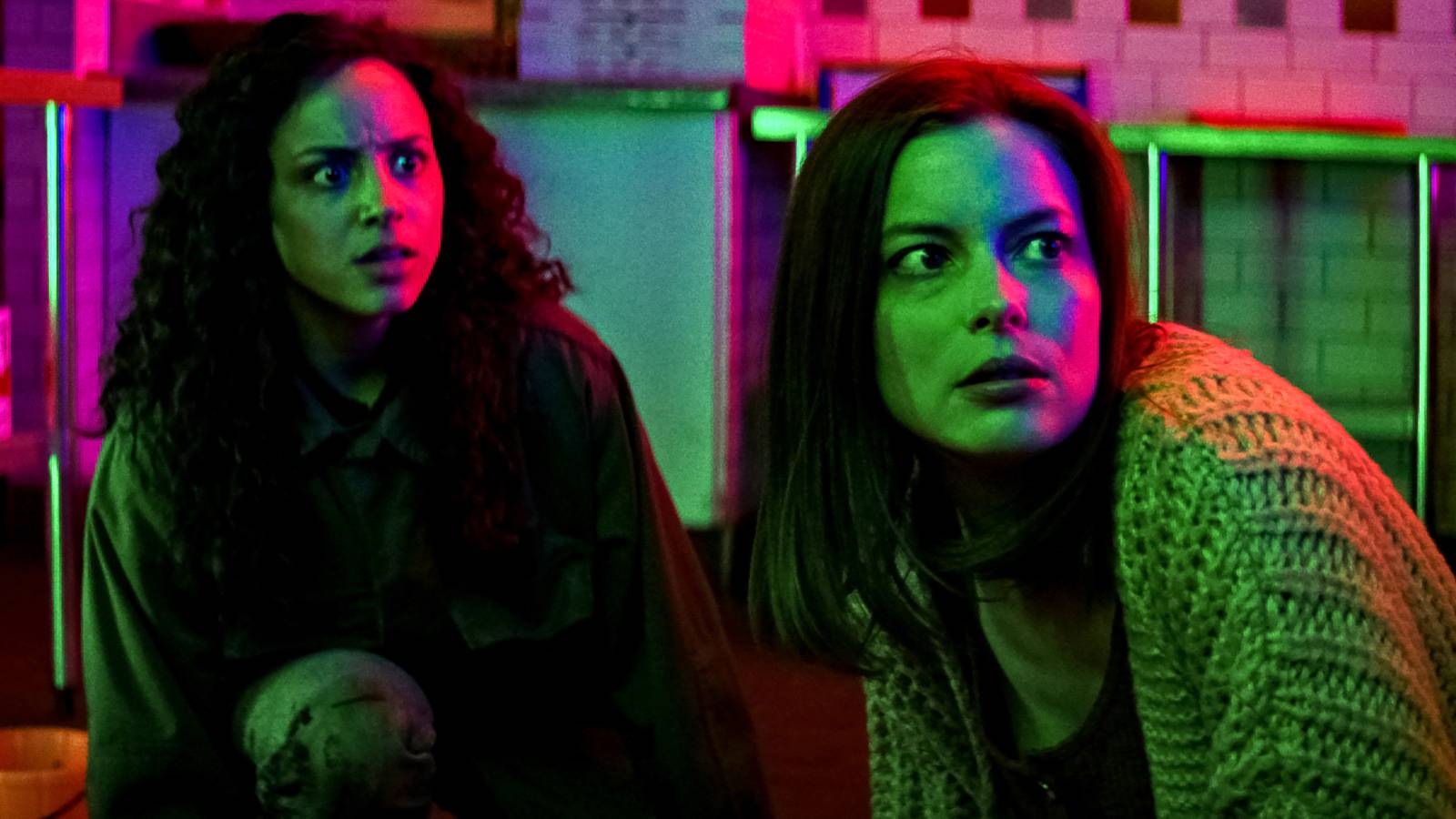
In a way, it had better. The film’s story centers around Evy (Nina Kiri), a young woman running a creepypasta/horror stories appreciation podcast with her friend Justin (Adam DiMarco) while she stays in her childhood home and provides end-of-life care for her comatose mother (Michèle Duquet).


If you’re broken inside (i.e., have done any podcasting), you’ll recognize Evy’s Focusrite Scarlett and raise an eyebrow at her Pro Tools presets. But everyone else will, more likely, pay more attention to the ways that Evy armors up when she puts on her noise-cancelling headphones. But in that isolated state, she becomes vulnerable to something hidden within the audio files she and Justin are looking into for their show.
“I specifically wrote a scene where Nina looks up, and I got to put a bang up on the ceiling, after A24 gave us the money to use Dolby Atmos. I like how the theater rumbles in Atmos. I really wish everyone watches [the film] that way, because it’s the complete experience,” Tuason told IndieWire.
Atmos’ precise spatialization allows sound designers to place different sounds in discrete physical locations around a room, mimicking where sound would be coming from diegetically with greater fidelity than surround sound. Tuason didn’t just want to use that power for realism, but for demonic evil. The sound of “Undertone” is a mix of unnerving precision and imperceptibility, with us knowing where sound is coming from, but not what it is, or what it means. “Gibberish is scarier than me telling you a scary phrase,” Tuason said.
 ‘Undertone’Courtesy Everett Collection
Tuason uses gibberish, audio apophenia (assigning meaning to sounds that shouldn’t be related), and audio played in reverse to make things sound scary without revealing a precise threat or a clear reason why they’re scary. “It’s an exercise for your imagination. You’re the one forming this horrible implication, this horrible image, in your head. You’re creating it. Not me,” Tuason said.
That internally created threat does get a helping hand from Tuason and his team’s sound design choices, though. He uses classic techniques to exaggerate mundane sounds and let us hear Evy’s downward spiral before we see it. He sneaks in some heavy metal “dungeon” banging to stand in for a clock ticking, in one instance, and in another, subtly confuses the sound of Evy’s reality and the audio messages she’s listening to.
“We are watching water dripping into Evy’s sink, and the sound aligns with the dripping in the audio clip [she’s hearing] — which shouldn’t happen, because those are two separate places and times. But that was fun, to align them and kind of blur that line between Evy’s world and the audio clip world,” Tuason said.
Sound is one of the only ways that Tuason can open up the world of “Undertone,” since it takes place all in one location, and often feels trapped at the kitchen table where Evy’s placed her podcasting setup (at least hang a sound blanket over the liquor cabinet, Evy, I beg you). But Tuason and his team use Atmos as much to remind us of the house’s limitations and how sound is coming from places it shouldn’t.
 ‘Undertone’DUSTIN RABIN
“Getting the audience settled into a spot so that all sounds are now static around you — that way I can pinpoint sounds, knowing that you’re familiar with the layout of the house. I can put footsteps in the direction of where [the bedroom] is, and stuff like that,” Tuason said.
About the only sound that Tuason doesn’t play with in “Undertone” is the song that inspired his first ideas for the story. He was looking at creepypastas on YouTube when he found a video examining a hidden message embedded in “Rainbow Connection,” by Kermit the Frog, if played backwards. That was scary enough, so he decided that children’s lullabies would be even scarier still. “ I love that contrast. It worked really well in ‘Hereditary’ with ‘Both Sides Now,’” Tuason said. “I was going to end the movie with the original version of ‘Rainbow Connection’ in the credits.”
But there may yet be a chance for Tuason to throw the banjo-playing frog and the all-powerful swine to whom he has pledged his soul, into horrifying relief. “‘Undertone’ is a trilogy. So a lot of the stories that you hear in ‘Undertone’ will be explored, and some questions will be answered in the next ones.”
In other words? Stay tuned, dear listeners.
“Undertone” is now playing in theaters.



 English (US) ·