
Science fiction as a genre has become increasingly pervasive. After all, visual effects technology has now made it possible to realize virtually any sci-fi setting. It could also be because our own technology has advanced so far as to eclipse what was once considered fanciful fiction that escapist films have had to evolve in kind. It’s also arguable that the elasticity of the genre allows for a kind of storytelling that can be simultaneously timely and timeless, tackling current issues but removed from any fixed point of historical reference. Whatever the reason, the genre has been going for decades and has only gotten stronger.
Enough science fiction films have been forgotten or remain underrated or outright ignored that this list is far from the first or last that will ever be compiled on the internet, including on this site. This list might be forgotten almost immediately, but the films on it shouldn’t be. Every year brings the loss of another filmmaker and the work they’ve put into their films, personal or dispassionate, should be recognized and remembered. Yet, few films are so small that they fade from everyone’s collective memory, and the internet is filled with pockets of people who remember them fondly. In the interest of deepening those pockets, here are ten more forgotten sci-fi movies you might have forgotten that are worth rediscovering.
'Colossus: The Forbin Project' (1970)
 Image via Universal Pictures
Fear of Artificial Intelligence is nothing new. We’ve been wary of machines since well before our technology had even remotely approached even rudimentary A.I., and movies have been simulating its dominion over us for decades. WarGames, 2001: A Space Odyssey, and Metropolis are all well-known examples of this. Less well known is the sci-fi thriller Colossus: The Forbin Project directed by Joseph Sargent. It’s a taut little Cold War film with an antagonistic supercomputer that’s obviously maintained its relevance and its aesthetically charming early '70s vibe.
After developing an advanced defense system, its creator becomes worried about its progress when it begins communicating with a correspondent Soviet system and then begins rapidly advancing its control. It’s the kind of intelligent and nihilistic science fiction film that dominated the '70s before Star Wars completely changed the game. Unlike films such as Logan’s Run or Soylent Green, though, Colossus: The Forbin Project hasn’t enjoyed the same kind of cult status, but it should. It’s an underrated thriller that Sargent brings the well-observed character drama and tight pacing that he did for The Taking of Pelham One Two Three.
'Golem' (1980)
 Image via Zespol Filmowy
A surreal sci-fi update of the Jewish folktale from antiquity, Golem is absolutely an acquired taste, but if you’re a fan of Terry Gilliam or David Lynch, it’s likely to be right up your alley. The film was the first of a series of sci-fi movies by director Piotr Szulkin in the '80s. It has a stark visual style, characterized by a sickly green color palette, which, along with themes of individualism in a totalitarian state, makes it an all the more bleak and existential experience.
Instead of the creature made from clay, the film focuses on an artificial man, who has no memory save for his profession, which would make him an ideal work drone if he weren’t striving to reclaim his humanity. Informed by the political and social state of his native Poland, Szulkin's film is a clear analog for the Communist experiment that was playing out in the country and the conflict between the body politic and the individual. All of Szulkin's contributions to science fiction remain underseen in comparison to the genre at large, and they can be narratively challenging to the uninitiated, but for anyone looking for something different, Golem is the perfect place to start.
'Liquid Sky' (1982)
 Image via Cinevista
Liquid Sky is a neon-lit, sex-crazed, synthpop sci-fi indie shot and set in New York City's club scene by the late Russian director Slava Tsukerman. It was an independent production made for half a million dollars with non-professional actors, and it captures the era and punk counterculture with a vivid expressionist style. Thanks to its specific setting, style and gender-fluid characters, the film has become an alternative classic but hasn't been as embraced by the mainstream as it should be.
The film follows a group of hedonistic models, partyers and drug pushers in the club scene, whose nightlife is disrupted by some unseen invading aliens who like to feast on brain chemicals, particularly those released during sexual climax. That's the kind of wild premise that scares off milquetoast movie goers, but it's catnip for anyone looking for something bold and uninhibited. With the recent passing of Tsukerman, it's time that more people discovered his colorful cult classic.
'Enemy Mine' (1985)
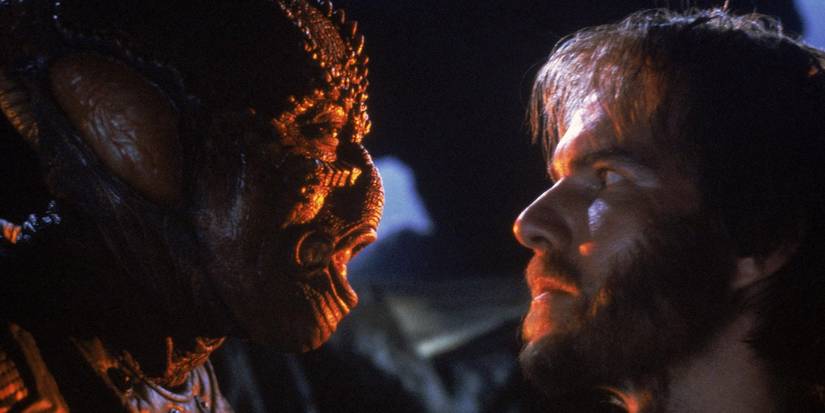 Image via 20th Century Studios
Enemy Mine was a box office flop when it was released in 1985, and critics were lukewarm at best on the pulpy sci-fi riff on Hell in the Pacific. Some blamed the marketing for its failure, and the film should have thrived in the high-concept '80s as so many of its science fiction contemporaries did. It also hasn't received the same kind of cult status that many of the other underrated movies of the era have either. Yet, Enemy Mine is a solid sci-fi adventure, sold by its two lead performers and thrilling direction by Wolfgang Petersen.
Based on the novella of the same name by Barry B. Longyear, the film follows two soldiers on opposite sides of an interstellar war — one human (Dennis Quaid) and the other a reptilian alien (Louis Gossett Jr.) — who crash-land on a dangerous planet and must rely on each other to survive. Over time, the two begin to bond, forging a friendship that breaks across species lines. Enemy Mine is simple and effective, with Quaid and Gossett both bringing more than is required in depicting their conflict and eventual camaraderie.
'Alien Nation' (1988)
 Image via 20th Century Studios
Enemy Mine wasn't the only '80s sci-fi film to team up a human and an alien odd couple. 1988's Alien Nation put a sci-fi spin on the buddy-cop formula with James Caan and Mandy Patinkin as the interspecies duo. It doesn't necessarily make the most of its unique premise, playing as a fairly straightforward police procedural with some extra-terrestrial wrinkles, but it was successful enough to spawn its own media franchise that included a television series and several made-for-TV movies. It's also aged better than you'd expect, particularly when compared to more recent films that follow its template, like Bright.
Set in Los Angeles several years after first contact, the aliens have now started to integrate into society, including as members of law enforcement. In the LAPD, human officer Sykes (Caan) is teamed up with alien officer Francisco (Patinkin) to investigate the death of another alien. Even if the world-building of the film is weak and its allegory is never fully explored, it's still fun to watch Caan and Patinkin team up together. The film's premise is actually ripe for a remake, and one was announced some years back before receding into development hell, but this original is still worth rediscovering.
'The City of Lost Children' (1995)
 Image via Sony Pictures Classics
A steampunk sci-fi fantasy brimming with ideas and visuals both gorgeous and grotesque, The City of the Lost Children was directors Marc Caro and Jean-Pierre Jeunet's follow-up to their cannibalism comedy Delicatessen, and is even more outlandish. Critics were naturally effusive in their praise of the film's visuals, but less enthusiastic about its narrative, which has a twisted, dream-like structure to it. It's still more audacious and fanciful than ninety percent of Hollywood's '90s output, with an attitude and approach that you can often only find in the work of international filmmakers.
The plot involves an aging man whose inability to dream has led him to kidnap children in order to steal their dreams. It also involves a group of clones, a group of cyborgs known as the Cyclops, and a circus strongman teaming up with an orphaned girl to save his adoptive brother, who is one of the kidnapped children. It's not a web worth untangling or even trying to make logical sense out of it, but instead is best enjoyed by letting it wrap around you with its extreme visual style and colorful performances. The City of Lost Children is a wicked trip of a sci-fi movie that should have a much bigger following.
'Six-String Samurai' (1998)
 Image via Palm Pictures
Six-String Samurai is a post-apocalyptic, rock'n'roll indie action movie that belongs in the same conversation as the original Mad Max and El Mariachi for its pure audaciousness of crafting something so wild on such a limited budget. With its rough-around-the-edges, go-for-broke attitude and rockabilly soundtrack by Igor & the Red Elvises, the film was destined to become a cult classic, but after its buzzy premiere at Slamdance, it only received a very limited release and has only enjoyed a very niche appreciation by a select group of fans.
Six-String Samurai is a camp combination of the same disparate genres and influences that are now infused into so many nostalgia-fueled films, but with a grungier spirit and aesthetic that is hard to replicate. Set in an alternate United States where the nation has been destroyed by Soviet nuclear attacks, the film follows the titular character, an American samurai and guitar player, on his way to Lost Vegas. On his way there, he picks up a kid sidekick and contends with bandits, cannibals and all other manner of wasteland residents. Co-written by star Jeffrey Falcon and director Lance Mungia, the film should have catapulted both to bigger things, instead of becoming a cult curio.

Six-String Samurai
Release Date September 18, 1998
Runtime 91 minutes
Director Lance Mungia








 English (US) ·