
Once in a while, there’s a movie. The perfect movie. It hits you so good and you’re left in the feels even hours and sometimes days later. These movies feel perfect because they never lose control of what you’re feeling. They start with a clear emotional promise, they keep raising the pressure in a way that makes sense, and they finish with an ending that stays in your body. You don’t need to forgive weak scenes. You don’t need to get past anything. You just watch it work.
This list is my last five years of that feeling, films that I can rewatch and still get the same rush: the performances stay truthful, the choices stay sharp, the big scenes still hurt or thrill because the smaller scenes built them honestly. No dead air. No wasted minutes. No embarrassment.
10 'Oppenheimer' (2023)
 Image via Universal Pictures
Oppenheimer pulls you into J. Robert Oppenheimer (Cillian Murphy) as a man who lives at a sprint. His ideas, ambition, ego, guilt, all racing at the same time. The early stretch feels like momentum you can’t interrupt: the recruitment, the politics, the way Los Alamos becomes its own world where everyone’s private life gets swallowed by urgency. You watch Oppie chase importance with a hunger that looks like purpose, and the movie makes you feel how quickly that purpose becomes a trap he helped build.
The Trinity sequence then comes in and you watch it all get assembled together, the tests, all that stays with you because you’ve lived inside the waiting. Faces, nerves, forced jokes, the quiet terror people try to hide. Afterward, the story keeps tightening through consequences that don’t let him breathe. The public praise that feels wrong, private panic he can’t confess, then the hearings that turn his life into a controlled demolition. The ending ordeal then leaves you thinking about the cost of responsibility in a way that feels personal, because the movie makes an act of deterrence look like a stupid choice because the flagbearer is punished for it.
9 'Past Lives' (2023)
 Image via A24
Past Lives makes romance feel adult and painful in the cleanest way. The film follows Nora (Greta Lee) carrying her life with control in a new city, with a new identity, new marriage until Hae Sung (Teo Yoo) arrives and suddenly the past feels present in her posture. Their conversations move with that specific intimacy of people who knew each other before they had armor. Every pause means something. Every smile carries years behind it. You can feel Nora trying to stay loyal to the life she built while also being pulled toward the person who remembers her first.
Arthur (John Magaro) makes the movie even better because he isn’t a villain and he isn’t clueless. He understands what’s happening, and that understanding creates its own tension of quiet honesty, quiet fear, quiet love. The ending leaves you wrecked. It shows how a single meeting can change your emotional temperature without changing your choices.
8 'The Zone of Interest' (2023)
 Image via A24
The Zone of Interest is one of the most emotionally violent movies of the last five years because it refuses to give you the comfort of distance. The movie leaves you shaken because it shows cruelty as a lifestyle. It makes you sit with how easily a family can treat atrocity as background noise. The premise basically is Rudolf Höss (Christian Friedel) living with his family beside Auschwitz, and the film shows daily life continuing with a steady rhythm, meals, gardening, swimming, hosting, while the sound of the camp stays present. And then horror then arrives through routine.
The casualness of that horror is what cuts. You keep realizing that everyone can hear what you can hear, and they keep choosing normal anyway. Hedwig Höss (Sandra Hüller) is the nightmare of domestic pride: she loves the house, the status, the feeling of having made it. Conversations about fabric, furniture, and errands sit beside smoke and screams, and the contrast stays sickeningly believable. It’s an extremely intense movie.
7 'Everything Everywhere All at Once' (2022)
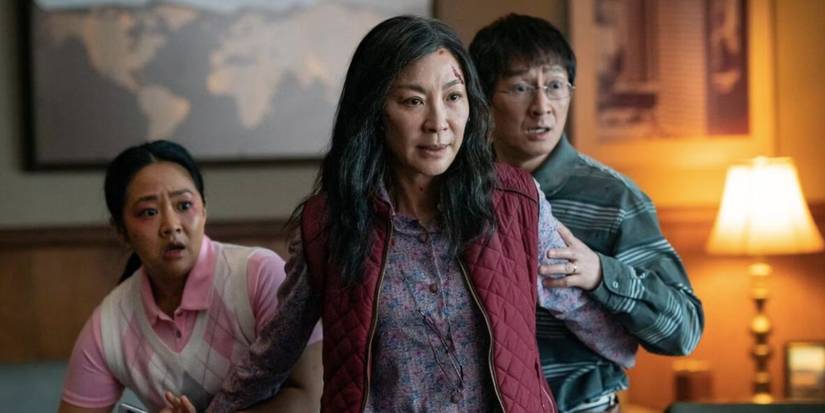 Image via A24
Everything Everywhere All at Once follows Evelyn Wang (Michelle Yeoh), a woman drowning in practical stress of taxes, laundry, a struggling business, family tension, and then the multiverse explodes into her life and turns her exhaustion into the center of the universe. The movie is perfect because it makes chaos feel emotional and specific. Joy (Stephanie Hsu) brings the pain that keeps the story honest: a daughter asking to be seen clearly, without conditions. Waymond Wang (Ke Huy Quan) becomes the soul of the film because his kindness is chosen under pressure.
The movie keeps delivering wild sequences while staying focused on one question: can this family stop hurting each other? Evelyn’s growth happens through decisions you can track — how she speaks to Joy, how she listens to Waymond, how she handles her own fear of failure. Every ridiculous universe, every fight, every quiet moment where love had to be practiced is just very believably filmed and digestible.
Collider Exclusive · Oscar Best Picture Quiz
Which Oscar Best Picture
Is Your Perfect Movie?
Parasite · Everything Everywhere · Oppenheimer · Birdman · No Country
Five Oscar Best Picture winners. Five completely different visions of what cinema can be — and what it can do to you. One of them is the film that was made for the way your mind works. Ten questions will figure out which one.
🪜Parasite
🌀Everything Everywhere
☢️Oppenheimer
🐦Birdman
🪙No Country for Old Men
FIND YOUR FILM →
01
What kind of film experience do you actually want? The best movies don't just entertain — they leave something behind.
ASomething that pulls the rug out — that makes me think I'm watching one kind of film and then reveals I'm watching another entirely. BSomething overwhelming — funny, sad, absurd, and genuinely moving, all at once. CSomething grand and weighty — a film that makes me feel the full scale of what I'm watching. DSomething formally daring — a film that pushes what cinema can even do. ESomething lean and relentless — pure tension with no wasted frame.
NEXT QUESTION →
02
Which idea grabs you most in a film? Great films are driven by a central obsession. What's yours?
AClass, inequality, and what people are willing to do when desperation meets opportunity. BIdentity, family, and the chaos of trying to hold your life together when everything is falling apart. CGenius, moral responsibility, and the catastrophic weight of a decision you can never take back. DEgo, legacy, and the terror of becoming irrelevant while you're still alive to watch it happen. EEvil, chance, and whether moral order actually exists or if we just tell ourselves it does.
NEXT QUESTION →
03
How do you like your story told? Form is content. The way a story is shaped changes what it means.
AGenre-twisting — I want it to start in one lane and migrate into something completely different. BMaximalist and genre-blending — comedy, action, drama, sci-fi, all in one ride. CEpic and non-linear — cutting between timelines, building a mosaic of cause and consequence. DA single unbroken flow — I want to feel like I'm living it in real time, no cuts to safety. ESpare and precise — every scene doing exactly what it needs to do and nothing more.
NEXT QUESTION →
04
What makes a truly great antagonist? The opposition defines the protagonist. What kind of opposition fascinates you?
AA system — invisible, structural, and almost impossible to fight because it has no single face. BThe self — the ways we sabotage, abandon, and fail the people we love most. CHistory — the unstoppable momentum of events that no single person can stop or redirect. DThe industry — the machinery of culture that chews up talent and spits out irrelevance. EPure, implacable evil — a force so certain of itself it becomes almost philosophical.
NEXT QUESTION →
05
What do you want from a film's ending? The final note is the one that lingers. What do you want it to sound like?
AShock and inevitability — a conclusion that recontextualises everything that came before it. BEarned emotion — I want to cry, laugh, and feel genuinely hopeful, even if the world is a mess. CDevastation and grandeur — an ending that makes me sit in silence for a few minutes after. DAmbiguity — something that leaves enough open that I'm still thinking about it days later. EBleakness — an honest refusal to pretend the world is tidier than it actually is.
NEXT QUESTION →
06
Which setting pulls you in most? Where a film takes place shapes everything — mood, stakes, what's even possible.
AA gleaming modern city with a hidden underside — beauty masking rot, wealth masking desperation. BA collapsing suburban life that opens onto something infinite — the multiverse of a single ordinary person. CThe corridors of power and science at a world-historical turning point — where decisions echo for decades. DThe grimy, alive chaos of New York and Hollywood — fame as both destination and trap. EVast, indifferent landscape — desert and highway where violence arrives without warning or reason.
NEXT QUESTION →
07
What cinematic craft impresses you most? Every great film has a signature — a technical or artistic element that makes it unmistakable.
AProduction design and mise-en-scène — every frame composed to carry meaning beneath the surface. BEditing and tonal control — the ability to move between registers without losing the audience. CScore and sound design — music that becomes inseparable from the dread and awe of what you're watching. DCinematography as performance — the camera not recording events but participating in them. ESilence and restraint — what's left unsaid and unshown doing more work than any dialogue could.
NEXT QUESTION →
08
What kind of main character do you root for? The protagonist is the lens. Who you choose to follow says something about you.
ASomeone smart and resourceful who makes increasingly dangerous decisions under pressure. BSomeone overwhelmed and ordinary who turns out to be capable of something extraordinary. CA brilliant, tortured figure whose gifts and flaws are inseparable from each other. DA self-destructive artist whose ego is both their superpower and their undoing. EA quiet, principled person trying to make sense of a world that has stopped making sense.
NEXT QUESTION →
09
How do you feel about a film that takes its time? Pace is a choice. Some films sprint; others let tension accumulate slowly, deliberately.
AI love a slow build when I know the payoff is going to be seismic — patience for a devastating reveal. BGive me relentless momentum — I want to feel breathless and emotionally spent by the end. CEpic runtime doesn't scare me — if the material demands three hours, give me three hours. DI want it to feel propulsive even when nothing is technically happening — restless energy throughout. EDeliberate and unhurried — I want dread to accumulate in the spaces between the action.
NEXT QUESTION →
10
What do you want to feel walking out of the cinema? The best films leave a mark. What kind of mark do you want?
AUnsettled — like I've just seen something I can't fully explain but can't stop thinking about. BMoved and energised — like the film reminded me what actually matters and gave me something to hold onto. CHumbled — like I've been in the presence of something genuinely important and overwhelming. DExhilarated — like I've just seen cinema doing something it's never quite done before. EHaunted — like a cold, quiet dread that stays with me for days.
REVEAL MY FILM →
The Academy Has Decided Your Perfect Film Is…
Your answers have pointed to one Oscar Best Picture winner above all others. This is the film that was made for the way your mind works.
Parasite
You are drawn to films that operate on multiple levels simultaneously — that begin in one genre and quietly, brilliantly migrate into another. Bong Joon-ho's Parasite is a film about class, desire, and the architecture of inequality that manages to be darkly funny, deeply suspenseful, and genuinely shocking across a single extraordinary running time. Your instinct is for cinema that hides its true intentions until the moment it's ready to reveal them. Parasite is exactly that — a film that rewards close attention and punishes assumptions, right up to its devastating final image.
Everything Everywhere All at Once
You want it all — and this film gives you all of it. The Daniels' Everything Everywhere All at Once is one of the most maximalist films ever made: action comedy, multiverse sci-fi, family drama, existential crisis, and a genuinely earned emotional core that sneaks up on you amid the chaos. You are someone who responds to ambition, who doesn't want cinema to choose between being entertaining and being meaningful. This film refuses that choice entirely. It is overwhelming by design, and its overwhelming nature is precisely the point — because the feeling of being crushed by infinite possibility is exactly what it's about.
Oppenheimer
You are drawn to cinema on a grand scale — films that understand history not as a backdrop but as a force, and that place their characters inside that force and watch what happens. Christopher Nolan's Oppenheimer is a film about the terrifying gap between what we can do and what we should do, told with the full weight of one of the most consequential moments in human history behind it. You want your films to feel important without feeling self-important — to earn their ambition through sheer craft and the gravity of their subject. Oppenheimer does exactly that. It is enormous, complicated, and refuses easy comfort.
Birdman
You are drawn to films that foreground their own construction — that make the how of the filmmaking part of the what it's about. Alejandro González Iñárritu's Birdman, shot to appear as a single continuous take, is cinema examining itself through the cracked mirror of a fading actor's ego. You respond to formal daring, to the feeling that a film is doing something that probably shouldn't be possible. Michael Keaton's performance and Emmanuel Lubezki's restless camera create something genuinely unlike anything else — a film that is simultaneously about creativity, relevance, self-destruction, and the impossibility of ever truly knowing if your work means anything at all.
No Country for Old Men
You are drawn to cinema that trusts silence, that refuses to explain itself, and that treats dread as a form of meaning. The Coen Brothers' No Country for Old Men is a film about the arrival of a new kind of evil — implacable, arbitrary, and utterly indifferent to the moral frameworks we use to make sense of the world. It is one of the most formally controlled films ever made, and its controlled restraint is what makes it so terrifying. You want your films to haunt you, not comfort you. You are not interested in resolution if resolution would be dishonest. No Country for Old Men is honest in a way that most cinema never dares to be.
↻ RETAKE THE QUIZ
6 'Top Gun: Maverick' (2022)
 Image via Paramount Pictures
Top Gun: Maverick is the rare legacy sequel that feels proud, emotional, and thrilling — just as the original Top Gun did. Pete “Maverick” Mitchell (Tom Cruise) returns older, stubborn, and still allergic to authority, and the film gives him a problem that suits him: teach a group of young pilots a mission designed to kill them if they hesitate. Rooster (Miles Teller) carries grief and anger that makes his role perfect. His every scene with Maverick is tense, because their history sits between every sentence. Phoenix (Monica Barbaro) brings that sharp competitiveness that makes the team dynamic fun and real. There’s also Glen Powell’s Jake, Jennifer Connelly returning as Penny. The film beautifully captures the competitive dynamics of an airforce team.
The training sections then hit the hardest. As a viewer, you always understand the goal, the risk, and who’s falling behind. The flying sequences deliver pure adrenaline with geography you can follow. The emotional spine stays strong because Maverick is trying to protect the next generation while carrying the weight of the last one. The film’s ending makes you feel like your heart is in your throat, then it gives you catharsis that comes from brilliant character choices.
5 'Dune' (2021)
 Image via Warner Bros. Discovery
Dune is perfect. It takes a dense world and makes you feel it through people. Paul Atreides (Timothée Chalamet) begins as a teenager trained to survive politics, war, and prophecy, and you can feel the fear under his composure once Arrakis becomes real. Lady Jessica (Rebecca Ferguson) carries discipline and maternal panic at the same time, and every time she masks her emotion, you feel how hard she’s working to keep Paul alive. Duke Leto (Oscar Isaac) gives the story a moral center that makes the betrayal hurt.
The Arrakis stretch builds tension through specifics: the harvesters, the sandworms, the heat, the rules of movement and survival. Duncan Idaho (Jason Momoa) brings warmth and swagger that makes the loss of safety feel sharper. The film ends with Paul stepping into a new identity that feels earned through pain. You finish it feeling hungry for the next chapter because the first one made you care about every step.
4 'The Batman' (2022)
 Image via Warner Bros.
The Batman is a slow burner. It’s not for everyone but those who can sit through it. It locks you into Gotham’s grime and keeps you there. Bruce Wayne (Robert Pattinson) is raw and obsessive, moving through the city like he’s punishing himself as much as the criminals. The detective work drives the story forward through concrete clues — crime scenes, coded messages, mistaken assumptions. Selina Kyle (Zoë Kravitz) brings her own mission and anger, and every scene with her feels charged because she isn’t there to be impressed by Bruce; she’s there to survive and get answers.
The Riddler (Paul Dano) is dangerous. His violence has structure. You can track how each move escalates and how public fear becomes part of the plan. Gordon (Jeffrey Wright) grounds the investigation with trust that feels earned. The final act stays in your head because Bruce learns something important through action: fear creates chaos, and the city needs more than punishment.
3 'The Holdovers' (2023)
 Image via Focus Features
This movie makes you love people while they’re still difficult. The Holdovers is perfect for that very reason because no other movie does it. The film follows Paul Hunham (Paul Giamatti) who starts as a teacher everyone hates for understandable reasons. He’s sharp, judgmental, socially clumsy and then the film traps him on campus over winter break with Angus Tully (Dominic Sessa), a kid carrying anger and sadness he can’t neatly explain.
While Mary Lamb (Da’Vine Joy Randolph) brings the emotional truth that keeps the story from becoming a cute bonding movie, it is a cute bonding movie. She’s grieving, she’s exhausted, and she still shows up. The humor helps too. The shared meals, reluctant honesty, tiny moments where someone finally feels seen. All that makes the movie keeps its emotional punches grounded. It’s just people changing because time together forces them to. The ending leaves you with that rare satisfaction of a story that respected its characters from start to finish.
2 'Killers of the Flower Moon' (2023)
 Image via Apple TV
This film moves through love, marriage, family, politics, and trust, poisoning the very spaces that should have been safe. It follows Ernest Burkhart (Leonardo DiCaprio), who is devastating to watch because he is weak before he is monstrous. The film understands how much horror can live inside cowardice, greed, and the need to be chosen by the wrong man. Mollie (Lily Gladstone) stands at the center with such grace, intelligence, and emotional clarity that every lie told around her feels even crueler.
What makes Killers of the Flower Moon feel so haunting is how ordinary the evil looks while it is happening. Conversations stay polite, rooms stay calm, faces stay composed, and all the while death keeps moving closer. William Hale (Robert De Niro) is a chilling character too. He wraps domination in affection, turning manipulation into something that can pass for family. The film keeps tightening that knot until the truth becomes almost unbearable to sit with.
1 'Spider-Man: Across the Spider-Verse' (2023)
 Image via Sony Pictures Releasing
Spider-Man: Across the Spider-Verse takes the top spot because it delivers spectacle, character, and emotional pain with zero wasted motion. Miles Morales (Shameik Moore) begins the film hungry to grow, desperate to be understood, and tired of being treated like a kid who needs permission. Gwen Stacy (Hailee Steinfeld) carries guilt and loneliness that show up in her voice and posture, and every scene with her feels like a person trying to stay strong while feeling abandoned. Miguel O’Hara (Oscar Isaac) brings a dangerous kind of authority built from grief and uncertainty.
The multiverse — with every new world, the film keeps pushing Miles closer to the question that actually matters: who gets to define him. Each reveal makes the pressure heavier. The people around him keep trying to turn his life into a rule he is supposed to obey. That is what makes his fight so powerful. He is not just running from enemies or trying to save the day. Miles Morales’ Spider-Man is fighting for the right to be his own person. Every choice, every clash, every moment of resistance makes you feel that desperation and that fire at the same time.





 English (US) ·