
 4 hours ago
9
4 hours ago
9
Hollywood is sending a clear message: it’s a friend of tech. Netflix is no longer a lone disruptor: historic studio MGM is now the property of Amazon’s Jeff Bezos; David Ellison’s takeover of Paramount and subsequent Warner Bros merger was supported by his tech giant father; and Apple TV has acted as a patron for multiple film-maker passion projects. Everyone, including trendy auteur-factory A24, is tying themselves financially to AI.
The enormous pull of the tech industry – including its many trillions of dollars, oversized influence on politics and heavily pushed algorithms and AI products – means Hollywood is not alone in courting its wealth, but it has intensified the historic tension between art and commerce in the entertainment business. Technology that augments the human experience may be a compelling narrative subject, but this year brings a trio of films about the gurus responsible for the industry’s false promises.
Starring Jeremy Strong as Mark Zuckerberg, The Social Reckoning is Aaron Sorkin’s pseudo-sequel to The Social Network, about Facebook employee Frances Haugen (Mikey Madison) blowing the whistle on her employer for building an algorithm that radicalised the “alt-right” and damaged teen mental health. This week, two further films receive their UK premiere at the BFI London film festival – Musk is a four-hour study of the SpaceX CEO from Alex Gibney, the documentarian who previously tackled the Enron bankruptcy scandal and Theranos founder and fraudster Elizabeth Holmes. Luca Guadagnino’s Artificial stars Andrew Garfield (whose breakout role was as Zuckerberg’s ex-bestie in The Social Network) as OpenAI co-founder Sam Altman, who was fired and rehired by his own board a year after the release of ChatGPT.
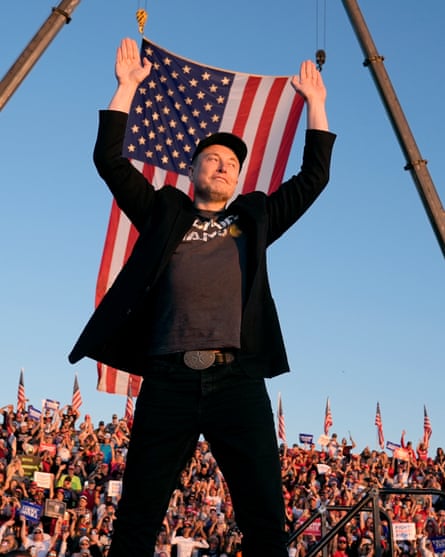
All three projects come with a degree of buzz that goes beyond their directors’ credentials. We are long overdue a meaningful, mainstream critical rebuke of the volatile and egocentric “great men” rewarded by our tech-obsessed culture. Zuckerberg, Musk and Altman are among the biggest names in tech, and all three recently aligned with President Trump to protect their companies’ interests. Seeing major if unrelated film projects taking them to task gives the impression of a united front of tech scepticism. But how strongly can a major motion picture attack big tech? In the case of Artificial, there may be a cost to biting the hand that feeds you, as Amazon decided to not distribute the film, after announcing a $50bn (£38bn) “strategic partnership” with OpenAI.
Certain contextual details lend the films an edge of legitimacy and danger: a distributor suddenly unloading a hot-button project; Sony hiring an outside law firm to vet every fact in The Social Reckoning; or TikTok and X blocking trailer advertisements for Musk. These anecdotes are cleanly rolled into the films’ marketing, fanning the audience’s desire to see something damning and damaging behind the curtain of Silicon Valley – but they are likely more useful in Oscar campaigns than as a challenge to big tech impunity.
Time will tell how severely these films will affect the credibility of their subjects, but recent surveys indicate young Americans are already turning on giants such as Zuckerberg, Musk, and Altman. It seems as if these projects are taking advantage of a rising tide of tech scepticism rather than forging it themselves. What’s more noteworthy is how the films coincide with the widespread devaluing of films as art by corporations and their products.
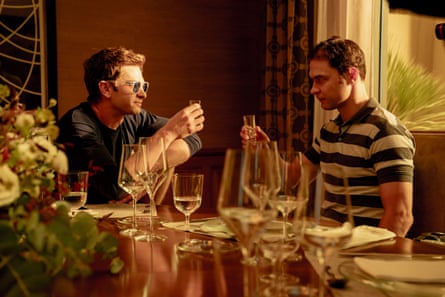
There’s an inconvenience to watching a two-hour film that rankles the compulsively tech-obsessed: its pleasures are better redistributed into short-form clips on Instagram, TikTok and YouTube, all of which handily drive traffic as part of users’ infinite scroll. You may not see any ads for Musk on X or TikTok, but some enterprising grifter is welcome to package up clips from Gibney’s doc for engagement farming once it’s released. Clips from The Social Reckoning will go nicely with the thousand other snippets of Sorkin’s verbal duels from The West Wing and The Newsroom on Meta’s platforms.
What’s more, the hype around GenAI has proven tech elites want to disrupt production and distribution – to their benefit. In light of tech’s accelerating entanglement with Hollywood, entire filmographies may soon used en masse to train image and video generation tools. Meta, OpenAI and Musk’s xAI have a head start, having already “scraped” scripts and books without permission to train their models. In 2025, Disney and Universal filed a suit against AI firm Midjourney for stealing their copyrighted works in this manner (Midjourney denies liability, arguing that its platform operates on transformative fair use). But don’t jump to defend their anti-AI integrity, Disney recently invested $1bn in OpenAI – they want a slice of the pie.
The triple release of The Social Reckoning, Musk and Artificial is less a clear political stance, more like movie studio opportunism. But as the industry grows more eager to placate big tech, studios are more likely to censor films like these getting made. Still, history is on the side of artists who take swipes at powerful moguls. When newspaper tycoon William Randolph Hearst found out Orson Welles’ Citizen Kane was based on him, he called on his network of columnists and producers to sabotage the film’s release – behaviour that is not beneath Elon Musk, if his posts are anything to go by. It’s surprising to learn that tech moguls – whether they’re protected by a cult of personality or not – still get seriously riled up by any narrative they don’t control.


 English (US) ·