
 3 weeks ago
24
3 weeks ago
24
In brief
- Strategy has raised billions of dollars via variable-rate preferred share, STRC, following the conclusion of its annual conference in Las Vegas last month.
- The dividend-paying product has been embraced by asset manager Strive, which debuted its own product modeled on STRC last year.
- Brazil-based OranjeBTC, Bitcoin’s 25th largest publicly traded holder, became the first among Strategy’s peers to unveil an allocation to STRC.
When Strategy held its annual conference, Strategy World, in Las Vegas last month, attendees heard plenty about how the digital asset could reshape corporate balance sheets. Yet the spotlight may not have shone as brightly on Bitcoin this year.
Although co-founder and Executive Chairman Michael Saylor still evangelized the asset that has transformed his company, as with any public appearance, this year’s focus centered on STRC, the firm’s variable-rate preferred share. That’s according to TD Cowen’s Lance Vitanza.
“It felt like every other panel was focused on STRC,” the investment bank’s managing director of equity research told Decrypt. “For the first time, the company made it clear [...] that is where they’re spending all their time in terms of marketing, promotion, and building an ecosystem.”
Saylor has said that STRC could be interesting for “a whole class of people,” including retirees. Now the adoption of the product that currently pays 11.5% annually is concentrating power among firms that analysts say can make the crypto’s largest market buoyant—or vulnerable through forced selling.
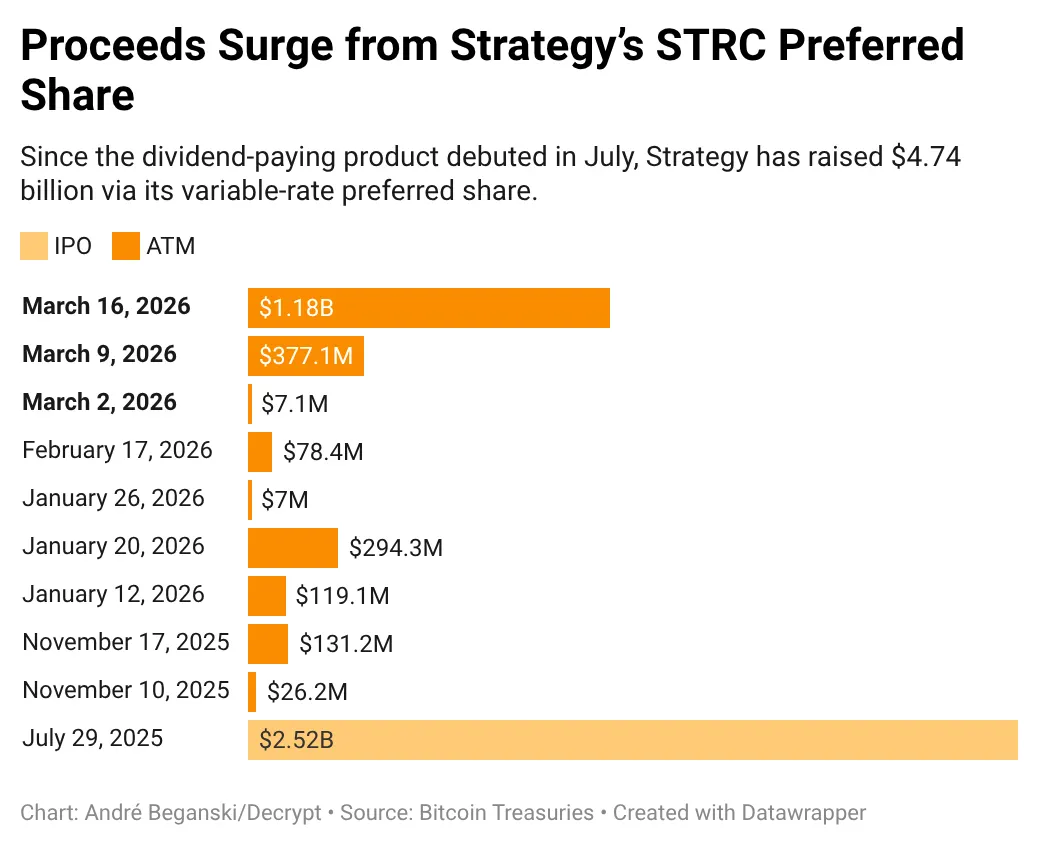
Strategy has raised more than $1.5 billion via STRC since that two-day gathering in Vegas ended last month. The sum represents 33% of STRC’s market cap, including its $2.5 billion public offering last year. Recently, Strategy notched its biggest Bitcoin buy so far this year, adding more than $1.5 billion worth in a week on the back of STRC sales.
Unlike Strategy’s other preferred shares, STRC is engineered to trade near its $100 par value. When the price climbs above par, Strategy issues more shares to expand its Bitcoin holdings. If the price slips below, the company can hike the dividend, with the aim of creating demand that pulls the share price back toward STRC’s $100 target.
During Strategy’s second-quarter earnings call last year, Saylor posited that the STRC, as a consumer product, could be viewed as the company’s “iPhone moment.”
Months later, Strive, the asset manager co-founded by Ohio Republican gubernatorial candidate Vivek Ramaswamy, debuted SATA. The product, which is modeled on STRC, currently pays 12.75% annually. Strive has allocated $50 million itself to Strategy’s product.
“We already had about $140 million of cash and it was sitting there, obviously,” CEO Matt Cole told Decrypt. “I think this is a trillion-dollar opportunity. STRC will play a big role, and SATA will play a big role, for years to come.”
Strive and Strategy are in similar positions when it comes to the value of their enterprises relative to the value of their Bitcoin holdings.
When taking into account the companies’ respective market caps, debt, and cash, they trade at slight premiums compared to their digital asset stockpiles. That means issuing common shares to buy Bitcoin, a once popular move, doesn’t move the needle much anymore when it comes to their stated goals: increasing Bitcoin-per-share incrementally over time.
"Digital credit"
The genesis of Strategy’s symbiotic relationship with other Bitcoin-buying firms via STRC took place on a Vegas stage, Sam Callahan, director of Bitcoin strategy at OranjeBTC, told Decrypt.
At Strategy’s conference, the Brazil-based Bitcoin treasury firm became the first to unveil an allocation in Strategy’s STRC, he said, describing the $11 million position as a milestone for the firm that controls 3,723 Bitcoin.
With an average purchase price of $105,000 per Bitcoin, Callahan said the company’s exposure to STRC comes with strategic advantages compared to stalwarts like cash and U.S. Treasuries.
“We have expenses, vendors, and taxes that’re all priced in fiat [currency],” he said. “We are believers in Bitcoin and Bitcoin-backed securities like STRC, and we actually think it’s a better treasury reserve asset for short-duration cash needs.”
OranjeBTC stands as Bitcoin’s 25th largest publicly traded holder, according to Bitcoin Treasuries. Callahan framed that place as a win-win regarding STRC: Strategy can buy Bitcoin with the proceeds, and while that may extend the company’s lead, OranjeBTC can effectively stoke demand for the asset its fortunes primarily ride on, he said.
Callahan raised the possibility that OranjeBTC uses STRC to capture a spread. The company has earmarked 20% of its Bitcoin holdings for “yield generation strategies,” and it can borrow against its stash more cheaply than STRC currently pays, he added.
Saylor has marketed STRC as “digital credit,” but the product technically lacks the legal protections and collateral requirements associated with traditional debt. Unlike actual credit, STRC is an unsecured asset with no pledge of collateral, no security interest, and no guarantee against the company’s Bitcoin holdings or those of other entities.
Strategy's Bitcoin purchases have accelerated in recent weeks amid increased issuance of its STRC preferred share.
Last week, Strive Asset Management spent $50 million on the dividend-paying product.
"I think we're going to see this continue to evolve and snowball," according… pic.twitter.com/BawaOtWZTA
— Decrypt (@DecryptMedia) March 23, 2026
Still, TD Cowen’s Vitanza said that it does make sense for Strategy to signal that STRC is indirectly backed by Bitcoin, because the firm has indicated that it could, if it ever felt it needed to, tap $51 billion in holdings to redeem STRC investors and “live another day without having destroyed their ability to issue in capital markets.”
Being able to issue in capital markets is key for Strategy, not least because it plans to fund STRC’s dividend by selling common shares, which have slid nearly 58% over the past six months to $138, according to Yahoo Finance. This year, TD Cowen analysts have maintained a “Buy” rating for Strategy while trimming their price target to $440.
Given that Strategy currently has $1 billion in annual dividend obligations, Vitanza said it’s unlikely that the company finds itself in a crunch for cash anytime soon. That’s partly due to it having shored up $2.5 billion in cash reserves last year.
Still, Strategy’s dividend obligations don’t reflect the entirety of costs it could face in years to come, with $8.2 billion in convertible debt that begins maturing in 2028. If Strategy’s stock price rises a certain amount, then investors can exchange the debt for common shares.
Saylor himself has said that Strategy would be able to withstand a plunge in Bitcoin’s price to $8,000 by tapping its treasury of 763,000 Bitcoin. On Myriad, a prediction market owned by Decrypt parent company DASTAN, traders foresaw an 18% chance of that happening this year.
On Monday, Strategy scooped up around 1,000 Bitcoin for $77 million—using proceeds from common shares. Meanwhile, Bitcoin recenty changed hands around $71,000, 44% below its all-time high of $126,000 in October, according to CoinGecko.
If Bitcoin’s price recovers, then Vitanza expects the company to shift STRC’s dividend lower, describing 8.5% as a feasible target within the next couple of years. “By definition, that [means] the instrument has become safer,” he added.
Nonetheless, institutional investors are trying to understand the conditions under which Strategy could decide to suspend STRC’s dividend and what that would entail for its broader capital structure, Vitanza said. Those investors are eager to “do their homework,” he added.
Daily Debrief Newsletter
Start every day with the top news stories right now, plus original features, a podcast, videos and more.








 English (US) ·