
 3 weeks ago
21
3 weeks ago
21
Director Clint Bentley’s “Train Dreams” is the most extraordinary kind of period piece, an absorbing character study that shows complete fidelity to its place and time (the Pacific Northwest across the first half of the 20th century) but feels immediate and timeless. Bentley and department heads like production designer Alexandra Schaller and costume designers Malgosia Turzanska and Dakota Keller carefully build a meticulously crafted world filled with vivid details that draw the audience into the life of logger Robert Grainier (Joel Edgerton) on a visceral, deeply emotional level.
One of the most vital elements of the film‘s tapestry is the cinematography by Adolpho Veloso, which is both achingly beautiful and completely convincing in its naturalism — Veloso’s framing gives the sense of life caught on the fly, as though he just happened to time travel and drop into the woods with a hidden camera. Yet it took extraordinary care and planning to create this sense of “effortlessness”; each composition is exquisite, each lighting source carefully chosen and positioned for maximum expressive impact.
What makes Veloso’s work all the more remarkable is the fact that almost all of these lighting sources were natural, as he and Bentley chose to work with available light or sources like candles that would have existed in the time the story took place. The result is that the audience feels the period on a subliminal level; everything feels real and immersive because there’s no cheating and no sense of modernity. Ironically, Veloso’s decision to shoot digitally only adds to the sense of authenticity, as the format’s sensitivity to low light levels allowed him to capture images that wouldn’t have worked the same way on celluloid.
In the video below, Veloso dives into his process and explains how he achieved his stunning effects.
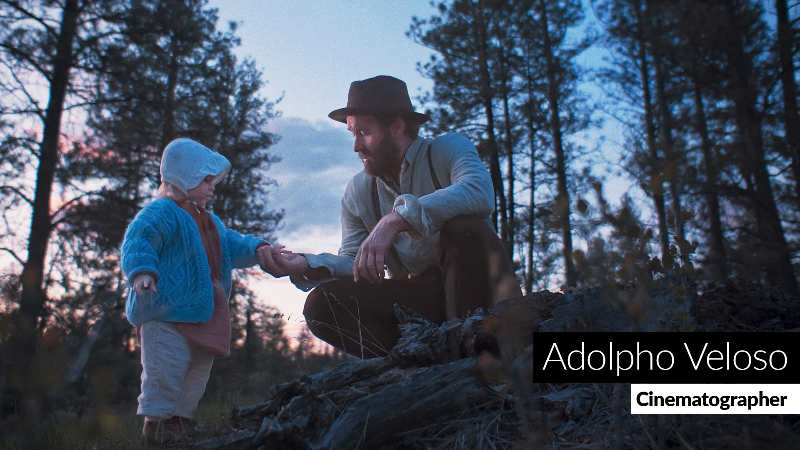
Veloso’s first response to the screenplay was that it felt less like a conventional biography than an impressionistic memory piece, and he was determined to honor that feeling in the imagery. “We were just trying to figure out how to translate that to the visual language,” he said, noting that each decision was designed to give the audience the experience of looking through old photographs. “From the aspect ratio to the way we framed it, we would always be reacting to what the characters were supposed to be feeling. It’s the usual aspect ratio for still photography, which is 3:2. When you look into it, you have the same feeling that you have when you’re looking at your old family photos.”
Although Veloso and Bentley went in with a careful plan, their approach was to respond to what the actors were doing on the day and let that dictate the blocking and lighting. This was especially true of key scenes like the ones between Grainier and his family. “The camera is more reactive to the characters than imposing something whenever he’s with the family,” Veloso said, adding that when Grainier is out working the visual style changes accordingly. “It is much more aggressive, faster and sharper.” Veloso felt that one of the pleasures of the film was that “you never know what you’re going to get and you’re just there with the camera trying to make sense of something.”
Veloso and Bentley briefly discussed the option of shooting “Train Dreams” on film but decided to go digital for reasons both aesthetic and practical. “With period movies there are usually so many layers already between the audience and the characters,” Veloso said. “We wanted to remove as much as possible, and we wanted the movie to feel as grounded as possible so people can actually connect to it. Actors would become those characters and inhabit those spaces. A lot of the scenes are lit by a single candle, or a campfire, and that wouldn’t necessarily be possible on film because we didn’t want to suddenly have 200 candles in the cabin.”
The filmmakers wanted the actors to have as much freedom of movement as possible, and Veloso felt the best way to have a smaller footprint was to shoot digital on the Alexa 35. In order to get the best light possible, he collaborated closely with other departments to schedule split days and take advantage of the natural beauty in the location’s surroundings. His partnership with Schaller was key, as she built a tower from scratch in a way that was oriented for the best possible lighting. “We had to find a location where she could build half of that fire tower facing the sunset,” Veloso said, crediting the entire crew with helping him achieve his vision. “It was teamwork from all departments to pull off that lighting approach.”
Presented in partnership with Netflix.




 English (US) ·