
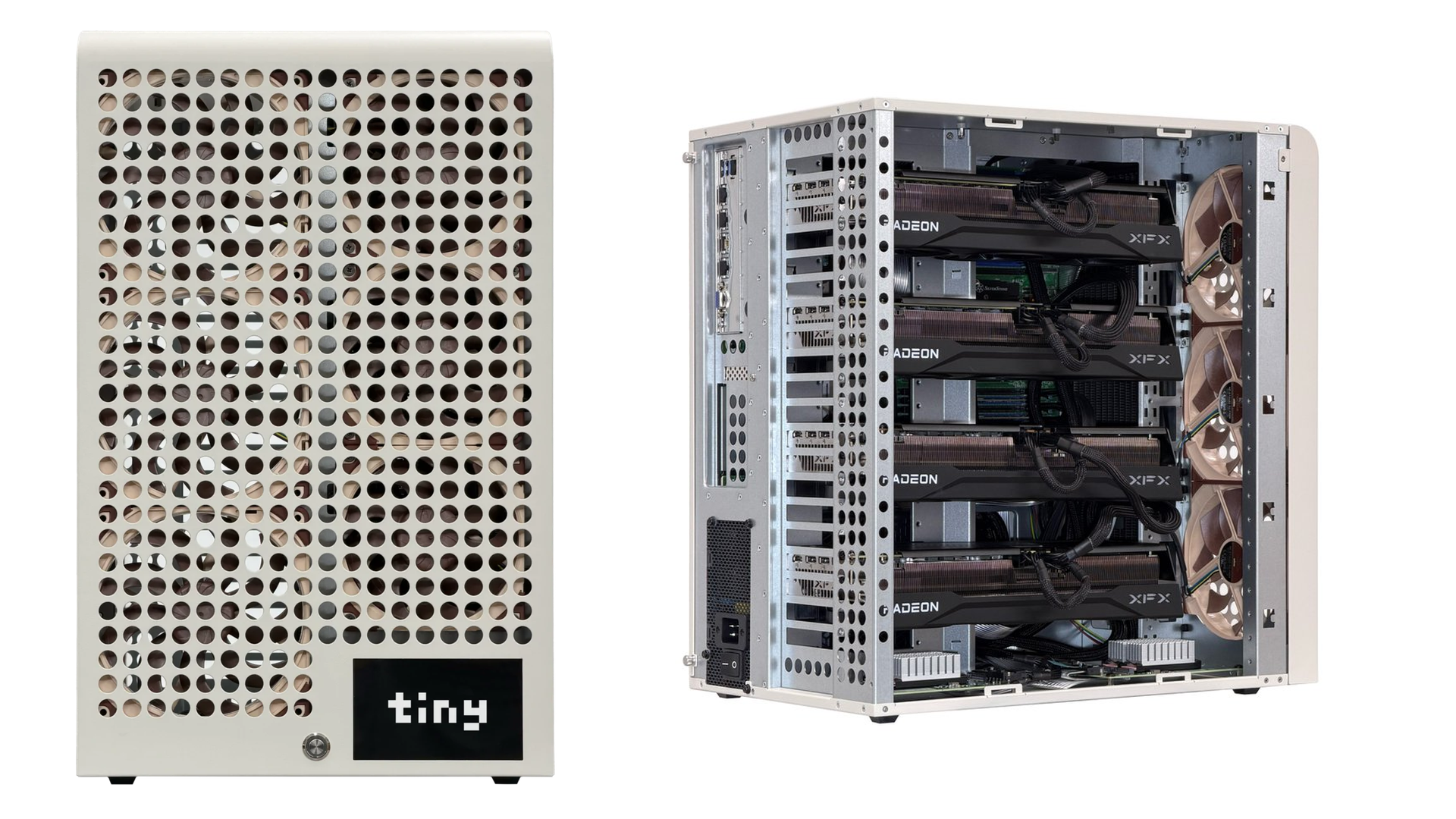
- Tinygrad's new Tinybox supports four AMD Radeon RX 9070 XT GPUs
- The four-GPU configuration raises the G4 workstation's price to $11,000
- Tinygrad retains DDR4 memory and PCIe 4.0 in its G4 platform
Tinygrad has introduced a redesigned Tinybox workstation built around a server processor and capable of accommodating four AMD Radeon RX 9070 XT graphics cards.
The device combines water cooling, a server-grade motherboard and a spacious internal layout intended for demanding deep-learning workloads.
Its standard platform uses DDR4 memory and PCIe 4.0, while an alternative configuration offers newer memory and connectivity technologies.
An older server platform anchors the design
The standard G4 configuration uses a 32-core AMD EPYC processor with 32 GB of DDR4 memory and a 1 TB boot SSD.
Its motherboard includes a baseboard management controller, while a 1,700 W power supply supports the system's demanding graphics configurations.
The controller also has a VGA output, allowing administrators to connect a display without using the installed graphics cards.
The system also includes two 1GbE network ports and an OCP 3.0 interface for connecting compatible networking hardware.
The enclosure measures 12 inches wide, 19.25 inches high, and 18 inches deep, and weighs 42 pounds.
This size feels like a PC from the 2000s, but TinyCorps defends this dimension on X, saying, “Everything old is new again. We're reentering an era where there are programs people want to run but can't because their computers are too small.”
The spacious enclosure leaves ample room between the graphics cards, allowing better airflow to keep them cool under heavy workloads.
Customers can also choose the G5 platform, which uses AMD's Genoa generation and supports DDR5 memory alongside PCIe 5.0 connectivity.
The company has not identified the exact processor model in the supplied specifications.
GPU and storage choices determine the final configuration
Tinygrad offers four AMD Radeon RX 9070 XT graphics cards, alongside Nvidia alternatives including the RTX 5090 and professional RTX 6000 models.
The company says acoustic output influenced its graphics selection, prompting it to exclude certain alternatives because their cooling systems generated more noise.
To maintain noise levels below 50 dB, Tinygrad combines low-speed Noctua fans with liquid cooling for the processor inside the workstation.
Two printed circuit boards (PCBs) at the system's bottom connect NVMe storage drives to MCIO interfaces, supporting the optional RAID configuration available to customers.
The G4 platform starts at $7,000, while the newer G5 configuration costs $12,000 before buyers select additional graphics cards, memory, or storage upgrades.
Adding four Radeon RX 9070 XT cards costs $4,000, bringing the complete G4 configuration to $11,000 before any optional upgrades are selected.
Nvidia configurations include one RTX 5090 for an additional $8,000, two RTX 5090 cards for $16,000, or RTX 6000 options costing $19,000 individually and $38,000 for two.
Memory can be upgraded from 32 GB to 128 GB for an additional $3,000, while storage options include a 4 TB RAID array for $2,000 or a 16 TB RAID array for $6,000.
After being called out for the rather expensive SRP, a spokesperson for the company said, “We strongly encourage others to compete with us”
Tinygrad builds each workstation to order, with estimated delivery between one and eight weeks after the purchase process is complete.

Follow TechRadar on Google News and add us as a preferred source to get our expert news, reviews, and opinion in your feeds.








 English (US) ·