
 Image via United Film Distribution Company

Published Mar 8, 2026, 4:33 PM EDT
Shawn Van Horn is a Senior Author for Collider. He's watched way too many slasher movies over the decades, which makes him an aficionado on all things Halloween and Friday the 13th. Don't ask him to choose between Michael Myers and Jason Voorhees because he can't do it. He grew up in the 90s, when Seinfeld, Everybody Loves Raymond, and TGIF were his life, and still watches them religiously to this day. Larry David is his spirit animal. His love for entertainment spreads to the written word as well. He has written two novels and is neck deep in the querying trenches. He is also a short story maker upper and poet with a dozen publishing credits to his name. He lives in small town Ohio, where he likes to watch professional wrestling and movies.
Long before zombies dominated television on The Walking Dead, all of its spinoffs, and The Last of Us, the living dead first shambled along on the big screen. Each decade has great zombie films of every kind of variety, and the subgenre has been the perfect outlet for social commentary.
Sometimes, with the likes of Train to Busan and Zombi, pure terror is the goal. Other times, as with Braindead, gore is the star of the show. Even comedy has found its way into the subgenre through Return of the Living Dead and Zombieland. As great as all of these examples are, only four can make the Mount Rushmore of zombie movies, and it's a list which must include the man who started it all, George A. Romero.
'Night of the Living Dead' (1968)
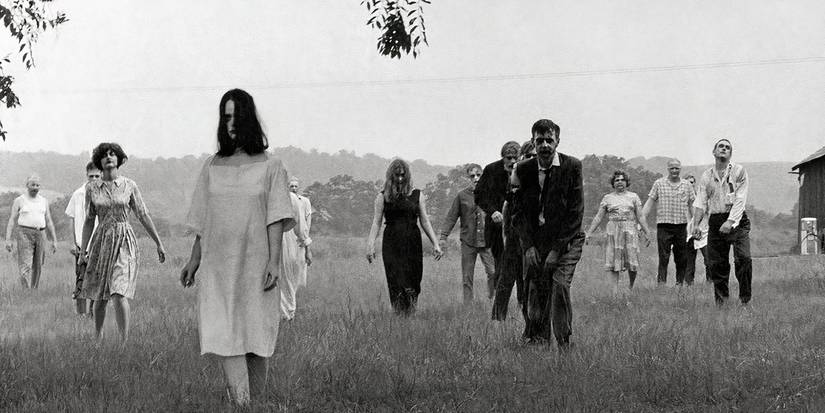 Image via Continental Distributing
"They're coming to get you, Barbra." That's the most famous line from George A. Romero's Night of the Living Dead, a transformative film that changed everything to come. Zombie movies existed before 1968, but not like this. Under Romero, the living dead rose with an insatiable desire for human flesh and the only way to kill them was with a shot to the head. Night of the Living Dead has a simple premise, with Barbra (Judith O'Dea), our hero, Ben (Duane Jones), and several others trapped in a boarded-up farmhouse from the growing horde outside. One by one, the living are ripped apart. Will anyone make it out in one piece?
There is so much more going on under the surface of Night of the Living Dead. It's a commentary not only on Vietnam, but racism. Romeo claims he wasn't trying to say anything profound, that he simply cast the Black Duane Jones as the lead because he was the best actor in auditions. Still, it's noticeable that in an era of civil rights, and in the very tumultuous year of 1968, a man of color is the hero among an otherwise entirely white cast. The ending is a heartbreaker, with grainy images reminiscent of a lynching. This is the first of its kind, and it will forever have the most important message.
'Dawn of the Dead' (1978)
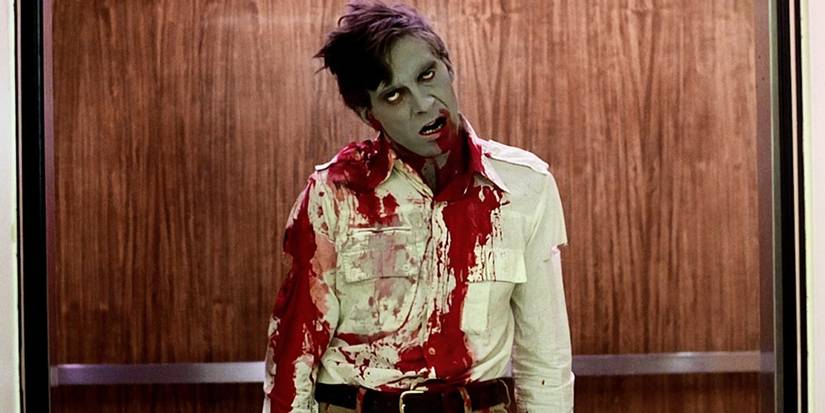 Image via United Film Distribution Company
Ten years later, Romero returned to the zombie genre with his follow-up, Dawn of the Dead. This time, black-and-white is traded in for living color, with green-tinted ghouls and plenty of red thanks to practical effects maestro Tom Savini (who also has an important role in the film). Romero drops us right in the middle of the chaos, as Pittsburgh collapses and a quartet of heroes look for a way out. Helicopter pilot Stephen "Flyboy" Andrews (David Emge), his pregnant girlfriend, Francince (Gaylen Ross), and two SWAT team members, Peter (Ken Foree) and Roger (Scott Reiniger), take to the skies in search of safety before landing at a giant mall. There, they barricade themselves inside and try to create some sense of normalcy. However, it's not the dead they should be scared of most.
Dawn of the Dead is scary, for sure, but it's also fun, as the viewer imagines what they'd do if they were trapped in a mall. The real life Monroeville Mall, with its wealth of stores and shadowy rooms, is a character unto itself. Romero's message is obvious without being heavy-handed: commercialism has turned us into zombies. The 2004 reboot from Zack Snyder, with its faster, more threatening zombies, is fun, but it can't compare to what the original accomplished.
'28 Days Later' (2002)
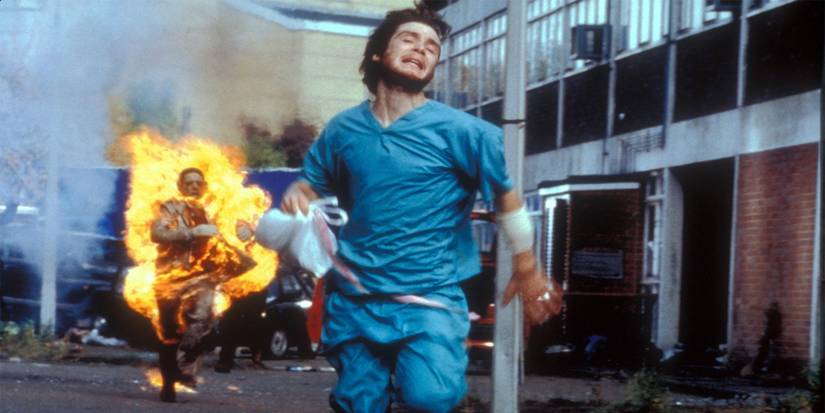 Image via Searchlight Pictures
There's never been a zombie movie like this one. In 2002, director Danny Boyle (Trainspotting) and screenwriter Alex Garland came together for a different kind of story in the subgenre. If you want to get technical about it, 28 Days Later isn't a traditional zombie film. Instead of being the dead brought back to a slow-moving life, the monsters in 28 Days Later are very much alive. They are infected with a rage virus which makes them a stronger and much faster threat. When Jim (Cillian Murphy) wakes up four weeks after the outbreak began, he's running for his life and looking for some friends to help him survive.
28 Days Later is immensely violent and fast-paced because of the speed of its zombies. Throw in Boyle's chaotic directing style, and it's an unnerving movie with a tension Romero and others couldn't create. As Romero did before, including in 1985's Day of the Dead, the uninfected are as dangerous as those who are. And just as the godfather of the zombie film accidentally created a movie about race, 28 Days Later says so much more than Boyle and Garland intended. The movie was in the middle of filming when 9/11 happened, adding a new layer of hurt to scenes of a barren London and boards filled with photos of the missing. After COVID, 28 Days Later gained another level of social commentary about the spread of a virus and what it does to those left behind. It created a franchise that continues today, but there is no topping the first.
'Shaun of the Dead' (2004)
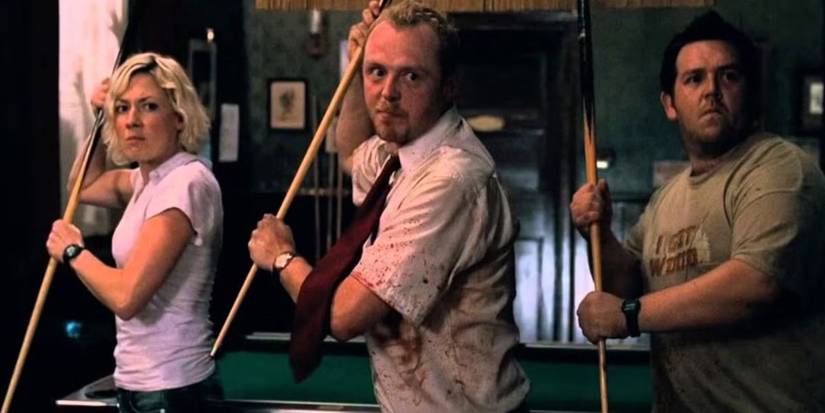 Image via Universal Pictures
Zombie movies can be scary with a deep, dark message, or they can be Shaun of the Dead, where laughter is the aim. Directed by Edgar Wright and co-written with star Simon Pegg, Shaun of the Dead is the first (and arguably the best) entry of the Three Flavours Cornetto trilogy. In it, slacker Shaun (Pegg) is ruining his relationship with his girlfriend, Liz (Kate Ashfield), and seems destined for a life of video games and loneliness with his best friend, Ed (Nick Frost). Then the zombies attack, and now Shaun has a reason to fight back as he attempts to rescue the love of his life.
Wright made a wise choice in not having the zombies be the source of the comedy. They're still gross, gory, and dangerous, keeping the horror in horror comedy alive. Where Shaun of the Dead succeeds is how smart the laughs are. In the early moments of the outbreak, a perfect scene shows an oblivious Shaun not noticing the changes around him. In 2004, the zombie genre had been done to death. Shaun of the Dead found a way to make it fresh again with gruesomely funny gags and lovable characters. The social satire is spot on in a movie where the characters might be dumb but the script has so much BBBRRAAIINNNSSS





 English (US) ·