
 Image via Warner Bros.
Published Sep 28, 2026, 5:09 AM EDT
Sign in to your Collider account
Christian Bale has the kind of career where the famous stuff can almost get in the way. Everyone knows the physical transformations. Everyone has heard the Batman voice jokes. Patrick Bateman became an entire internet language of morning routines, business cards, headphones, and terrifyingly intense restaurant reservations. But go back to the actual movies and the impressive part is much simpler. Bale keeps ending up in films that have something substantial to say even after you stop staring at what he did for the role.
That distinction is important because a great performance can rescue a mediocre movie for a scene or two. A masterpiece has nowhere to hide. The story has to hold. The world has to feel complete. The character has to become more interesting after you know where everything is going. These five survive that test so comfortably that the harder argument is deciding which one deserves to lose.
'Empire of the Sun' (1987)
 Image via Warner Bros. Pictures
Jim Graham (Christian Bale) is a privileged British boy living in Shanghai when Japan expands its occupation during World War II. He gets separated from his parents in the chaos, ends up inside an internment camp, and has to learn very quickly that the adult world he assumed would protect him has disappeared. Empire of the Sun never turns Jim into some conveniently wise movie child. He remains excitable, scared, selfish, adaptable, and completely fascinated by airplanes even when those airplanes belong to the people imprisoning him.
That contradiction makes some of the movie’s best moments unforgettable. Jim watches American P-51 Mustangs attack the airfield and screams “Cadillac of the skies” with almost uncontrollable excitement, momentarily forgetting that people are being killed around him. Later, the boy who once treated warplanes like toys has seen enough starvation and death that his face barely resembles the child from the opening. Bale was still a kid himself, which makes the confidence of the work almost absurd. Yet Steven Spielberg wisely keeps the film bigger than a prodigy showcase. War is being understood through someone young enough to be thrilled by it before he understands what it costs.
'The Big Short' (2015)
 Image via Paramount Pictures
Michael Burry (Christian Bale) reads mortgage data nobody else has bothered to examine closely and reaches a conclusion that sounds insane in 2005. The American housing market is built on loans that are going to fail. He then persuades major banks to sell him credit default swaps against mortgage bonds, effectively betting enormous amounts of investor money on an economic collapse almost everyone else considers impossible. The Big Short takes material that could put a room to sleep and makes the process of discovering financial catastrophe genuinely exciting.
Burry is especially fascinating because he spends much of the movie waiting to be proven right while the market refuses to behave rationally. Investors rage at him. Banks keep charging premiums. He sits barefoot in his office, blasts heavy metal, drums when the pressure gets ugly, and keeps returning to the numbers because the numbers are still saying the same thing. Elsewhere, the movie has celebrities explain finance in bathtubs and kitchens because Adam McKay knows most viewers did not arrive fluent in mortgage-backed securities. It should be unbearably smug. Somehow it becomes one of the funniest and angriest explanations of 2008 ever made.
'American Psycho' (2000)
 Image via Lionsgate
Patrick Bateman (Christian Bale) is a wealthy Wall Street professional living in 1980s Manhattan, although “living” may be generous. His days are built around restaurants, clothes, workouts, skincare, status, and making sure nobody owns a better business card than he does. Underneath that polished routine is something much uglier. American Psycho follows Bateman as violence, fantasy, narcissism, and the empty sameness of his social world become increasingly difficult to separate.
The business-card scene tells you more about these men than ten pages of dialogue could. They sit around comparing nearly identical pieces of cream-colored paper, and Bateman looks physically ill because Paul Allen’s card apparently has superior lettering and a watermark. Minutes later, he can lecture somebody about Huey Lewis and the News before attacking him with an axe while “Hip to Be Square” plays. That mixture is why the movie has aged so strangely well. Bateman is monstrous, but the world around him is so obsessed with surfaces that people repeatedly confuse one banker for another. The memes are funny. The actual joke is much nastier.
Collider Exclusive · Horror Survival Quiz Which Horror Villain Do You Have the Best Chance of Surviving? Jason Voorhees · Michael Myers · Freddy Krueger · Pennywise · Chucky
Five killers. Five completely different ways to die — if you're not smart enough, fast enough, or self-aware enough to avoid it. Only one of them is the villain your particular set of instincts gives you a fighting chance against. Eight questions will figure out which one.
🏕️Jason
🔪Michael
💤Freddy
🎈Pennywise
🪆Chucky
TEST YOUR SURVIVAL →
01
Something feels wrong. You can't explain it — you just know. What do you do? First instincts are the difference between the survivor and the first act casualty.
ALeave immediately. I don't need to understand a threat to respect it. BStay quiet and observe. If I can see it, I can understand it. If I can understand it, I can avoid it. CStay awake. Whatever this is, I am not going to sleep until I feel safe again. DConfront it directly. Fear grows in the dark — I'd rather know what I'm dealing with. ECheck everything, trust nothing. The threat might be closer than I think — and smaller.
NEXT QUESTION →
02
Where are you most likely to find yourself when things go wrong? Setting is everything in horror. Where you are determines which rules apply.
ASomewhere remote — a cabin, a campsite, off the grid and away from people. BA quiet suburban neighbourhood where nothing ever happens. Except tonight. CIn my own head — the most dangerous place of all, depending on what's already in there. DWherever children are — because something about this place attracts the worst things. ESomewhere ordinary — a house, a toy store, a place where the last thing you'd expect is a threat.
NEXT QUESTION →
03
What is your most reliable survival asset? Every survivor has a quality the villain didn't account for. What's yours?
APhysical fitness — I can run, I can swim, I can outlast something that relies on brute persistence. BSpatial awareness — I always know the exits, the hiding spots, the fastest route out. CPsychological resilience — I've faced my worst fears before. They don't have the same power over me. DEmotional steadiness — I don't panic. Panic is what gets you caught. EScepticism — I don't underestimate threats because of how they look. Size is irrelevant.
NEXT QUESTION →
04
What kind of fear is hardest for you to fight through? Knowing your weakness is the first step to not dying because of it.
AThe unstoppable — something that will not stop, cannot be reasoned with, and is always getting closer. BThe invisible — a threat I can feel but can't locate, watching from somewhere I can't see. CThe psychological — something that uses my own mind and memories against me. DThe unknowable — something ancient, shapeless, that feeds on the fear itself. EThe mundane — a threat so ordinary-looking that no one will believe me until it's too late.
NEXT QUESTION →
05
You're with a group when things start going wrong. What's your role? Horror movies are brutally clear about who survives group situations and who doesn't.
AThe one who says "we need to leave" first — and means it, even when no one listens. BThe one who stays quiet, watches the others, and figures out the pattern before anyone else does. CThe one who holds the group together when panic sets in — because someone has to. DThe one who asks the questions nobody wants to ask — because ignoring them gets people killed. EThe one who takes the threat seriously when everyone else is laughing it off.
NEXT QUESTION →
06
What's the horror movie mistake you're most likely to make? Honest self-assessment is a survival skill. Denial is not.
AGoing back for someone — I know I shouldn't, but I can't leave them behind. BAssuming I'm safe once I've found a hiding spot. That's when it finds me. CFalling asleep when I absolutely cannot afford to. Exhaustion is its own enemy. DLetting my curiosity override my instincts — I always need to understand what I'm dealing with. EDismissing the threat because of how it looks. That's exactly what it wants.
NEXT QUESTION →
07
What's your best weapon against something that can't be stopped by conventional means? Every horror villain has a weakness. The survivors are always the ones who find it.
AThe environment itself — I use the terrain, the water, the geography against it. BPatience — I wait, I watch, and I strike at the one moment it doesn't expect. CLucidity — if I can stay in control of my own mind, it loses its primary weapon. DCourage — facing it directly, refusing to run, taking away the fear it feeds on. EImprovisation — I use whatever's at hand, however unconventional. Creativity over brute force.
NEXT QUESTION →
08
It's the final scene. You're the last one standing. How did you make it? The final survivor always has a reason. What's yours?
AI kept moving. I never stopped, never hid for too long, never let it corner me. BI figured out the pattern before anyone else did — and I used it against the thing following it. CI stayed awake, stayed lucid, and refused to give it the one thing it needed most. DI stopped being afraid of it. And the moment I did, everything changed. EI took it seriously from the start — and I never once made the mistake of underestimating it.
REVEAL MY VILLAIN →
Your Survival Odds Have Been Calculated Your Best Chance Is Against…
Your instincts, your strengths, and your particular way of thinking under pressure point to one villain you actually have a fighting chance against. Everyone else — good luck.
Jason Voorhees
Jason is relentless, but he is also predictable — and that is the gap you would exploit.
- He moves in straight lines toward his target. He doesn't strategise, doesn't adapt, doesn't outsmart. He simply pursues.
- Your ability to keep moving, use the environment, and resist the panic that freezes most victims gives you a genuine edge.
- The Crystal Lake survivors were always the ones who stopped running in circles and started thinking about terrain, water, and distance.
- You think like that. Which means Jason, for all his indestructibility, would face someone who simply refused to be where he expected.
Michael Myers
Michael watches before he moves. He is patient, methodical, and almost impossible to detect — until it's too late for anyone who isn't paying close enough attention.
- But you are paying attention. You notice the shape in the window, the car parked slightly wrong, the silence where there should be sound.
- Michael's power lies in the invisibility of ordinary suburbia — the fact that nothing ever looks wrong until it already is.
- Your spatial awareness and instinct to map every room, every exit, and every shadow before you need them is precisely the quality Laurie Strode had.
- You are not a victim waiting to happen. You are someone who already suspects something is wrong — and acts on it.
Freddy Krueger
Freddy wins by getting inside your head — using your own fears, your own memories, your own subconscious as weapons against you. That strategy requires a target who can be destabilised.
- You are harder to destabilise than most. You've faced uncomfortable truths about yourself and you haven't looked away.
- The survivors on Elm Street were always the ones who understood what was happening and chose to face it rather than flee from it.
- Freddy's greatest weakness is that his power evaporates in the presence of someone who refuses to give him the fear he feeds on.
- Your psychological resilience — the ability to stay grounded when reality itself becomes unreliable — is exactly the quality that keeps you alive here.
Pennywise
Pennywise is ancient, shapeshifting, and feeds on terror — but it has one critical vulnerability: it cannot function against someone who genuinely stops being afraid of it.
- The Losers Club didn't survive because they were braver than everyone else. They survived because they faced their fears together, and faced them honestly.
- You ask the questions others avoid. You look directly at what frightens you rather than turning away.
- That directness — the refusal to let fear fester in the dark — is Pennywise's worst nightmare.
- It chose the wrong target when it chose you. You are exactly the kind of person whose fear tastes like nothing at all.
Chucky
Chucky's greatest advantage is that nobody takes him seriously until it's already too late. He exploits the gap between how something looks and what it actually is.
- You don't have that gap. You take threats seriously regardless of how they present — and you never make the mistake of underestimating something because of its size or appearance.
- Chucky relies on surprise, on the delay between recognition and response. You close that delay faster than almost anyone.
- Your instinct to treat every unfamiliar thing with appropriate scepticism — rather than dismissing it because it seems absurd — is the exact quality that keeps you breathing.
- Against Chucky, not laughing is already winning. You are very good at not laughing.
↻ RETAKE THE QUIZ
'The Prestige' (2006)
 Image via Warner Bros. Pictures
Alfred Borden (Christian Bale) and Robert Angier (Hugh Jackman) begin as working magicians and become consumed by beating one another after a stage accident destroys whatever friendship existed between them. Angier wants the audience to experience wonder. Borden cares about making the trick impossible to explain. The Prestige keeps pushing that difference until professional rivalry becomes sabotage, obsession, ruined relationships, and an increasingly dangerous search for the perfect illusion.
Borden is the character who becomes far more interesting after the movie has shown its hand. On a first viewing, his behavior can seem difficult to pin down. His warmth toward Sarah (Rebecca Hall) changes. His relationship with Olivia (Scarlett Johansson) feels contradictory. Even small conversations can leave the impression that something about him does not line up neatly. Watch the film again and those apparent inconsistencies become evidence. That is the delicious part. Christopher Nolan tells you repeatedly that a magic trick has three stages and practically begs you to watch closely, yet the movie still manages to keep information sitting directly in front of you. Bale fits beautifully inside that construction because Borden has built his entire life around taking the trick more seriously than anyone reasonably should.
'The Dark Knight Trilogy' (2005–2012)
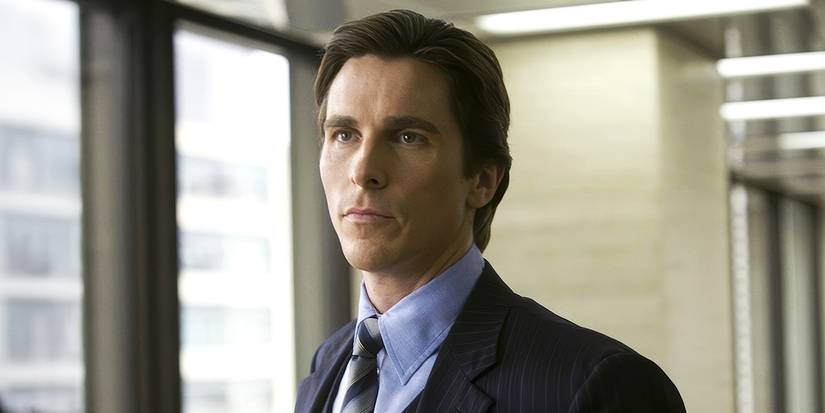 Image via Warner Bros.
Putting three movies at number one is cheating a little. It is also impossible to care once The Dark Knight Trilogy starts playing again. Batman Begins takes Bruce Wayne (Christian Bale) from the murder of his parents through years of anger, training, and experimentation until Batman finally becomes something Gotham’s criminals can fear. The Dark Knight then asks what happens when that symbol inspires an enemy who wants to prove Gotham’s morality is only temporary. The Dark Knight Rises finds Bruce years later living with the physical and emotional consequences of everything that came before.
Bale’s Bruce is widely regarded as the best one out there even though his trilogy contains villains people never stopped talking about. Fair enough. The Joker (Heath Ledger) is extraordinary. But Bruce is the connective tissue that makes all three films one story rather than three Batman adventures. The arrogant public playboy is deliberately ridiculous because the real Bruce cannot afford to look like Batman. His relationship with Alfred (Michael Caine) keeps puncturing the mythology whenever obsession starts sounding noble. His belief in Harvey Dent (Aaron Eckhart) becomes painfully important once Gotham needs a hero without a mask. And when an older, damaged Bruce has to climb out of the pit in Rises, the challenge is no longer learning how to fight. It is finding a reason to fear death again. That is a complete character journey hiding inside one of the greatest blockbuster trilogies ever made.







 English (US) ·