


Published Jul 15, 2026, 12:00 PM EDT
Alex is the Senior Editor of Reviews & Prestige Content, overseeing ScreenRant's film reviews as one of its Rotten Tomatoes-approved critics. After graduating from Brown University with a B.A. in English, he spent a locked-down year in Scotland completing a Master's in Film Studies from the University of Edinburgh, which he hears is a nice, lively city. He now lives in and works from Milan, Italy, conveniently a short train ride from the Venice Film Festival, which he first covered for SR in 2024.
Sign in to your ScreenRant account
As a filmmaker, I associate Christopher Nolan with groundedness above all else. He's made movies in all kinds of fantastical genres, many of which make leaps into the impossible, but he uses everything at his disposal to drag them as close to believability as he can. He brought architecture to the dream world; science to stage magic; and plausibility to superheroes. He films practically when he can, and aims for verisimilitude in VFX when he cannot. His stories are bound to a rigorous logic that shapes every creative decision, which can make it feel like even the most complex ideas or structures in them are fundamentally knowable.
So, when it was announced that his next film would be The Odyssey, I wondered: What happens when Christopher Nolan tackles a world of gods, monsters, and honest-to-goodness magic? When he cannot coat it in the "science" part of science fiction, what does the supernatural look like?
The answer, it turns out, is one of the most impressive accomplishments of Nolan's career. With one foot planted firmly in reality, this is a painfully human retelling of Homer's epic, mired in the visceral experience of Odysseus and his crew while grappling with what it means to be the kind of man whose deeds become songs. The Odyssey is gripping, fascinating, sometimes horrifying, and, just when it needs to be, quite moving. It's also very clearly a Christopher Nolan movie – so much so, in fact, that it made me realize he's been making grounded myths for some time.
The Odyssey Takes Its Time To Tell Its Story – And Is All The More Epic For It
Homer's Odyssey famously does not start at the beginning, and neither does Nolan's. When the film opens, Odysseus (Matt Damon) has been away from his island kingdom of Ithaca for nearly two decades, the first of which was spent sieging the city of Troy. The Trojan Horse, his ploy that won the Greeks the war, has already become the stuff of legend. But unlike many others who survived the fighting, Odysseus and his men have yet to return home; after so long with no news, many would presume him dead.
Damon is superb with the movie on his shoulders...
In his absence, Ithaca has become a powder keg. The palace is filled with unruly suitors seeking the hand of Queen Penelope (Anne Hathaway), and though she has kept them at bay for years, they brazenly abuse their people's custom of hospitality, eating and drinking Odysseus' estate into disrepair. Those same customs have kept the men from attempting to take the throne by force. But now that Telemachus (Tom Holland), Odysseus' son and heir, has come of age, they try each day to goad him into striking the first blow. Both Penelope and Telemachus sense that they cannot afford to wait much longer.
They will have to, though, as will we. The Odyssey is an exercise in patience – and delicious anticipation. Though we're taunted with a glimpse of the Trojan War at the very beginning, Nolan (or, rather, Penelope, who cannot bear to hear Travis Scott's bard tell that particular tale again) makes us wait to see it, in favor of laying other groundwork first. When we meet Odysseus on Calypso's (Charlize Theron) island, where he has spent years in a lotus flower-induced haze, his memory returns to him slowly, and there's a lot to remember. It's some time before he's caught up to the present we started with. And, as anyone who's read the epic knows, the third act doesn't rush through to its conclusion.
Though some sequences seem to fly by, The Odyssey isn't one of those three-hour movies you'd swear was half its length. It takes its time, and you feel it. But rather than signaling any issues with pacing – editor Jennifer Lame, an Oscar-winner for Oppenheimer, has once again done exquisite work – this is one of the film's greatest strengths. Cutting out the middleman of Homer's oral narrator, Nolan has brought us very close to these characters, immersing us as much as possible in their experience. In doing so, he has managed to capture the story's full scope. Odysseus' journey conveys the weight of its arduous years. The film's conclusion, told with a steady, patient hand, feels like a payoff 20 years in the making.
The Odyssey's Massive Scope Is A Team Effort, And Everyone Delivered
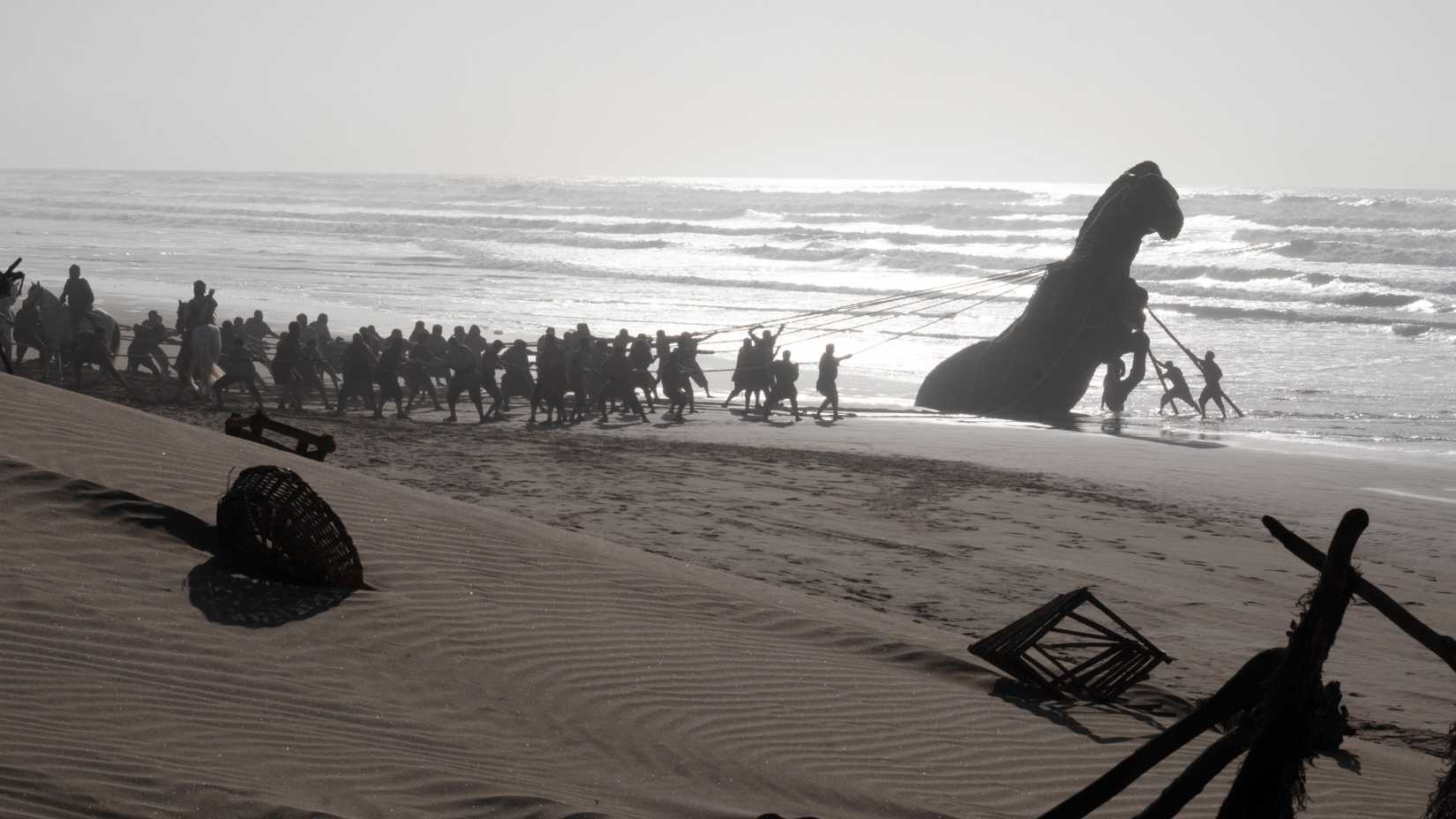
Indeed, this sense of scope can be found everywhere. (Sit down to put your thoughts about it into words, and The Odyssey suddenly seems impossibly big.) It's been well-publicized that this is the first movie of its kind to be shot entirely with IMAX cameras, and the effect is wondrous, especially when capturing firelit scenes after dark. Ludwig Göransson's score is striking; through my theater's speakers, I often felt the sound mix in my bones. The effects work that brought the film's creatures to life is stunning and seamless. All these things weave together to give this story its grandeur.
...all the actors are perfectly in tune. There is no one who doesn't manage to add to the story with their choices.
As thrilled as I am by the effect of the whole, however, this movie will surely be discussed in pieces. Odysseus' journey is by nature episodic, and some of those episodes stand out as among the most memorable set pieces in Nolan's filmography. The sacking of Troy is perhaps the showstopper, this film's equivalent of Oppenheimer's atom bomb test, and the segment featuring Bill Irwin's cyclops Polyphemus is mesmerizing. But The Odyssey is never better than when Odysseus and his crew are on Circe's (Samantha Morton) island. I'll be honest – I did not know Nolan had this imagery in him.
The performances, too, differ when looking at the parts or the sum. Seen together, all the actors are perfectly in tune. There is no one who doesn't manage to add to the story with their choices. But, whether because of the film's old-school Hollywood epic quality or the IMAX cameras being used for so many closeups, the cast members with the most movie star juice are the ones who end up shining brightest. Damon is superb with the movie on his shoulders, and Hathaway a worthy equal in much less time. Holland finds the right way to channel the boyish charm that's made him an excellent Spider-Man, while Pattinson, perhaps my favorite of the supporting players, adds to his great canon of sniveling losers.
Theron and Zendaya, who plays Athena, are used sparingly, but to fittingly ethereal effect. Similar for Lupita Nyong'o, but her dual role of Helen and Clytemnestra proves far more haunting. Morton is absolutely spellbinding in her limited appearance. John Leguizamo, as Odysseus' loyal swineherd Eumaeus, and Himesh Patel, as second-in-command Eurylochus, are critical emotional anchors. It's truly a feast of performances. Talk about one, and the rest will soon follow.
There's No Right Way To Watch Christopher Nolan's The Odyssey

All of these elements combine for a truly cinematic experience that, if you wish, you can simply sink into. But anyone wishing to pick apart The Odyssey, as audiences often do to Nolan's other blockbusters, has many avenues to do so. It is a fascinating adaptation, both for the ways it's faithful and the ways it isn't. Any fan of this filmmaker should be thrilled by how it elaborates on pet themes he's returned to over the years – the struggle to return home, for example, is often central to his movies, but he's never dedicated as much time to the homecoming itself as The Odyssey requires. The resulting scenes are all the more emotional in that context.
Anyone who wants to dissect whether the story's supernatural elements are "real" within the world of the film – which the title card tellingly describes as "a time of apparent magic" – could have a field day. But I find myself dwelling more on the unsettling ways that this film and Oppenheimer seem to speak to each other. The latter was based on the biography American Prometheus, the title of which draws a line from the father of the atomic bomb to Greek mythology; in the former, Nolan draws that line in the other direction.
Both films are, in their way, pre-apocalyptic. But after having first left us with Cillian Murphy's tortured premonition, The Odyssey's lingering final note suggests he's getting more optimistic about humanity's ability to endure our own worst impulses.
The Odyssey releases in theaters nationwide on Friday, July 17.
Release Date July 17, 2026
Runtime 172 Minutes





 English (US) ·