
Serving tech enthusiasts for over 25 years.
TechSpot means tech analysis and advice you can trust.
Forward-looking: Intel is bringing its 18A process node to space with two Starfire chips designed for onboard AI processing and computing in harsh environments. Intel lists two SoC variants: one optimized for low-power applications and another focused on higher performance. If everything goes smoothly, the company expects to deliver samples in the third quarter.
Starfire features an eight-core CPU built on the 18A node, with each chip combining four performance cores and four low-power efficiency cores. The two models operate at different clock speeds, with the low-power version prioritizing efficiency and the performance model targeting higher compute capability.
Performance cores run at 1.0 GHz on the low power model while the efficiency cores operate at 850 MHz, keeping the entire package within a 10W TDP. The performance version increases clock speeds, with the four performance cores running at 3.1 GHz and the efficiency cores reaching 2.1 GHz. It carries a 35 W TDP for systems capable of supporting higher power consumption.
The chips also include a dedicated graphics tile. Both versions feature a GPU tile built on Intel 3, with four Xe cores and a total of 64 execution units. On the low power model, the Xe cores operate between 800 MHz and 1.0 GHz. The performance model increases that frequency to up to 2.0 GHz, providing additional headroom for graphics and compute workloads in orbit.
Both variants also feature an NPU. The low power Starfire delivers up to 45 TOPS of INT8 AI performance, while the performance version reaches up to 75 TOPS. Combined, the CPU, GPU, and NPU in a single space-qualified chip allow satellites and other systems to process more data and run AI workloads onboard, reducing reliance on ground-based processing.
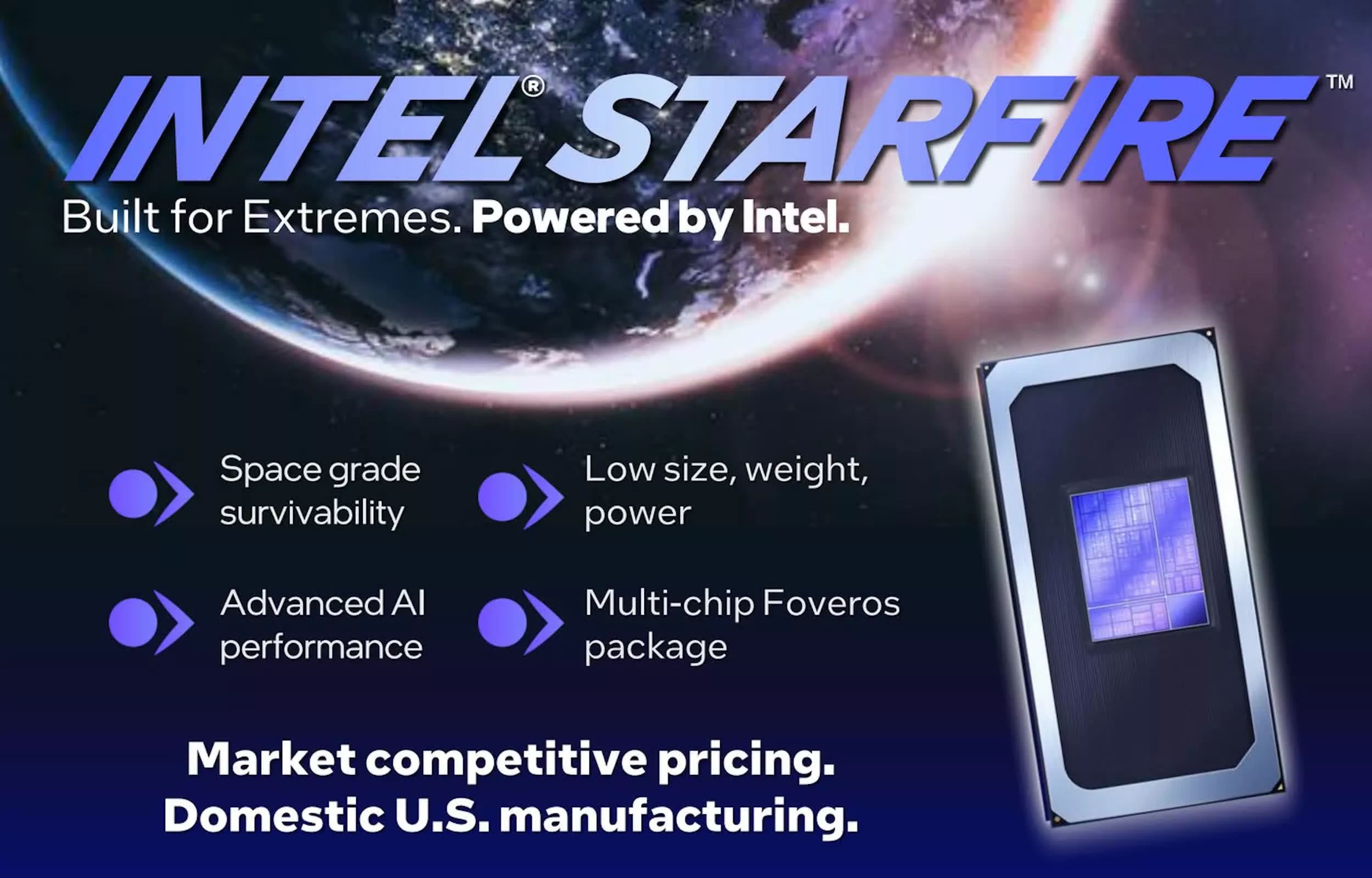
The operating limits are designed for space. Starfire is rated to operate at junction temperatures ranging from -55°C to 125°C. The documentation notes that the chips carry radiation-hardening certifications for total ionizing dose, single-event latch-up, and single-event effects. These measures are intended to reduce damage from long-term radiation exposure and short bursts of high-energy particles.
Radiation is a major challenge for any processor deployed in space. Ionizing radiation can pass through a chip and flip bits in memory or logic circuits, potentially corrupting data or causing errors. Over time, accumulated radiation exposure can degrade devices, while single events can trigger immediate faults. For this reason, space-grade chips undergo radiation hardening and qualification before deployment, including processors derived from commercial designs.
By integrating an 18A CPU, an NPU, and an Intel 3 GPU into a single SoC, Intel is bringing newer process technology to systems that have traditionally relied on older nodes. Intel is targeting Starfire at satellites and other spacecraft that require real-time data processing, onboard AI capabilities, and strict size, weight, and power constraints.








 English (US) ·