
- Chinook concept expands role beyond transport into coordinated drone deployment platform
- Rear ramp launch design enables flexible unmanned systems deployment during missions
- Heavy lift capacity supports integration of launchers, sensors, and mission systems
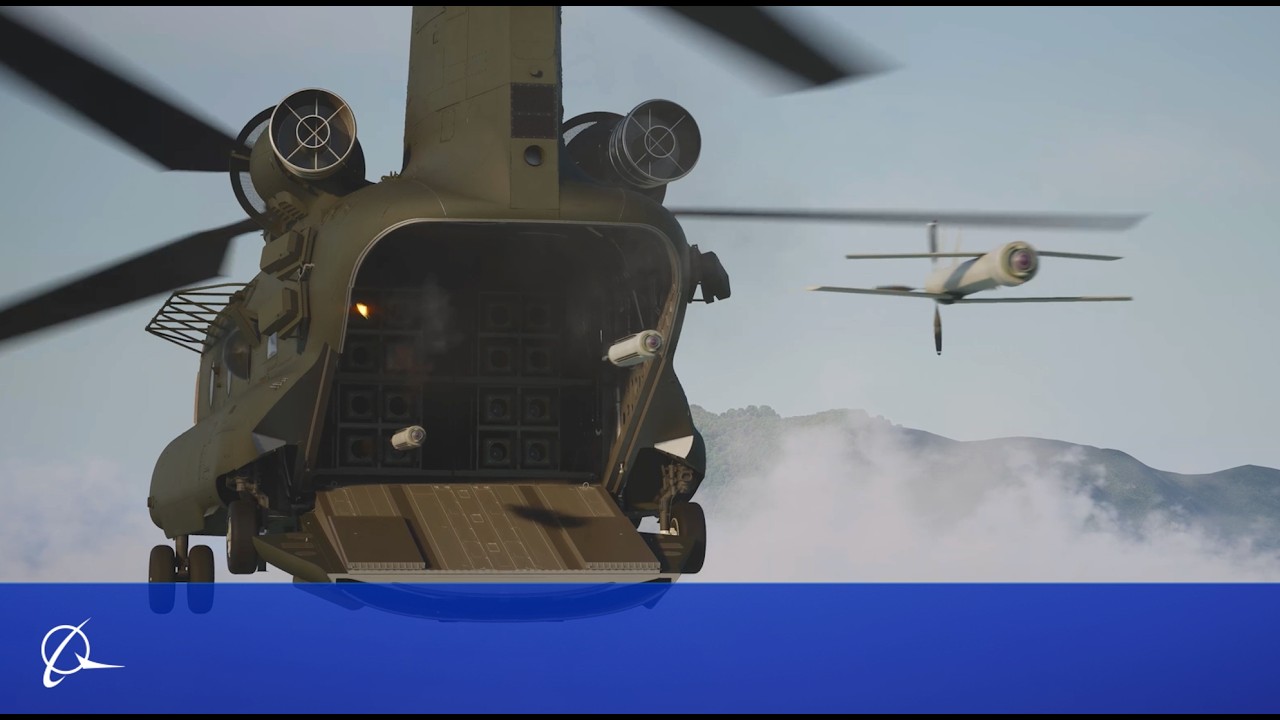
Boeing has released a concept video showing the CH-47 Chinook deploying swarms of drones from an internal palletized launcher.
The video depicts the aircraft opening its rear ramp and releasing launched effects that move ahead of the helicopter to expand the reconnaissance screen and detect threats.
Rather than simply moving troops and cargo, the Chinook would become a forward node for manned-unmanned teaming in contested airspace.
Article continues below
Boeing CH-47F Block II Chinook: the Future Evolution - YouTube
From payload carrier to Airborne Node
The CH-47 Chinook operates not just as a transport asset but as a forward node capable of deploying multiple launched effects from its rear ramp.
It can hover at low altitude while unmanned systems move ahead, extending visibility and shaping the environment before troops or cargo are committed.
The Chinook’s baseline characteristics make it a plausible candidate for this expanded role.
With a maximum gross weight of 54,000 pounds and a useful load nearing 27,700 pounds, the aircraft offers considerable internal space and power margins.
Those specifications translate into the ability to carry launcher systems, communications equipment, and mission modules without stripping away its core transport function.
The tandem rotor design, and the absence of a tail rotor, allows deployment from the rear ramp without the same clearance constraints seen on conventional helicopters.
This configuration is not being explored in isolation. The U.S. Army has already tested launched effects from platforms like the AH-64E Apache.
A common launcher framework, known as LEDGR, is also under evaluation, which suggests interoperability across platforms.
What distinguishes the Chinook concept from these other platforms is scale and flexibility.
A heavy-lift helicopter carrying internal launch cells could perform transport duties while simultaneously deploying drones for route reconnaissance, deception, or electronic support.
In that scenario, the aircraft begins to function less like a simple lifter and more like a coordinating element within a distributed operational network.
Boeing has indicated the aircraft is expected to remain relevant “into 2060 and beyond,” pointing to long-term planning rather than a near-term fielded system.
Boeing ties its long-term confidence in the aircraft directly to the Block II upgrade path, which it sees as a foundation for keeping the Chinook relevant for decades.
Structural reinforcements, improved fuel systems, and digital flight controls create a foundation for integrating additional systems.
The company also refers to autonomy developments, including systems that reduce pilot workload and allow safer operation near performance limits.
When combined with launched effects, this could support a model where the aircraft manages both physical payload and distributed sensing assets during the same mission.
Despite the appeal of the concept, several practical issues remain unresolved.
Rear-ramp deployment in a tandem-rotor downwash environment raises concerns about safe separation and flight stability for unmanned systems.
Datalink resilience under electronic attack, onboard processing demands, and crew workload from added system complexity remain key constraints.
These factors represent more than minor engineering details — they define whether the concept can move beyond controlled demonstrations.

Follow TechRadar on Google News and add us as a preferred source to get our expert news, reviews, and opinion in your feeds.






 English (US) ·