
Paramount
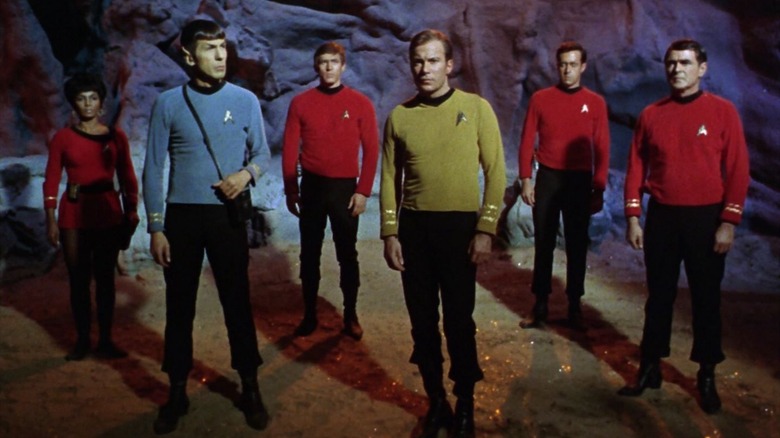
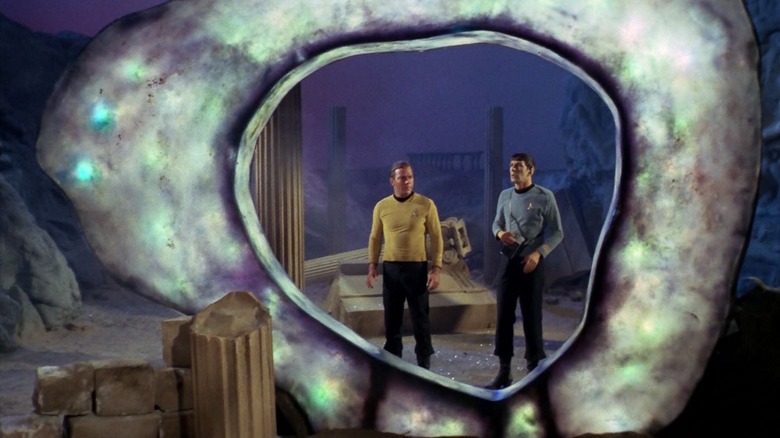
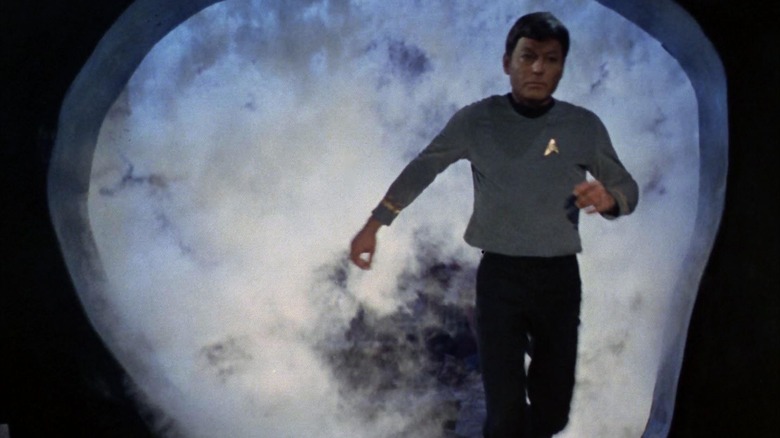
Harlan Ellison is the only credited writer on the classic "Star Trek" episode "The City on the Edge of Forever" (April 6, 1967), although other authors had a hand in it. "City," for the newbies, is the episode wherein Kirk (William Shatner) and Spock (Leonard Nimoy) leap through a sentient time portal called the Guardian of Forever (voice of Bartell LaRue) to rescue a drugged-up Dr. McCoy (DeForest Kelley).
The writing of the episode took a very, very long time, with "Star Trek" creator Gene Roddenberry getting involved. Ellison was already an award-winning sci-fi author in 1967, and was given full reign to write whatever story he wanted. Sadly, his ideas conflicted with Roddenberry's idealism, as it featured a subplot about drug-dealing on the U.S.S. Enterprise and a crew member being sentenced to death by firing squad. These things are anathema to "Star Trek." Many Trekkies know about the drama that followed. Ellison was asked to re-write the script several times, partly to make it more in the spirit of "Star Trek," and partly to make his episode cheaper to film. Ellison was cantankerous at the requests, and supposedly yelled at Shatner when he also tried to make an appeal. Roddenberry and "Trek" writers D.C. Fontana and Gene L. Coon ended up "fixing" "City," much to Ellison's chagrin.
The conflict over "City" led to years of resentment between Ellison and Roddenberry. The pair frequently beefed in interviews, and Ellison claimed Roddenberry claimed a lot of his ideas as his own. The whole debacle was just one reason why Ellison ended up hating everything about Hollywood. Back in 1979, Ellison was interviewed by The Comics Journal, and he explained in detail why Hollywood was terrible, and how the city was full of I.P. thieves who were constantly ripping him off.
Harlan Ellison hated everything about Hollywood
Paramount
Ellison speaks in a roundabout fashion, and he likes to make insulting puns and legal references that only he and his lawyers would understand, so it may be difficult to understand what specifically he's referring to at times, but the general sentiment is clear as a bell: Hollywood, he says, rips off its own ideas all the time. His issue is that writers will gently steal ideas from others, and then never give credit or compensation:
"Arrogant stupidity is the base of it. First of all, they do not understand that it is wrong to steal. A man like Glen Larceny does not understand that it is bad to rip off 'Smokey and the Bandit' and do 'B.J. and the Bear.' It is wrong to rip off 'Butch Cassidy and the Sundance Kid' and do 'Alias Smith and Jones.' It is wrong to rip off 'Star Wars' and do 'Battlestar Ponderosa.' It is wrong to do these things. He does not understand this. He says 'Wu-ull, it's a viable idea.' That's the wrong use of the word 'viable,' but that's the kind of language a jerk like him uses. They don't understand."
"Glen Larceny" is a reference to Glen A. Larson, the co-creator of the 1979 chimp-based TV series "B.J. and the Bear," a show that tapped into the CB radio/trucking craze that rose in the United States in the wake of "Smokey and the Bandit." He also deliberately altered the title of the sci-fi TV series "Battlestar Galactica," which suffered its own accusations of thievery from George Lucas, as "Battleship Ponderosa" as a way of mocking it. Ellison then described an encounter with a film executive who invited Ellison to read old sci-fi magazine for ideas. Ellison pointed out that's plagiarism.
Ellison had trouble with his ideas being ripped off his whole career
Paramount
Harlan Ellison was aware how angry he came across in interviews, saying:
"If somebody reads this, he's going to say, 'Ho ho ho-o, has this poor f***er gotten paranoid.' No, I'm not paranoid, I just know that industries and corporations and machines like the movie studios, huge, giant corporations that are owned by conglomerates are no longer human beings."
Ellison was not known for having a calm demeanor, and often felt the need to take action against people who were ripping him off. The 1979 interview came before the production of James Cameron's sci-fi film "The Terminator" in 1984, and Ellison had to take legal action against that film. Ellison felt that the story about a evil robot that travels back in time to the present to murder the mother of the future human resistance, was very similar to his short story "Soldier from Tomorrow" and an episode of "The Outer Limits" that he wrote simply called "Soldier." Cameron maintains that he invented "The Terminator" on his own (although he also revealed a connection to "Westworld"), but the film's distribution company, Orion Pictures, settled with Ellison nonetheless. His name appears in the end credits now, and he was paid an undisclosed amount of cash.
In 2009, he even sued "Star Trek" for royalties over "City." He was granted another undisclosed settlement.
Ellison said openly in the 1979 that he wanted full-page ads in the Hollywood reporter from all the studio heads that casually ripped off ideas for sci-fi stories and all other stories. Anything that was derivative or trendy, he hated. Ellison passed in 2018 at the age 84. He always hated showbiz. He left a legacy, however, as one of the best sci-fi authors of all time.


 English (US) ·