
 4 hours ago
44
4 hours ago
44
It’s been an exciting time for underwater filming firsts. Not long after divers captured what is believed to be the first underwater footage of a great white shark in the Mediterranean, scientists captured the first-ever footage of the incredible, very strange-looking deep-sea goblin shark in its natural habitat.
Goblin sharks (Mitsukurina owstoni) are an extremely rare species of deep-sea shark. Often referred to as a “living fossil” because it’s the only extant species of the family Misukurinidae, a 125 million-year-old lineage of ancient sharks, the goblin shark lives hundreds of feet below the ocean’s surface. In 2024, scientists confirmed a sighting of one at a depth of about 2,000 meters (6,560 feet).
Given how far below the surface that goblin sharks live, the rare species is very rarely seen alive. They have been documented numerous times over the years, but typically after they get caught in a fishing line and dragged to the surface, which sadly leads quickly to their deaths.
A new study by researchers at the University of Hawaii at Manoa, published in Journal of Fish Biology, outlines two live observations of goblin sharks in their natural habitat. One of them was captured at a seamount near Jarvis Island in the South Pacific Ocean, about halfway between Hawai’i and the Cook Islands, and the other documents the shark near the Tonga Trench, the deepest trench in the Southern hemisphere and second-deepest on Earth, behind the Mariana Trench.
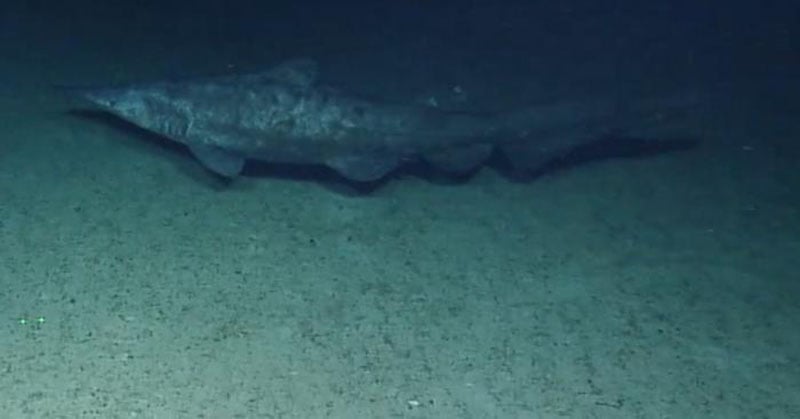 Goblin shark near Jarvis Island, 2019 | Credit: Ocean Exploration Trust, Nautilus Live
The first sighting near Jarvis Island occurred in 2019, when scientists were filming with a remotely operated vehicle. At the time, the researchers didn’t realize the significance of the sighting, as they were unable to positively identify the species.
“At the time no one board really knew the significance of what we had just seen,” said Steve Auscavitch, a PhD scientist at the Department of Invertebrate Zoology at the Smithsonian Institution’s National Museum of Natural History, ABC News reports.
Later, Aaron Judah, a PhD candidate at the University of Hawaii at Manoa, heard from fellow marine scientists that there might be some special footage in the video archives.
“I was shocked because this species is not known from the Central Pacific, and this would be an enormous range extension for the animal,” Judah explained.
Then, in 2024, researchers from the University of Hawaii teamed up with researchers at the University of Western Australia to capture baited-camera footage in the Tonga Trench. This area, about 1,250 miles (over 2,000 kilometers) southwest of Jarvis Island, provided scientists their first-ever footage of a living goblin shark in trench slopes.
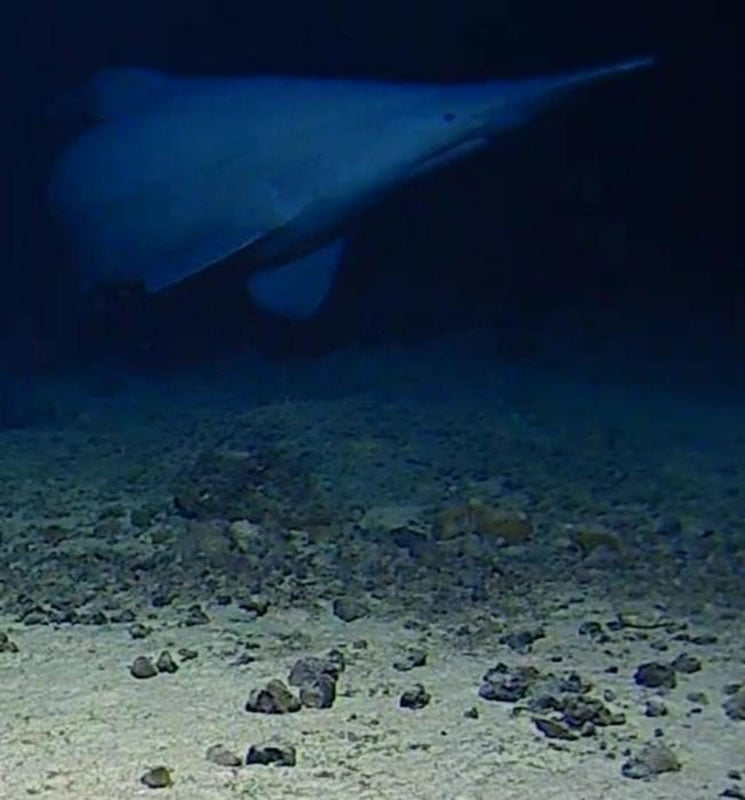 Goblin shark near Tonga Trench, 2024 | Credit: Minderoo-University of Western Australia Deep-Sea Research Center and Inkfish.
The new study marks the first time that videos of a live goblin shark in its natural habitat have been peer-reviewed and fully confirmed.
“They’ve captured the imagination of so many people, but we’ve never really seen them alive,” said Professor Alan Jamieson, director of the Minderoo-UWA Deep-Sea Research Centre, The Guardian reports. “We actually know virtually nothing about them.”
“It’s the most bizarre animal,” Jamieson added. “They have this incredible mouth that kind of protrudes down from the head, and does a kind of slingshot feeding thing.”
While this is not only generally interesting and offers a rare look at an exceptionally elusive and very strange animal, footage like this is also vital for conservation efforts. The crew captured a little over 20 seconds of footage of a goblin shark from over 50 days of nearly nonstop filming.
“They are ridiculously horrendous to look at,” adds Professor Culum Brown of Macquarie University in Australia. “Not even their mother would love their faces… It’s like something out of a horror movie.”
As Judah explains, if scientists don’t know where a species lives, it is very difficult to develop new legislation or regulations to help protect it.
“If we don’t know if the animals are there, we can’t really do anything with it or about it,” Judah says.
“Just the two observations of this study alone have broadened our knowledge of goblin shark geographic range and depth use,” Lea said. “They are so rare that every sighting gives us new glimpses into their lives,” James Lea, CEO of the Save Our Seas Foundation, tells ABC News.







 English (US) ·