
 1 day ago
92
1 day ago
92
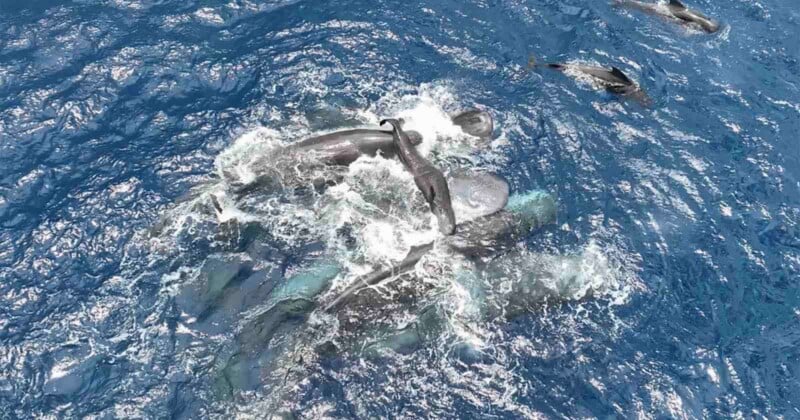 A group of sperm whales, including individuals that are not related, help support a newborn calf at the surface in the hours following its birth. | Project CETI
Scientists have captured one of the most detailed recordings of a sperm whale birth ever documented, using high-tech drones and underwater audio.
A global research group known as Project CETI, or the Cetacean Translation Initiative, documented the birth in a study published in Science and Nature’s Scientific Reports. The research draws on more than six hours of underwater audio and aerial drone footage collected on July 8, 2023, in waters off Dominica, where scientists have studied sperm whale families for over 20 years. The findings provide new insight into whale behavior and social structure.
According to a report by NPR, CETI researchers were tracking a sperm whale in the Caribbean when they encountered a larger group of 11 whales gathered near the surface. The group appeared unusually still and less social than expected. In response, the team launched two aerial drones to record the scene.
The footage captured a 19-year-old female whale named Rounder as she prepared to give birth to her second calf. She was surrounded by multiple whales, including her mother Lady Oracle and her daughter Accra representing three generations present during the birth. Each played a role in helping the mother and the newborn calf.
Over nearly five and a half hours, researchers observed and recorded the group’s behavior from a boat, using drones for aerial footage and equipment to capture underwater sound. The data collected represents an exceptionally rare scientific record. The birth itself lasted 34 minutes, from the moment the whales’ tails emerged above the water to the delivery of the calf. During labor, other adult females were seen diving beneath Rounder’s dorsal fin, often positioning themselves upside down with their heads facing her genital slit.
Observations of whale births in the wild are uncommon and have been recorded in fewer than 10 percent of cetacean species. The study used drone footage, computer vision, multiscale network analysis, and a newly developed software tool, alongside long-term data from this well-studied group, to analyze coordinated caregiving behavior.
The findings show that female sperm whales from different, unrelated family groups help each other during birth. Both relatives and non-relatives take turns supporting the mother and the newborn. Researchers say this is the first clear, data-based evidence of this kind of birth assistance outside humans and a small number of other primates.
Taken together, the studies suggest that helping during birth may be a very old behavior in evolution. The analysis indicates that some of these actions, such as lifting newborn calves to the surface, could date back more than 36 million years. The researchers say this kind of cooperation likely helps strengthen social bonds within sperm whale groups.
“These findings fundamentally reshape how we understand whale society,” David Gruber, National Geographic Explorer, Founder and President of Project CETI and Distinguished Professor of Biology at the City University of New York, says in a statement. “What we’re seeing is deeply coordinated social care during one of the most vulnerable moments of life.”
Drone footage continues to reveal new and rarely observed whale behaviors. Scientists recently captured the first-ever footage of sperm whales headbutting each other, documenting a behavior long described by sailors but never previously confirmed.
Image credits: Header photo by Project CETI.








 English (US) ·