
Orion Pictures
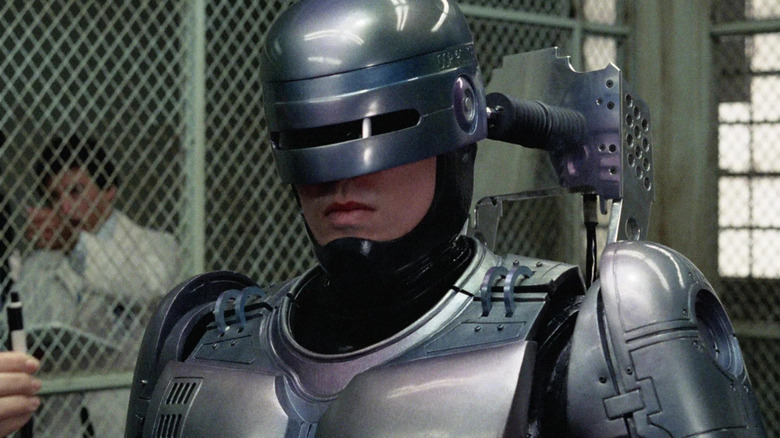
In 2014, Dr. Peter Weller obtained a PhD in Italian Renaissance art history from UCLA. His thesis, titled "Alberti Before Florence: Early Sources Informing Leon Battista Alberti's De Pictura," is available online and covers some of the earliest recorded instances of humanism in the Italian arts, dating to the mid-15th century. It runs about 300 pages and is, naturally, stringently researched, as all theses must be. This would be an impressive enough achievement in one's life if Weller didn't also have decades of acting experience behind him, including playing the title robotic superhero in director Paul Verhoeven's 1987 film "RoboCop." Weller is not shy about using his acting fame to draw people into his lectures about the Italian Renaissance; he literally called a 2025 speaking appearance "From Renaissance to RoboCop." You can buy his book online.
Weller began acting in the 1970s, appearing on stage in several notable Broadway productions. His first TV movie was 1973's "The Man Without a Country," and his first feature film was 1979's "Butch and Sundance: The Early Days." He received an Oscar nomination in 1993 for directing the short film "Partners" and has directed dozens of TV show episodes over the decades. 1987's "RoboCop" might be his most famous movie, but it's merely one star in the galaxy of Weller's career.
When it comes to "RoboCop," though, Weller can't watch it. Weller was on stage at a speaking event when he recalled the last time he had been asked to introduce "RoboCop" at the Egyptian Theater in Hollywood (as seen in this video posted to his Instagram account). However, during the screening, he finally realized what a horrid tragedy the film is at its core and could no longer stomach it, especially after having kids. It's just too sad for him to bear now.
Peter Weller has grown up a lot since RoboCop
Orion Pictures
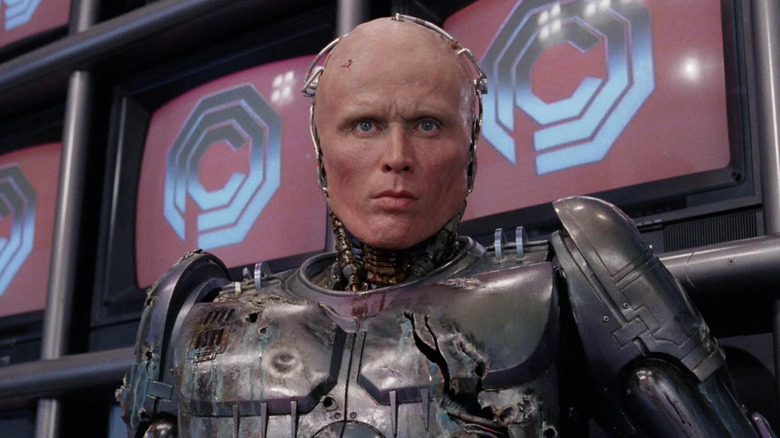
"RoboCop," to remind readers, takes place in the near future of Detroit when the local police have been privatized. When a human cop named Murphy (Peter Weller) is viciously gunned down in the line of duty, the mega-corporation Omni Consumer Products takes his broken body, wires what's left into a robotic exoskeleton, and introduces the resulting cyborg as RoboCop, the future of law enforcement. "RoboCop" plays like a superhero movie but is just as much a sci-fi satire of corporate greed. Murphy is basically dead, yet his brain and body are forced to become a violent corporate mascot.
The film has been the subject of numerous repertory screenings over the years, so Weller has likely seen "RoboCop" many times. On top of being blockbuster entertainment, the movie is deeply beloved by critics for its daring and cartoonish take-down of Reagan-era thinking. During the aforementioned event, Weller recalled attending one such screening after the passing of his "RoboCop" co-star Miguel Ferrer. Specifically, he remembered sitting next to the film's co-writer, Ed Neumeier, and reflecting on how much he had grown personally since 1987. As he put it:
"We do the Q&A at the end, and I sit there and watch the movie. It's the last time I've seen it, the last I will watch it, was with Ed. And I turn to Ed, and at the end of it [...] now I got a kid. Now I'm married. When I did 'RoboCop,' I did not have a kid. I was not married. I did not live in a house. I did not have somebody who was in love with superheroes. Now, I got a kid at this time watching this movie who's in love with superheroes."
That triggered something in Weller.
Peter Weller can't watch RoboCop because it's too sad
Orion Pictures
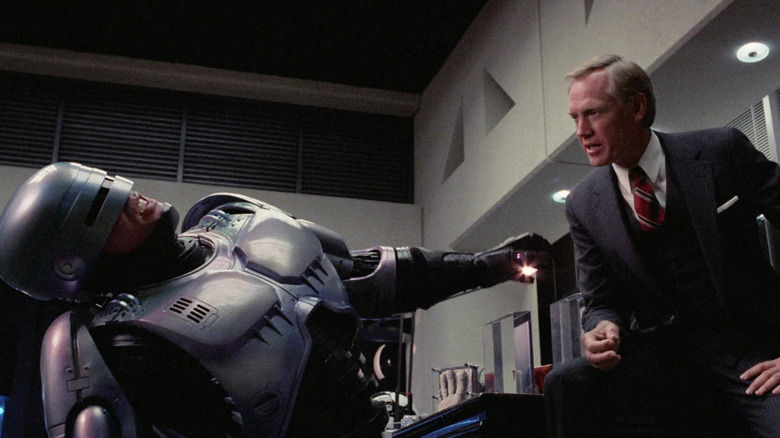
Continuing, Peter Weller confessed he can no longer get in on the action. He feels that his character, once a cop named Murphy, is robbed of his humanity and it's never fully reclaimed. "RoboCop" ends with RoboCop introducing himself as Murphy, but that could very well have been the cyborg realizing that it was once a human; he didn't become Murphy again. Per Weller:
"I watch this movie, I end up weeping at the end of it, taking me out of it. And I turn to Ed, and I said, 'This is a tragedy. This film is a tragedy.' No matter what, it brings back to humanity. 'What's your name, son?' 'Murphy.' No matter what it is about the rebirth, the resurrection — as Aristotle said, of the third act of all brilliant scripts or plays, they're all about resurrection — I sat there and wept. I turned to Ed, I said, 'I ain't watching this movie no more.' And I am not."
Ed Neumeier, keeping the mood light, suggested that Weller could just rewatch the funny parts. Weller laughed at that.
But Weller does have a point. The underlying story of "RoboCop" is a horrific tragedy. And the tragedy, it seems, wasn't transformative. Murphy's so-called resurrection impressed Weller from a writerly perspective, but he didn't seem to think that it was a positive catharsis. He just saw a dead man losing his life. He thought of his family, his home, his own life, and he cried. That is just as legit a response to "RoboCop" as any. One can understand why he would never want to put himself through that again. Paul Verhoeven nearly didn't make "RoboCop." We're all grateful he did.








 English (US) ·