
 Image via Focus Features


Published May 15, 2026, 6:00 PM EDT
Sign in to your Collider account
[Editor's Note: The following contains spoilers for Obsession.]
Summary
- Collider's Perri Nemiroff chats with Curry Barker for Obsession.
- Barker discusses the inspiration for the movie and the most challenging scenes to shoot.
- He also explains the One Wish Willow and Nikki's terrifying obsession.
It’s easy to mistake writer-director Curry Barker’s debut feature film, Obsession, for a possession horror. Once you’ve seen the movie, with Inde Navarrette’s standout performance as the lovesick Nikki, creeping in dark corners and succumbing to fits of maniacal laughter, subgenre lines begin to blur. But Barker is adamant this is not a possession movie. In fact, the filmmaker tells Collider’s Perri Nemiroff, “We were very specific…I didn't ever want her to play possessed.” His vision for the script has been in the works for years, and in this interview, he explains the inspiration that ultimately sparked what we see today, how he crafted the mysterious One Wish Willow, and how he keeps the horror firmly rooted in toxic relationships.
In the movie, Michael Johnston plays Bear, who’s introduced to the audience while sitting at a diner, practicing spilling his guts to a waitress and his best friend, Ian (Cooper Tomlinson) — a scene Barker reveals was added with reshoots. Bear is pining after his co-worker and friend, Nikki, and it’s finally time to make his move. But Bear loses his nerve and instead makes a throwaway wish on a One Wish Willow (“I looked at wishbones, stuff like that, but nothing really worked, so I just made something up”), and the results are instant. Now, Nikki’s obsession with Bear consumes her, like an entity controlling her from within, and her feelings for him are something darker than love, something toxic and deadly.
In the full conversation, which you can check out in the video above or the transcript below, Barker goes into detail about the creation of the One Wish Willow, discusses his approach to the lore, and how he and the cast, Navarrette, Johnston, Tomlinson, and Megan Lawless, studied films like Ti West’s Pearl and Ari Aster’s Midsommar to tap into Nikki’s desperation. Don’t miss all this and Barker’s potential ideas for a whole Obsession series, cut scenes, and what he learned on set that he’ll put to use on future films like A24’s Texas Chainsaw Massacre remake.
Inside the Making of Horror's Newest Cursed Object
 Image via Focus Features
PERRI NEMIROFF: I'm going to give you my absolute favorite writing question to ask when I become really, for lack of better words, obsessed with a story concept. Can you tell me what idea number one was, the thing that started this all, but then also if you had a break-story moment, something you came up with along the way that made it feel especially whole?
CURRY BARKER: Well, it's interesting. I had this idea for a while about an obsessed person, and just the relationship and how that could go crazy, but it didn't have anything to do with the wish. It was just this idea of, like, an obsessed relationship and codependency and kind of diving into that.
But then, I was watching an episode of The Simpsons one day. I had booked Always Sunny in Philadelphia, I was in the episode, and we were all gathered around to watch it, but it was live television. So, before that episode, there was an episode of The Simpsons, and it just happened to be the episode where Bart Simpson has a monkey paw and is making wishes and is wreaking havoc, and I just was like, “Oh, wait, that actually could lend itself really well to this obsession idea that I have.”
So, I started brainstorming and writing. I also tried to find some sort of device that is the wish, right? And I did research. I looked at wishbones, stuff like that, but nothing really worked, so I just made something up.
Did you come anywhere close to choosing one of those pre-existing things, or did you very quickly recognize, “I have to create something original for this movie?”
BARKER: Well, I thought about the monkey paw for a second. That was the thing. But then I was like, “No, I just want to do something that he could purchase,” something that could be kind of classic, and we could reproduce it. I was already thinking about how to market it and make it a thing.
I'm so happy I own one now. I don’t know if I'm going to use it, but at the very least, I have it.
So, ultimately, you land on going down the path of creating your own original idea versus using something pre-existing. What is the very first concept you came up with in terms of what it was and what it looked like, and how does that compare to the One Wish Willow we see in the finished film?
BARKER: I came up with the name One Wish Willow pretty quickly, so that kind of stuck, but I will say there were so many different boxes. I'd love to share at some point with the public, the concepts of the boxes that me and my mom put together, like square boxes, big boxes, small boxes, boxes that we figured out looked too much like a toothpaste box. Like, just going down this rabbit hole of all these different boxes. We worked really hard on that box. [Laughs]
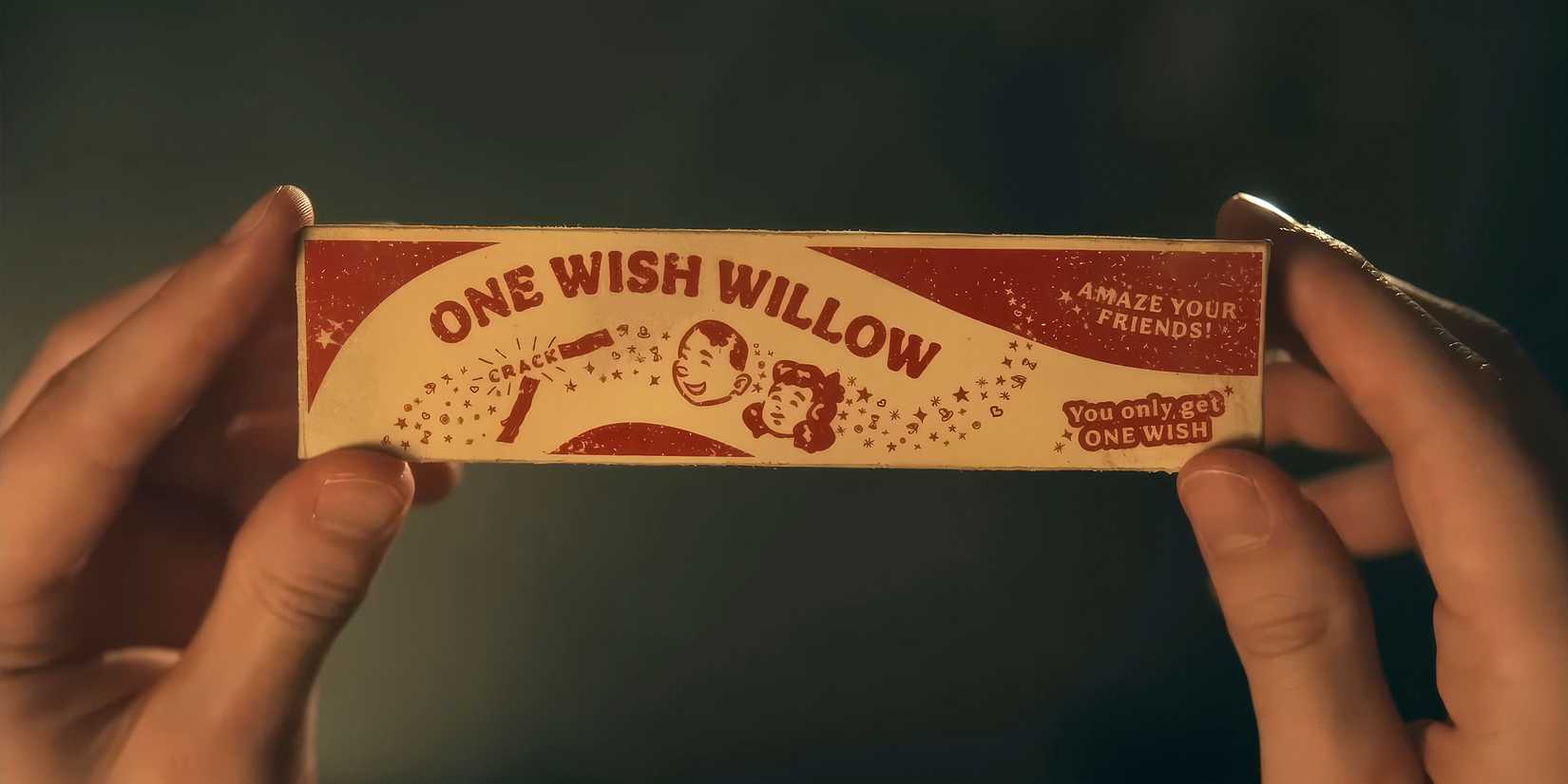 Image via Focus Features
Is your mom in the arts? How did that wind up happening?
BARKER: She's a graphic art designer, but I'm really into that, too, so I love making logos or things for anything I'm making. I've always loved that. On my phone, I'll make fake logos and stuff, and then I'll send it to her, and she'll make it a vector file, and she'll make it better. So, it's something we kind of do together.
What a cool thing to share.
So we have the basics of the design, both in terms of the box and also what the actual stick looks like, but I'm also curious about not just creating something that looks cinematically cool on screen, but also creating something that feels like it has history to it. Can you talk a little bit about that part?
BARKER: I think the key to that is just making something that feels lived-in but not going too deep into it, because I think people might get quickly bored if you go too far into where it came from or how it started. I think people are like, “Okay, whatever.” Almost keeping it mysterious is sometimes the best way to go.
You do that very, very well in this movie. My lore-obsessed brain does make me want to ask you though, do you have a full One Wish Willow bible?
BARKER: Nope. And that's the thing, right? Same thing with The Chair, all my horror films, and stuff. I know that there's some crazy lore behind it, but it's almost not my job to figure it out. It's up to interpretation.
'Pearl' Inspired 'Obsession's Twisted Relationship
"I didn't want it to just be this angry, possessed, dark-eyed thing."
Going from designing the One Wish Willow to how it actually impacts Inde [Navarette]’s performance, can you tell me a little bit about some notes that you gave her so she knows that when that snap happens, it needs to affect her character in that particular way?
BARKER: We were very specific. It was all about not leaning into the “possessed.” Like, I didn't ever want her to play possessed. I wanted her to play like a jealous girlfriend. Even the movements that are creepy, we wanted to do something different. We didn't want to do an anger. We never wanted to play angry. We always wanted to play whiny or desperate. I think when you play anger, it feels different and more threatening, but it wasn't about being threatening; it was about being manipulative, so it's more about the whiny.
We used Pearl as a reference. We watched that together. But even like the dry heave crying from Midsommar. Stuff like that. Just the rawness of the performance. We’d do different takes, and I would often make myself look really silly in front of the whole crew and just be like, “No, say it more like this.”
That's such an effective choice. I feel like I've been trying to precisely put my finger on why your film feels so different from others that tap into similar concepts, and I feel like when it comes to possession movies, that's something that really sets yours apart. I love that.
BARKER: I didn't want it to just be this angry, possessed, dark-eyed thing. I wanted it to be more like, “No, this is just a toxic, toxic relationship, and she's just so obsessed with him.” And I didn't want to add anything that felt like it wouldn't… Because it's so easy to go down this rabbit hole of just becoming a slasher movie, but it's like, no, no, no, what would a person do if in the circumstance, all they want is you? All they want is to be with you. So then it becomes manipulation, it becomes tactics of like, “How can I get you to stay longer? Can I use my self-harm to make you feel guilty?” Things like that, instead of, like, “I'm going to kill everybody.”
 Related
Mia Goth Explains How 'Nymphomaniac' Put Her on the Path to 'Pearl'
Goth also discusses Pearl's epic monologue and that unforgettable end credits shot.
Do you think anyone can beat the One Wish Willow? Is there actually any wording in your mind that could get someone what they want without any of these extra ramifications?
BARKER: I think yeah! That's the thing that's really funny is that everyone kind of treats the One Wish Willow like it's this cursed thing, and I understand why, because of the context of the movie, but the thing is, the thing that Bear wishes for is cursed. Like, taking away someone's autonomy, taking away someone's self, that's cursed. It's just that the wish itself is a very cursed thing.
So, I do think if you you chose your words wisely, the One Wish Willow doesn't have to be… I mean, you see the crystal shop guy. He's like, “I already used my wish, man.” He must have gotten away with it.
There's some sort of world where you turn this into a cinematic universe, and each film falls in a completely different genre.
BARKER: I've actually had a lot of thought about that. I actually thought about what would be really cool is a TV show. Each episode is a different wish. Maybe like a 10-episode...
I like using my interviews as manifestation spaces. I would like that. Bring that on!
Curry Barker Reveals 'Obsession's Biggest Changes From Script to Screen
"It took me a long time to give that up."
 Image via Focus Features
Going into filming this movie, which particular scene did you think was going to be the toughest to pull off, and ultimately was it, or did a different one catch you by surprise?
BARKER: I thought that the party scene was going to be really tough, and it was, mostly because I've only done short films and films with friends and stuff, and so it was overwhelming to think about an entire party. I wanted the head bash to be crazy. I wanted the reactions to be raw, and you have to think about, “Okay, what kind of coverage is it to get here?” And it is overwhelming until you realize that the only coverage you need is the perspectives that matter.
There are only a few characters whose perspectives we care about. We care about Ian's perspective, we care about Sarah's perspective, and then once you start thinking about that, all the pressure kind of goes away. It's like, as long as we're getting the things that are important, everything else is just background, make the background go crazy, whatever. But it felt really overwhelming, and it was an overnight shoot, so everyone was tired. Everybody was just so tired.
You can never tell. That scene is so incredibly effective.
BARKER: Oh, thank you!
 Image via Focus Features
So that one is on set, but you're also the editor of this movie, so I also want to know what particular scene changed the most from first cut to finished film in the edit?
BARKER: Well, actually, we reshot some of this movie, so that's a big, big change. The opening shot of this movie was on Bear, and then we tilt the camera down, and we see the dead cat, and then we keep tilting, and we see that he's watching a romance movie on the TV. So that was the opening shot, which obviously mirrors the very, very last shot of the movie. It took me a long time to give that up. I was like, “No! It's a bookend.” It's the first shot of the movie, the last shot of the movie. But ultimately, we discovered that having him giving that monologue at the beginning, at the diner, and getting a little note about his character was better.
It’s such an effective opening. It brings you into this situation so quickly.
You brought up reshoots before, and I love me an opportunity to talk about reshoots and to demystify them because it feels like they've taken on a negative connotation, which is ridiculous because they are literally there to make a movie stronger. So, can you tell me some lessons you learned during principal photography, and how those lessons shaped your goals for reshoots?
BARKER: Yeah, I think reshoots are just getting a second chance to fix some of the things that maybe irk you when you're sitting there. A note that we were getting was that Bear's character was very frustrating because it felt like he wasn't doing enough to fix it, and I was like, “Okay, hold on a second. Why don't we do a better job of showing why he doesn't want to fix it right away?”
So that scene where he comes out of the bathroom after seeing that his hair was cut, and he confronts her, and he sits her down, and he's like, “Nikki, we need to talk about last night,” and she's all like, “Okay!” and he's like, “Don't do that anymore. Don't act like that anymore,” that was a reshoot to just emphasize that it's not that he wants to fix this, it's that he wants to make it work. It's not that he wants to make the wish go away; it's that he wants to keep the wish. And that's the thing that I thought, like, “No, let's not make Bear more trying to make the wish go away, let's lean even more into, like, he wants to make it work.” So, the reshoots really helped with that.
 Image via Focus Features
I want to veer into the tail end of this journey now, because you're getting this wonderful opportunity to team up with Focus Features and release your movie in theaters nationwide, which is really something else. I was wondering if you could tell me a little bit about that experience at TIFF, and what it was about them and how they wanted to release your movie that felt right to you.
BARKER: Oh my gosh, it's just unreal. We got the news that it got into TIFF, and that was already such a cool thing. Your hopes and dreams only go so far. You want there to be a theatrical release. I have a manager who's very pessimistic in a good way, but he's always trying to manage my expectations, which I think is very good. So, I'm already kind of like, “Okay, the best thing that could happen probably is we get bought for $1 million or so, maybe. That would be amazing if that happened.”
I mean, it's just unreal. It's just unreal. It was really a life-changing night. They say your life changes overnight — I can point to that night, because I woke up the next day, and there were phone calls from my agents and stuff, and I'm like, “What's going on?” They’re like, “People are putting in bids!” And Focus just felt really, really right. They pitched me their campaign for the movie, and it felt really right, and we all seemed to be on the same page about not giving too much away.
I'll end with a question to look to the future, because, again, I think the world of your movie. I love the fact that it will and probably already has opened a lot of doors for you. What is a particular new tool that you've added to your directing toolkit, so to speak, because of Obsession that you are most eager to apply to the next film you're making?
BARKER: I learned a lot about pacing in this movie. The way that I like to shoot is not very coveragey. I like to maximize storytelling in the frame, so I like to figure out, “How can we get it all in one shot? How can we show this and this and this without having to cut, without just cutting to inserts?” Or “Whose perspective are we showing?” So that was something I kept in an Obsession that I will be keeping.
But what I learned is that when you don't cut, the pace in which your actors play is very important, because there's nothing to cut to. You can't speed up the scene in post. It's stuck that way. So, really, really focusing on rehearsals and pacing, that way you could avoid being like, “Oh, I wish this scene was a little bit faster.”
Obsession is in theaters now.
Release Date May 15, 2026
Runtime 108 minutes
Director Curry Barker

 English (US) ·