
 Image via SBS TV

Published Feb 7, 2026, 9:08 AM EST
Mauricio is a Mexican guy who gets attached to cancelled TV shows, likes to read Marvel comics about underdog teams, and has been told one-too-many times he looks like Penn Badgley, specifically in his stalker-y roles. He discovered his passion for pop culture with Power Rangers and the Star Wars Special Edition re-releases. Professionally, he's got a degree in International Finance and has been in the real estate business for almost 10 years now (yikes!). Magically, he's 83% Ravenclaw and 17% Slytherin. Musically, he thinks Jack Antonoff is a multiversal being with the key to create bop after bop.
He specializes in over-analyzing his favorite shows like Glee, Lost, Community, Ugly Betty, and Grey's Anatomy; as well as his favorite actors' performances, like Olivia Colman, Olivia Colman, and Olivia Colman. Just kidding, other faves include Anna Kendrick, Rachel Bloom, Lee Pace, Maggie Smith, Elizabeth Olsen, and Olivia Colman.
You can’t think of sci-fi and not think of Christopher Nolan. The director has revolutionized the genre by mastering the plausibility of fantastical elements in many of his works. Becoming one of the top proponents of science fiction in modern pop culture, Nolan has set (and raised) the bar upon which many other movies and TV shows are evaluated. Thus, if you’re craving more entertainment with that Nolan feeling, a recent K-drama could fill that need.
Kim Eun-sook’s The King: Eternal Monarch masterfully blends an intricate mythology without losing sight of its main characters. The series builds worlds comparable to Nolan's masterpieces, particularly Interstellar and Tenet. Both have become an essential addition to the entertainment roster of time-travel stories. Whereas The King: Eternal Monarch was released five years ago, it still attracts millions of viewing hours each year, positioning it as a worthy addition to time-travel and dimension-jumping lore.
History is Rewritten as Two Parallel Worlds Collide in ‘The King: Eternal Monarch’
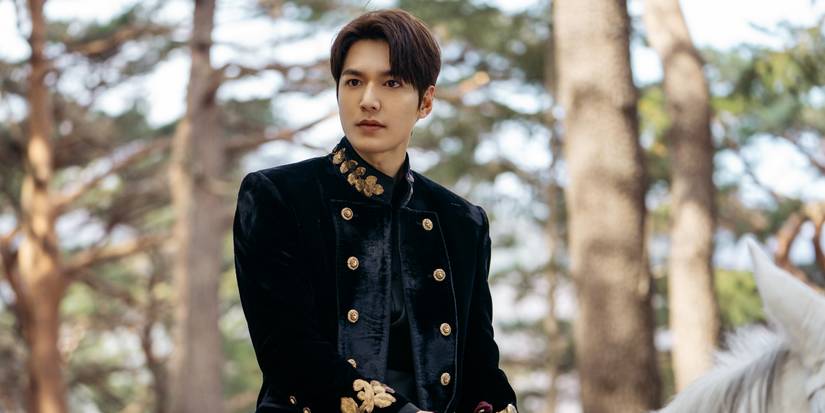 Image via Netflix
From the start, The King: Eternal Monarch establishes its complex setting between two Koreas – one under monarchical rule and one under democratic rule. Only those who possess the Manpasikjeok, a magical flute, are able to go back and forth between dimensions – and across time. It may appear straightforward, but The King: Eternal Monarch takes its time to establish these complex rules by which its characters are bound. In the middle of this turmoil is Lee Min-ho’s Lee Gon, the king of monarchical Korea.
By having Lee Gon travel between the two versions of Korea, Eun-sook weaves a story of duality. For every character, the simplest choice becomes of the utmost importance, as it has the power to alter the course of their lives. This way, Lee Gon meets drastically different versions of his loved ones, while also finding a woman who only lived in a distant memory – Kim Go-eun’s Jeong Tae-eul. Convinced that she saved him from an assassination attempt during his childhood, The King: Eternal Monarch explores their predestined relationship as star-crossed lovers.
In 16 Episodes, ‘The King: Eternal Monarch’ Builds and Explores One Intricate Timeline
Contrary to the feature-film format in which Nolan tells his stories, The King: Eternal Monarch is told across 16 episodes that allow for exhaustive world-building. The flutes, the portals, and the time-altering schemes are all juxtaposed to show how Lee Gon’s time loop develops exactly as it was always meant to happen – not unlike the way Matthew McConaughey’s Cooper realizes he was fated to be his daughter’s “ghost” in Interstellar.
In The King: Eternal Monarch, time loops are embedded in the timeline itself, without any real chance of breaking them. Whether it’s Lee Gon trying to save his father, or Lee Lim (Lee Jung-jin), his uncle, trying to secure a position of power, there is a circular path that doesn’t allow them to change the outcome. Whatever they think they are doing to alter its course is what was predestined to happen – a perfect and tightly sealed loop to witness in this 16-part saga.

Related
As Nolan-Esque As It May Feel, ‘The King: Eternal Monarch’ Has the True Essence of a K-Drama
 Image via Hwa&Dam Pictures/Studio Dragon
The King: Eternal Monarch achieves a unique mix: it's Nolan-esque, but never losing sight of its K-drama qualities. The show spotlights a central predestined couple that has to go through a series of tests to realize they’re meant for each other. And though their romance might feel distant or cold at times, the show sustains it by reminding us one is a king and the other a police officer – from different dimensions nonetheless. This way, while the scope is wide enough to hold the fate of two universes in it, it still feels personal.
Like other K-dramas, The King: Eternal Monarch is also heavy on melodrama. Lee Gon’s childhood was scarred by Lee Lim. He’s been carrying this trauma ever since, and it becomes his fuel to try to correct his destiny, thus closing the loop. And it does loop back, by recalling one of Nolan’s non-sci-fi entries. The show shares its most important message with Oppenheimer. The existence or discovery of unlimited power doesn’t mean it should be wielded by anyone. In the case of Oppenheimer and The King: Eternal Monarch, the possession of such power is sacrificed in favor of the greater good. The real world of today should take notes and start putting this into practice.

Release Date 2020 - 2020-00-00
Network SBS
Directors Baek Sang-Hoon, Yu Je-won
Writers Kim Eun-sook
-

Lee Hwang-eui
Prime Minster's Adviser
-
-
Kim Go-eun
Jung Tae-eul / Luna
-
Kim Jung-young
Kim Sung-ae







 English (US) ·