
 1 month ago
30
1 month ago
30
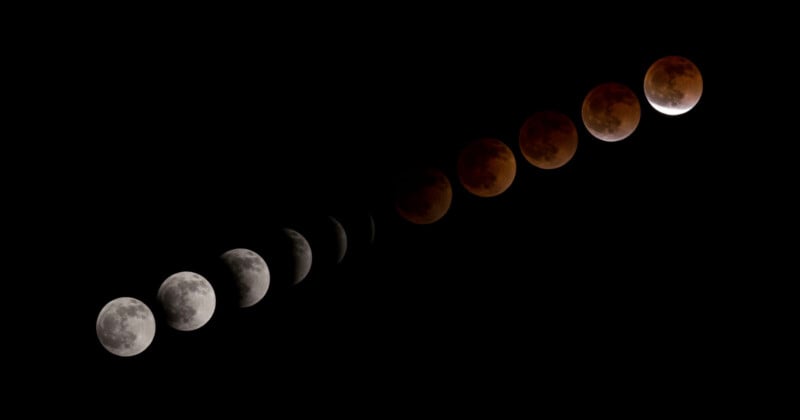
A total lunar eclipse will take place over half the planet on March 3, visible from Central China and Australia all the way across to the East Coast of the United States and the western edge of South America, providing an excellent photographic subject and viewing experience.
A lunar eclipse occurs when the Earth passes directly between the Sun and the Moon, casting a shadow across the face of the Moon. Unlike during a solar eclipse, there is no specialized equipment necessary to view it directly, and those who will be in the path of totality will only need a dark environment to see it clearly. That said, there is a benefit to using binoculars, telescopes, or telephoto lenses on cameras.
This eclipse will be what is colloquially referred to as a Blood Moon, when the color of the Moon takes on a reddish, rust-colored hue.
“On March 3, totality will be visible in the evening from eastern Asia and Australia, throughout the night in the Pacific, and in the early morning in North and Central America and far western South America. The eclipse is partial in central Asia and much of South America,” NASA explains. “No eclipse is visible in Africa or Europe.”
Viewers in Asia will start to see the eclipse in the early evening, with Japan and eastern China seeing totality starting around 7 and 8 PM local time, respectively. Australia’s eastern seaboard, which includes Brisbane and Sydney, will see it slightly later at around 9 and 10 PM local time, respectively. North America has to wait until later, with totality not taking place in San Francisco until 3 AM local time. New York City will see it just before the sun rises at 6 AM.
“As Earth’s shadow dims the lunar surface, constellations may be easier to spot than they usually are during a full Moon. At the time of the eclipse, the Moon will be in the constellation Leo, under the lion’s hind paws,” NASA adds.
NASA’s graphic above is helpful, but perhaps the easiest way to see all of the details on the eclipse — including exact times of totality and the angle it will appear in the sky — is via the Eclipse App, which is a free browser-based resource. For those who are planning to photograph this lunar eclipse, the website will prove a great resource.
The Eclipse App also has details on the 2026 total solar eclipse that will take place on August 12, visible from Greenland, Iceland, and Spain.
Image credits: Header photo via NASA/JSC






 English (US) ·