
 4 hours ago
4
4 hours ago
4

Intel is developing its own version of neural compression technology, which will reduce the footprint of video game textures in VRAM and/or storage, similar to Nvidia's NTC. Intel's solution can achieve a 9x compression ratio in its quality mode and an 18x compression ratio in its more aggressive setting. The GPU maker also announced it will have two versions of the tech for different hardware, similar to XeSS. One will be tuned for its XMX engine while the other will be designed to run on traditional CPU and GPU cores at the expense of performance.
Intel is using BC1 texture compression and linear algebra for the XMX-accelerated portion of its neural texture compression technology. BC1 takes advantage of a "feature pyramid" that compresses four BC1 textures with MIP-chains. Compared to traditional compression, Intel's neural compression uses weights to compress textures with minimal loss to image quality. An encoder is responsible for encoding the textures, and a decoder is responsible for the decompression stage.
Texture Set Neural Compression | Intel Software - YouTube
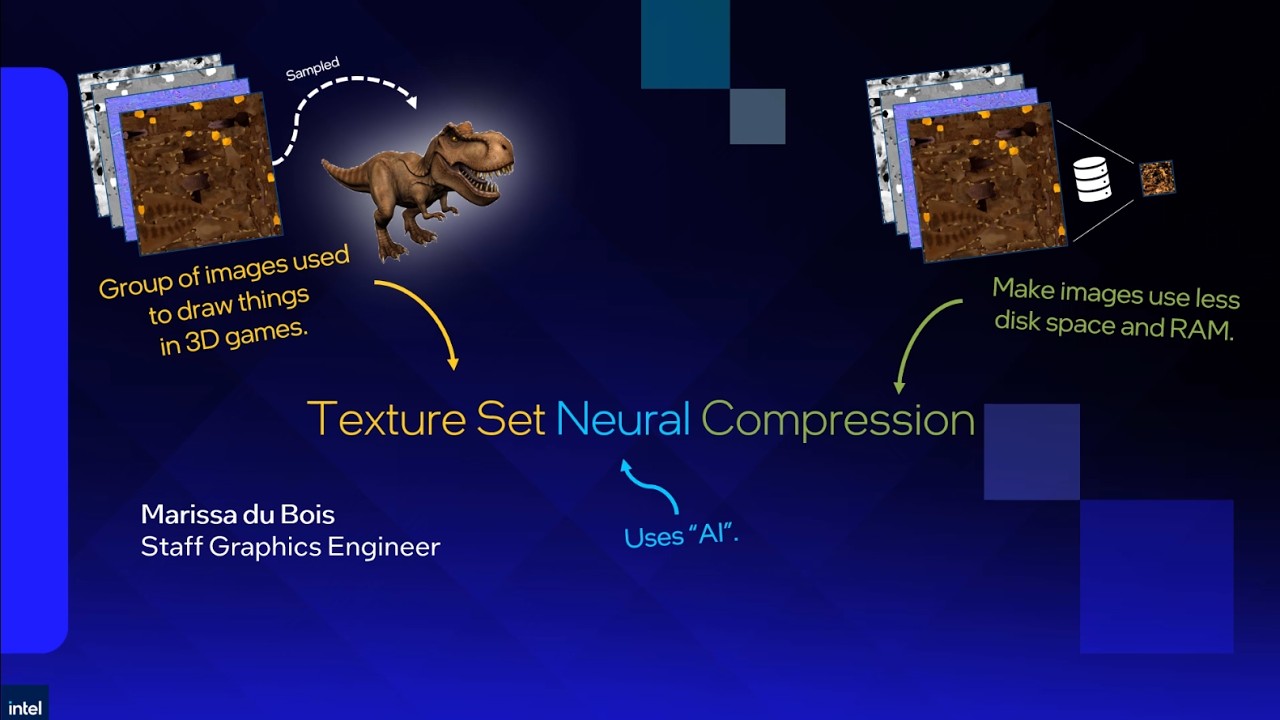
By contrast, the fallback mode is using an FMA or fused multiply and add implementation that runs slower than its linear algebra counterpart.
Article continues below
Intel noted four ways developers can deploy its texture compression, aimed at accelerating install times, saving disk space, or saving VRAM. The first is aimed at saving space on a server and reducing file size downloads by compressing textures beforehand, uploading those files to a server, then having the client download those textures and decompressing the textures on local storage.
The next three revolve around gameplay itself; one of these is streaming in textures as the game loads, the next involves streaming textures during gameplay, and the last one is loading textures on the fly without holding textures in VRAM (the latter is likely aimed at low VRAM GPUs).
Intel's compression tech has two modes of operation: a variant A mode that runs at higher quality and a variant B mode that sacrifices quality for higher compression. Intel claims variant A can take two of the first 4096 x 4096 64MB textures in a feature pyramid and compress them down to 10.7 MB each while retaining the 4K texture size. The remaining bottom two 4K by 4K pyramid feature textures are reduced to half their resolution and are compressed down to 2.7 MB.
With variant B, the textures are compressed more aggressively. The first texture in a feature pyramid is compressed down to 10.7 MB while retaining its resolution, the second texture is reduced down to half its normal resolution and compressed down to 2.7 MB, and the third texture's resolution is reduced to quarter resolution and compressed to 0.68 MB. The last texture's resolution is reduced to one-eighth of the texture's resolution and compressed down to 0.17 MB.
In Intel's own testing, it compared its variant A and variant B texture compression using BC1, against an industry standard compression format using a 3xBC1 plus 1xBC3 format. Variant A achieved over a 9x compression ratio, and variant B an 18x compression ratio over the aforementioned industry standard format, which was only capable of a 4.8x compression ratio.
Intel's new texture compression tech is achieving almost the same compression ratios as Nvidia's own neural texture compression using variant B. It still remains to be seen whether Nvidia or Intel's solution provides better quality, but Intel is the only one of the three major Western GPU manufacturers to have a solution that works on graphics cards besides its own (for now).

Follow Tom's Hardware on Google News, or add us as a preferred source, to get our latest news, analysis, & reviews in your feeds.





![New 100% RT Cyber Thriller Unleashes 10-Minute Sneak Peek [Exclusive]](https://static0.colliderimages.com/wordpress/wp-content/uploads/2026/01/wardriver-sasha-calle-dane-dehaan.jpg?w=1600&h=900&fit=crop)


 English (US) ·