
 2 hours ago
280
2 hours ago
280
Unusually for a political period drama that is not in the English language, runs nearly three hours and peppers its authentic portrayal of a military dictatorship with sight gags and gory shootouts, The Secret Agent has transpired to be quite the awards magnet. Best picture and best actor, for its star Wagner Moura (who recently won a Golden Globe), are two of the four categories in which it will compete at next month’s Oscars.
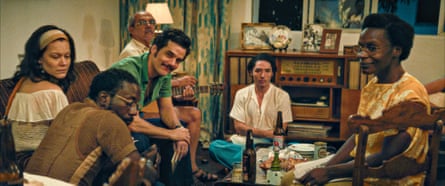
The nominations haven’t yet been announced when I meet Moura in a London hotel room, but it is unlikely they will have turned the head of this seasoned 49-year-old. He has years of experience: he headlined the Elite Squad thrillers, played Pablo Escobar in the streaming hit Narcos, and joined Parker Posey as husband-and-wife assassins in the TV version of Mr & Mrs Smith. He exudes relaxed, matinee idol charisma, as well as the same air of decency and humility as Armando, his character in The Secret Agent. A widowed academic hiding out in a refugees’ safe house in Recife at the height of the dictatorship in 1977, Armando is plotting to flee Brazil on a fake passport. To do so, he will need to outrun the hitmen hired to kill him by a vengeful industrialist.
If Moura is ice-cube-cool, that goes double for the film’s unexcitable 57-year-old director, Kleber Mendonça Filho. Seated beside his leading man today, he has the shrewd gaze and thin, amused lips of Peter Sellers. “Yes!” agrees Moura when I draw the comparison. Filho responds with a nod and a perfectly unimpressed, Sellers-like murmur: “I’ve heard that before.”
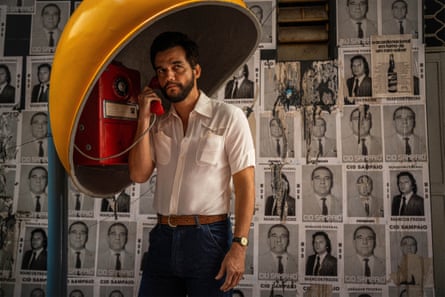
Both men have already amassed a fair few trinkets between them, beginning with best actor and director at last year’s Cannes festival. The roaring success of The Secret Agent must feel to them as much like a vindication as a victory. Though historical in one sense, it is also a response to a turbulent and harrowing decade in Brazilian politics, and the personal bruising that they have sustained: professional prohibitions, smear campaigns, even death threats.
Their friendship stretches back two decades, to the days when Filho was a film critic. He and Moura got on famously at Cannes in 2005, and kept chatting once their interview was over. “My wife took a picture of him,” Moura says.
They bonded over their shared origins in the beleaguered north-east of Brazil, a region mocked and belittled by those in the south-east. “There’s still a lot of prejudice towards us. As an actor, if you go to work in Rio or Sao Pãulo with this accent, you get relegated to playing the funny guy or the doorman. My attitude, and Kleber’s too, is: ‘Fuck this. Fuck you.’” There is a cost to speaking out, especially where politics is concerned. “The Secret Agent is a result of something that we both …” He weighs up his words. “I don’t want to say, ‘the price we paid’, but it wasn’t easy to be vocal about Bolsonaro.”
The actor and director lost touch. But years later, when Filho’s short films trickled out into the world, followed by Neighbouring Sounds, his itchy, unnerving 2012 debut feature about class tensions in a residential Recife suburb, Moura’s ears pricked up. “Neighbouring Sounds had such a sense of danger. There might just be a scene of two people talking, but you feel something terrible is about to happen, as if the roof might fall in. I was like: ‘Hey, I know that guy!’” The friendship was reignited.
In subsequent years, the waters grew choppy for both men, as well as for their country. Filho was pilloried at home after he and the cast of his second feature, Aquarius, brandished signs at its 2016 Cannes premiere to protest against the impeachment of Brazil’s then-president, Dilma Rousseff. That protest, Filho says now, “was one of the proudest moments of my life”. The director’s masterpiece, Aquarius concerns an indomitable ageing writer (Sônia Braga) standing her ground against rapacious property developers; no wonder it played at the time like a metaphor for the unspooling crisis. The movie was duly blocked from being Brazil’s official entry at the Oscars.
Around the same time, Moura wrote a newspaper article warning of an impending coup d’état and taking aim at the judge Sérgio Moro, whom the UN human rights committee later confirmed had been biased in his rulings. “I was attacked for that article,” Moura says gravely. “I received death threats. It was hardcore.”
In 2019, Moura made his own directorial debut with Marighella, a film about the Brazilian revolutionary Carlos Marighella, who the CIA considered the new Che Guevara before being killed by the military dictatorship. After premiering in Berlin 50 years after Marighella’s assassination, the film was kicked into the long grass by Bolsonaro’s government; it remained unreleased for more than two years. “It was cynically and unofficially sabotaged,” says Filho. “And Wagner will never get an explanation. That’s where Kafka comes in.” Bewilderment flickers across Moura’s face: “You can’t fight it because you don’t exactly know what’s happened.”
Out of this friendship, and a mutual experience of persecution, emerged The Secret Agent. “In the film, you’ve got an honest man who doesn’t follow the script,” the director explains. I had earlier described the campaign against Armando as “low level”, at least until the hitmen get involved, but Filho takes issue with that. “It may not yield a car chase. Or someone turning the ignition and a car blowing up. But the persecution is incredibly destructive. Some people have the pleasure of making you lose sleep by planting things in newspapers.”
He is speaking from experience. “Stories, say, about the use of public funding for a film you have done. Even though funding for the arts is in the Brazilian constitution.” Moura explains: “Kleber and I are being attacked in Brazil right now. There are stories saying we received millions of dollars from the Brazilian government to support them.”
Facts are beside the point. The intention is to suggest corruption. “If you express yourself in a time when democracy is running on fumes, the attacks can be pervasive, brutal and cruel,” says Filho. “They’re not low level at all. I could have shown Wagner’s character being taken to the police precinct and given electric shocks to his genitals all night.” Moura raises a finger: “I’ve done that film!” he laughs. Filho continues: “But the dictatorship manifested itself in many ways.”
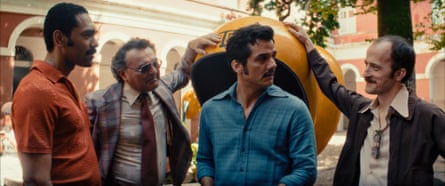
Some are comically grotesque. In the 1970s, an urban legend circulated in Recife about a disembodied leg attacking people at night. A scapegoat for the violence meted out by the military police, it started being mentioned in the press as a kind of countercultural code. If you were in the know, it would be clear when reading these stories in the morning paper that the “hairy leg” referred surreptitiously to the regime’s violence. Rendered in jerky stop-motion in The Secret Agent, the hairy leg has been a runaway – or hop-away – hit. Nine months on from Cannes, it is still being mentioned. This leg has legs.
Did he foresee that it would become a kind of shorthand or symbol for his movie, much like the bunny in Fatal Attraction or the semen hair gel in There’s Something About Mary? “It is one of the things people mention,” he concedes, then points out that attention has also been paid to the opening sequence, in which Armando steers his yellow VW Beetle into a dusty petrol station only to find a corpse, several days old, lying in the forecourt. “Many have also praised Wagner’s amazing performance,” he reminds me, exercising a special skill he has of upbraiding you without doing so explicitly; it is more that he invites you to feel disappointed in yourself. I apologise to Moura for suggesting that his work had been eclipsed by a hopping limb, but the actor laughs it off. “It’s like: ‘What the fuck?’ That leg is crazy. It’s crazy and it’s hairy. So hairy.” He’s not wrong.
In mixing political commentary and meticulous period detail with these B-movie-style touches, Filho is working in the spirit of John Sayles, the US indie pioneer who was equally adept at exploitation shockers (he wrote Piranha, Alligator and The Howling) and conscientious liberal dramas (directing Matewan, City of Hope and Lone Star). Sayles, a friend of Filho’s, is thanked at the end of The Secret Agent, but the difference is that Filho doesn’t demarcate his impulses. They’re plaited together in his films – especially the new picture and his grisly modern western, Bacurau (co-directed by Juliano Dornelles). His all-time top 10 may include masterpieces by Chantal Akerman and Werner Herzog but it also makes room for Mad Max 2, a scuzzy fly in the arthouse ointment.
Cinephilia and politics are vital to The Secret Agent, but nothing is more integral to its character than an alertness to history, a determination to memorialise struggle and injustice. Some way into the film, there is a flash-forward to modern-day researchers transcribing recordings of Armando’s voice. “That gives the story a different point of view, and amplifies its power,” Filho explains. “It’s the whole idea of making a time-travel film without a time machine. You go in the time machine and sparks come out and you’re back in, say, 1927. But we’re also travelling through time right now as people. The sounds we record, the pictures we take – this is all time travel to people who find it in the future. My mother was a historian and I think she implanted this feeling in me.”
In an era when governmental lies and misinformation have grown too routine to be shocking, The Secret Agent could not feel more relevant. “The way these autocrats are discrediting journalists, people getting information from social media,” says Moura, “it scares the shit out of me.” More crucial than ever, then, to not be muzzled. “I don’t think you can be a serious artist and go through life without exposing your views on things,” Filho says. “If you keep quiet, you will not have my respect.”
Aren’t actors discouraged from speaking out? “They are,” says Moura, more sympathetic to those who don’t than his friend. “It’s not easy. I don’t like it when actors are pressured to say shit. Not everybody is ready. I’ve been advised not to say certain things.” Would he be discouraged from speaking out today against, say, the actions of the current US president? “Yes. Right now, I’m being very discouraged.” A twinkle. “But I’ll keep saying it, right?”







 English (US) ·