
GTBox T1: 30-second review
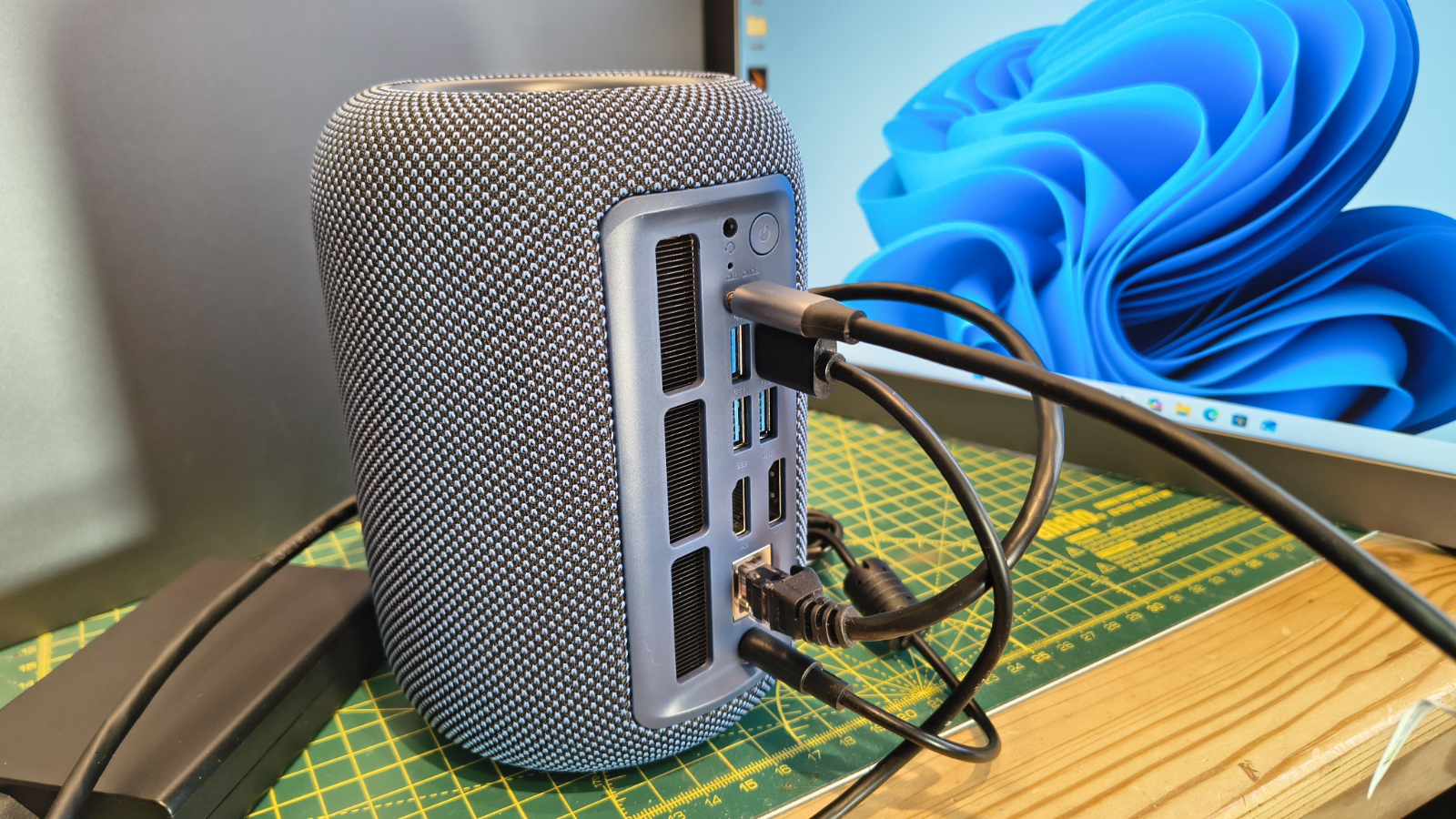
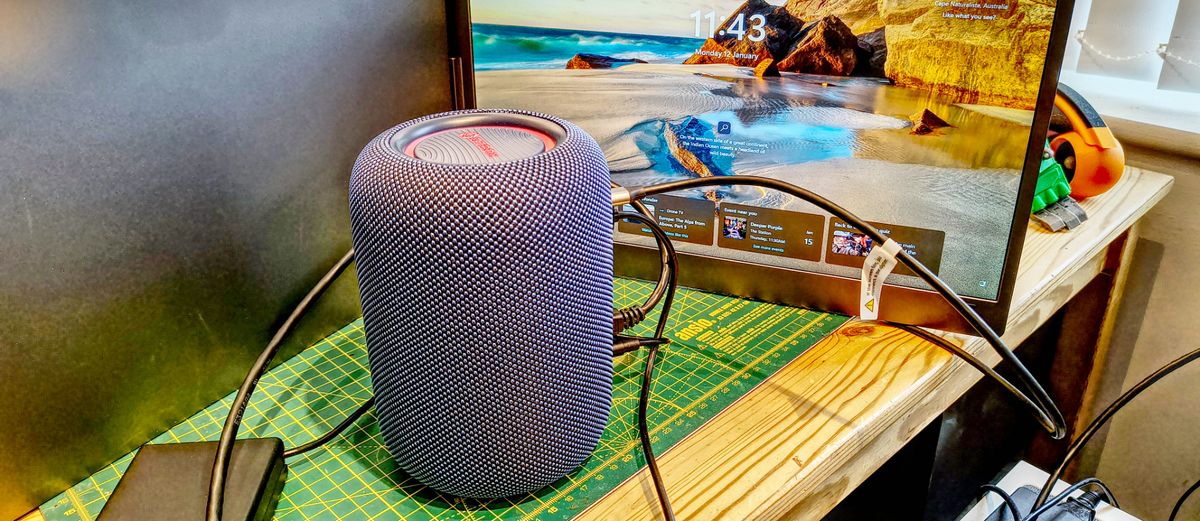
Since Intel stopped its NUC platform, and by its definition guidance, we’ve seen a significant number of mini PC designs that have stepped outside the norms of shape and size in mini systems.
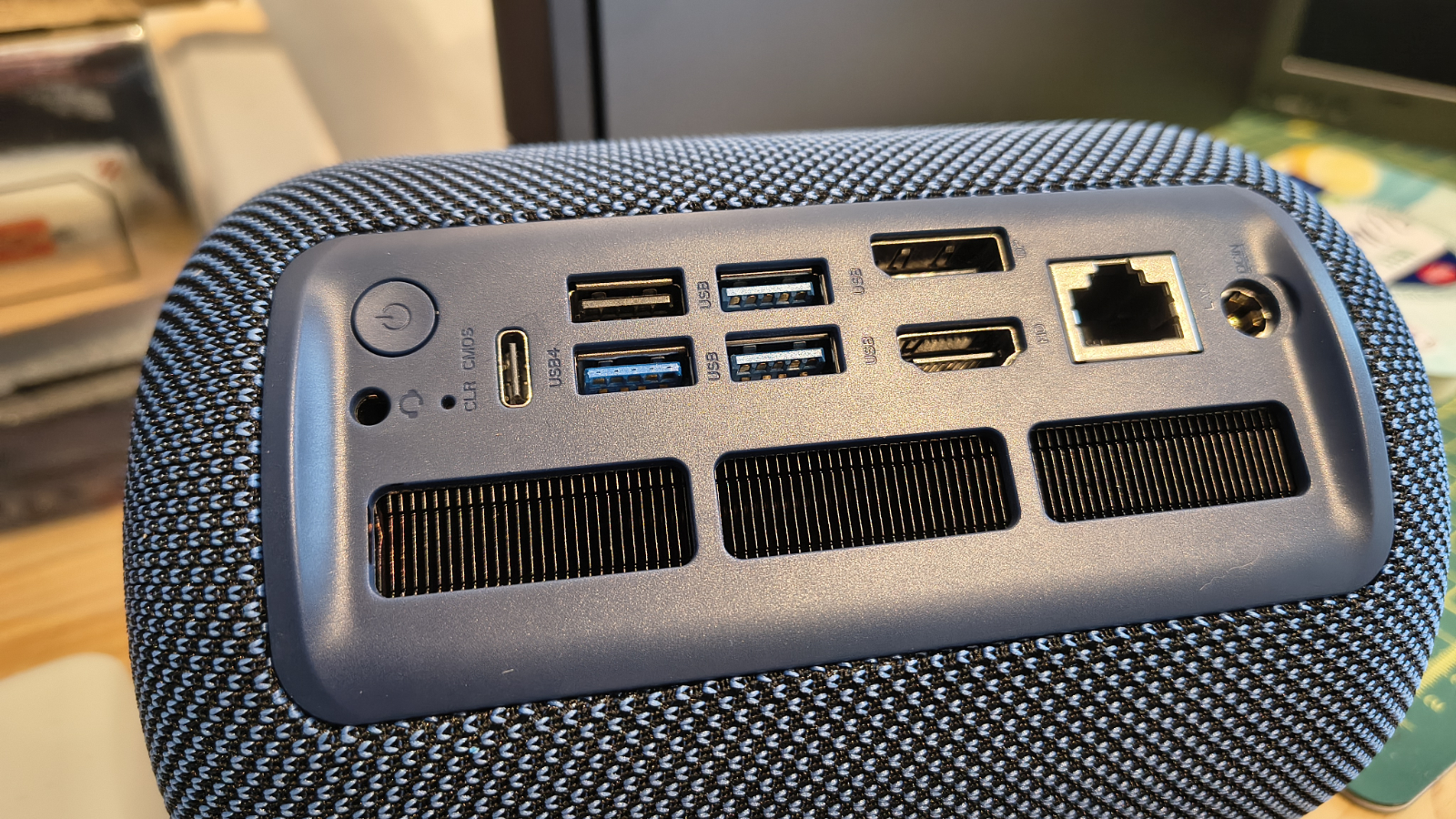
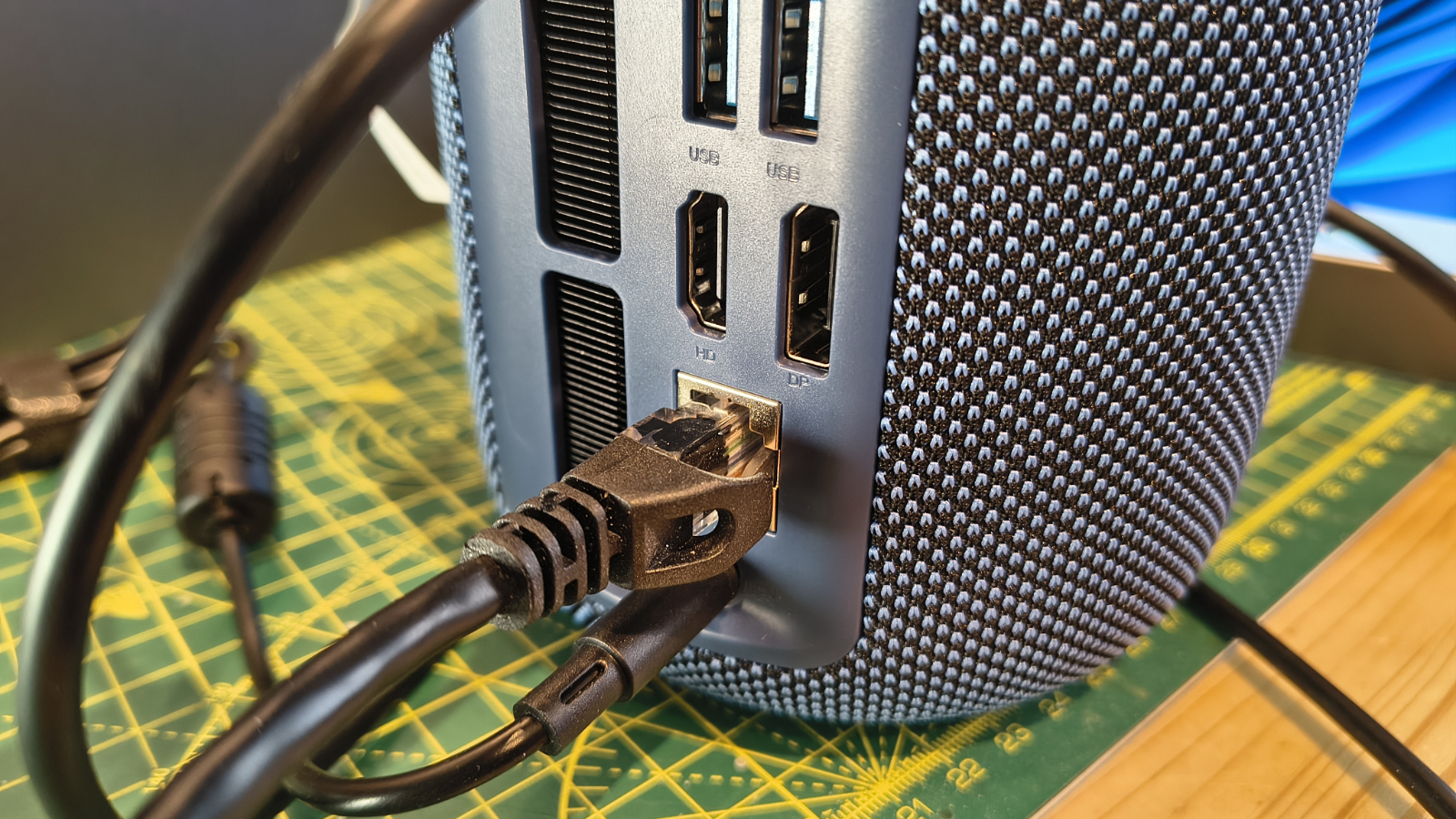
Because of that ergonomic choice, there is no front or back, only a single I/O section where all the ports and the power button are located. That’s a bit of a crunch, and due to this, there is only one USB4 and LAN port, but there are HDMI and DisplayPort video outs.
Inside the cylindrical speaker case is a punchy AMD Ryzen 7 8745HS processor, Zen 4 architecture from the 2023 Hawk Point series. In this context, it's combined with 32GB of DDR5 memory and a 1TB Gen 4 NVMe SSD.
This makes the T1 a powerful small system eclipsed only by Ryzen AI platforms, and the pre-release pricing is extremely competitive.
However, the downside to this design is that there is no access to the memory or storage, and you are specifically told that opening up the T1 to do this is ‘irreversible’.
If you are happy with those limitations, then the T1 might be a good choice, but the lack of flexibility precludes it from being one of the best mini PCs I've tested. Maybe with the T2, or whatever, GTBox can work out a way to put the mainboard on sliding rails to make memory and storage upgrades (or replacements) possible.
GTBox T1: Price and availability
- How much does it cost? From $700
- When is it out? Available now
- Where can you get it? Direct from GTBox
At the time of review, there is only a single SKU of the GTBox T1 available from the official GTBox site.
That model comes with 32GB of DDR5 and 1TB of storage. The cost is $699.99 for US customers with shipping included. GTBox doesn’t quote specific prices in other currencies, but they will ship to the UK, EU and Switzerland.
One oddity I noticed is that before you add this system to the cart, it tells you that “Free standard shipping on orders over $99” and “Free shipping and tax included in Europe and the United States.”
When you add it, it says that if you spend another $100, you can get free shipping.
I hope that’s a mistake. In both the UK and the EU, there are rules about real price discounts, where you can’t say you’ve made a reduction if you never sold it at the pre-discount price. GTBox has this machine reduced from $799.99 to $699.99, and I suspect it had that from the start.
Looking at competitor systems using the same platform, the candidates include the Bosgame M4 and the Acemagic W1.
The Boxgame M4 has had some hardware changes since I reviewed it, but you can still find the original M4, which uses the AMD Ryzen 7 8745HS and costs $559 for the 32GB+1TB SKU, via Amazon.com.
And, the Acemagic W1 is $549, but there is no stock of the memory and storage options. However, Acemagic will sell you the barebones model for only $280.
All of these systems, when in stock, are cheaper than the GTBox T1, and all of them also have the ability to be internally upgraded with extra RAM and storage.
On that basis, the T1 doesn’t look like an especially hot deal.
- Value: 3 / 5
GTBox T1: Specs
Swipe to scroll horizontally
CPU: | AMD Ryzen 7 8745HS ( 8C/16T, 3.8GHz up to 4.9GHz) |
GPU: | AMD Radeon 780M, 12 cores, up to 2.6 GHz |
NPU: | AMD Ryzen AI 16 TOPS (38 TOPS total) |
RAM: | 32GB DDR5-4800 (16GB x 2) not expandable |
Storage: | 1TB M.2 2280 PCIe Gen 4 |
Expansion: | N/A |
Ports: | 1x USB4, 3x USB 3.2 Gen 2 Type-A, 1x USB 2.0, 1x HDMI 2.0, 1x DisplayPort 1.4, 1x 3.5mm Audio |
Networking: | 1x 2,5GbE Realtek RTL8125, WiFi 6E, Bluetooth 5.2 |
OS: | Windows 11 Pro (pre-installed) |
Base Power: | 35W-54W |
PSU: | 19V 6.32A 120W |
Dimensions: | 115 x 115 x 165 mm |
GTBox T1: Design
- Speakerific
- Limited ports
- Zero internal access
There is something about the mesh covering that speakers use that is lovely to touch, with a distinctly fabric feel. As this system is a computer-in-a-speaker, with a slate blue colour scheme, it looks great perched on the edge of a desk.
That’s where this system was designed to sit, since it doesn’t have any VESA mounting options, and you wouldn’t be able to hear the sounds it generates if it were out of sight.
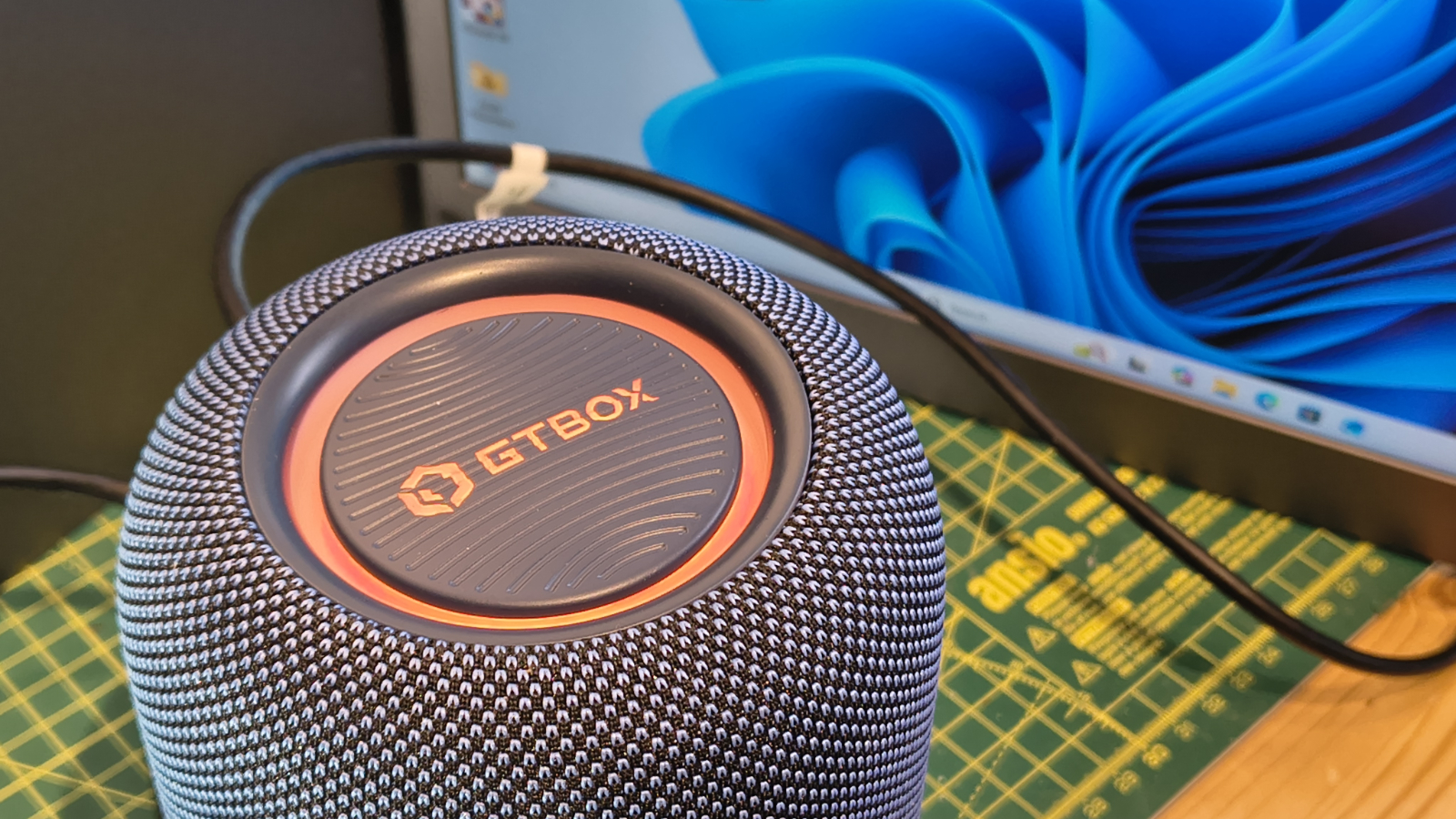
On top is a circular depression with an LED light that can be set to pulse through various RGB colours via the BIOS. That there isn’t a software component to set this is disappointing, as repeatedly going into the BIOS to make changes seems excessively complicated.
But where this system entirely leaves behind the current world of mini PCs is that it only has one place where ports are accessible, and there is no access whatsoever to the internal system.
All the ports are on a single I/O shield, and that includes five USB ports, one USB4, three USB 3.2 Gen 2 and one USB 2.0. There are both HDMI and DisplayPort, and if you use the USB4 port for video, it allows triple displays to be operated from this one computer.
There is also a 3.5mm audio jack, a single 2.5GbE LAN port, the power inlet and a power button. But there is no security slot to stop anyone from walking off with the T1.
With things so tight in this area, maybe the top might have been utilised for a second USB4 port, but that wasn’t something the designers embraced.
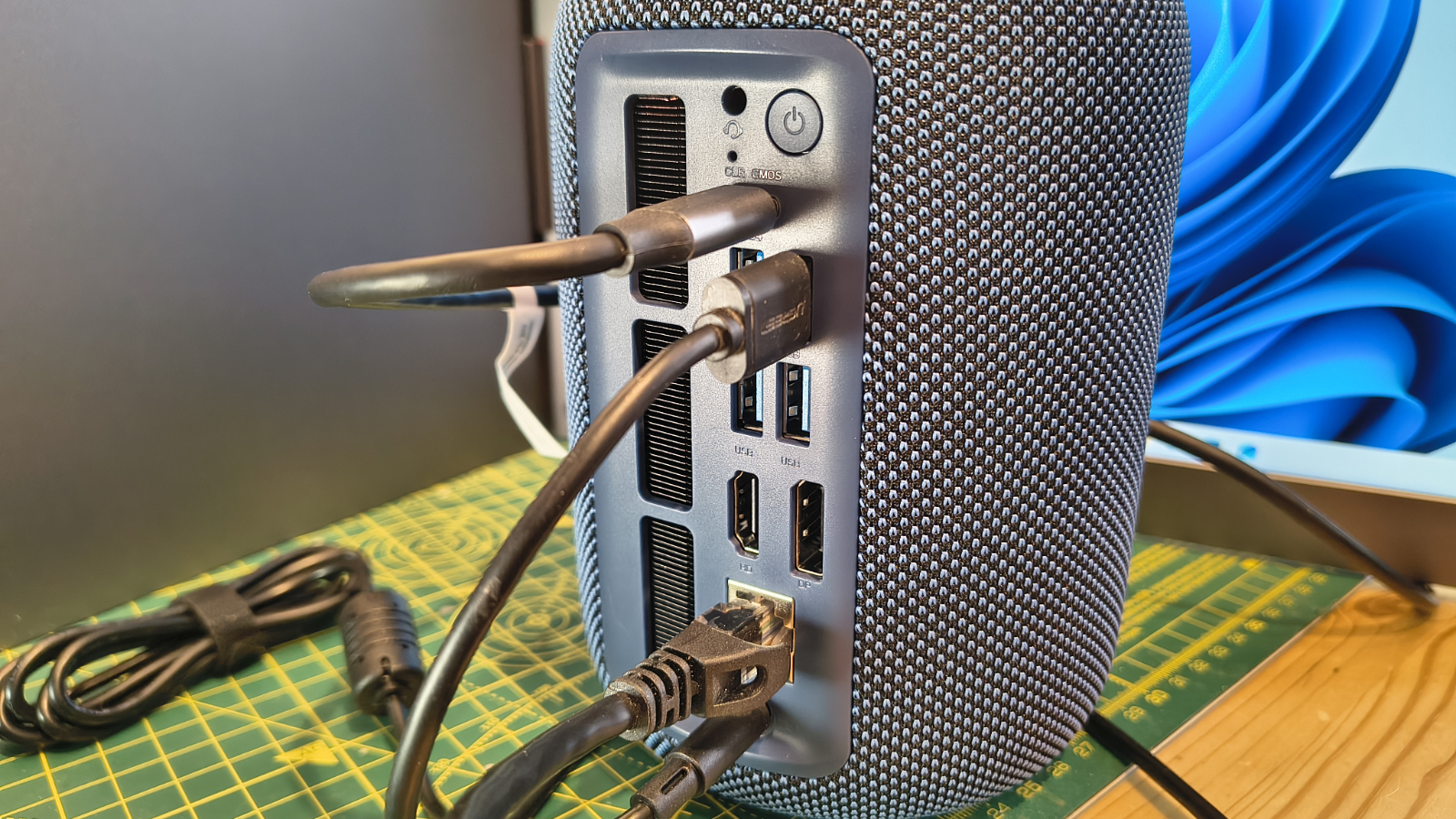
Having more ports is always better, but what really confronts the reality of this system is the lack of internal access. With no approved way in, should you want more memory (if it's even socketed) or to replace the storage, there are no options. That limitation is problematic for a business customer as it reduces the flexibility of this design considerably.
What you do get is a system with an inherently fairly loud speaker, but you can’t really use this for conferencing, since there is no corresponding microphone.
- Design: 2.5 / 5
GTBox T1: Hardware
- AMD Ryzen 7 8745HS
- One USB4 port
- Unused PCIe lanes
Many mini PC builders are turning to AMD, largely due to the affordability of its components and the generous number of PCIe lanes, which allow for an array of high-speed ports. The Ryzen 7 8745HS is a Hawk Point processor that, to my knowledge, was originally released in June of 2023.
This chip boasts eight cores with hyperthreading, enabling it to handle sixteen concurrent threads. It offers a slightly improved power profile over the Ryzen 7 8745H, resulting in modestly higher clock speeds.
While there are several advantages to this processor, but also one notable drawback. That caveat is the age of the 780M GPU, which has now been superseded by the 890M and also the new 8060S integrated GPUs. It’s not Intel UHD Graphics bad, but there are faster options that aren’t discrete video cards.
On the upside, it utilises Zen4 architecture, matching the performance of the previous generation's 7745HX. Additionally, it supports DDR4, DDR5, and the latest LPDDR5x memory standards. Its most significant advantage for mini PC applications lies in the twenty PCIe 4.0 lanes provided by AMD, which facilitate multiple ports and significant expansion capabilities.
The capacity of these lanes has enabled the implementation of USB 4 and Oculink on some systems, but here there is only one USB4 port and no Oculink. However, the M.2 SSD slot does at least get PCIe 4.0 lanes, even if you can’t get inside to use an SSD of this spec in that slot.
With only one USB4 port, no Oculink and a single M.2 Gen 4 slot, this machine has PCIe lanes that sit entirely idle and contribute nothing to the overall experience.
Therefore, this system is something of a contradiction, as it has a decent processor and DDR5 memory technology with dual modules, providing ample bandwidth and enhancing GPU performance.
But, there are also at least eight PCIe lanes doing nothing, no way to exploit the PCIe 4.0 M.2 slot, and no expansion path other than using a single USB4 external drive or the LAN.
- Features: 3.5 / 5
GTBox T1: Performance
Swipe to scroll horizontally
CPU | Row 0 - Cell 1 | AMD Ryzen 7 8745HS | AMD Ryzen 7 8745HS |
Cores/Threads | Row 1 - Cell 1 | 8C 16T | 8C 16T |
RAM | Row 2 - Cell 1 | 32GB DDR5 (2x16GB) | 32GB DDR5 (2x16GB) |
Storage | Row 3 - Cell 1 | 1TB GTP3000-1TB | 1TB NVMe Kingston OM8PGP41024N |
Graphics | Row 4 - Cell 1 | Radeon 780M | Radeon 780M |
3DMark | WildLife | 19813 | 17746 |
| Row 6 - Cell 0 | FireStrike | 7726 | 7448 |
| Row 7 - Cell 0 | TimeSpy | 3194 | 3126 |
| Row 8 - Cell 0 | Steel Nom Lt. | 2765 | 2559 |
CineBench24 | Single | 103 | 104 |
| Row 10 - Cell 0 | Multi | 903 | 909 |
| Row 11 - Cell 0 | Ratio | 8.8 | 8.71 |
GeekBench 6 | Single | 2587 | 2609 |
| Row 13 - Cell 0 | Multi | 12380 | 12840 |
| Row 14 - Cell 0 | OpenCL | 30593 | 26664 |
| Row 15 - Cell 0 | Vulkan | 25443 | 31667 |
CrystalDisk | Read MB/s | 3431 | 4087 |
| Row 17 - Cell 0 | Write MB/s | 2258 | 3142 |
PCMark 10 | Office | 7458 | 6992 |
WEI | Row 19 - Cell 1 | 8.2 | 8.2 |
As a counterpoint to the T1, I chose the excellent Bosgame M4. But if you go to the Bosgame website now and select the M4, it shows as discontinued for the M4 Neo and the M4 Plus. However, it is still possible to get the original M4 from other outlets.
The reason I went with the M4 was that it uses the same CPU, GPU, and memory as the T1, giving some indication of whether the T1 is a good version of this platform.
And, looking at the first part of this benchmark collection, all the signs are good, as it edges the M4 in the GPU tests and matches it in most of the processing metrics.
But where it all goes slightly awry is when we get to the CrystalDisk benchmark and discover that the best performance the GTP3000-1TB can achieve is below the 4,000Mb/s threshold that PCIe 3.0 M.2 NVMe drives can almost reach.
This is a guess, since I can’t identify the maker and spec of the GTP3000-1TB, but given the number, I’m inclined to believe that this is a Gen 3 drive, which, as this system has a Gen 4 slot, is a depressing conclusion. If it is a Gen 4 drive, then it's one of the slowest I’ve ever seen. What makes this even worse is that because you can’t get inside the T1, this drive can’t be replaced with something quicker or larger.
The phrase grasping defeat from the jaws of victory seems suitable for the T1, since it had all the pieces it needed to be a winner, and then blew it with an apparent cost-cutting exercise.
Overall, aside from the storage, this machine performs well and is perfect for a power user, or rather one who doesn’t need more than 32GB of RAM or 1TB of quick storage.
- Performance: 4 / 5
GTBox T1: Final verdict
There are two elephants in the GTBox T1 room, and the first of those is a design where you explicitly can’t get inside the system to do any form of upgrades. There are plenty of appliances where that sort of limitation is considered normal, but the PC isn’t one of them.
And, given the upgrade paths that other mini PCs provide, that’s a significant problem.
I’d had less of an issue with this if GTBox had at least made some sort of effort to make the M.2 slot accessible, but the owner is told not to open the T1 under any circumstances.
The other elephantine problem is the asking price, which seems about $150 more than it should be with this specification. It may be that, with this unique speaker styling, GTBox assumed a price premium was in order, but nothing about this design justifies it.
With memory and storage going up in price, the cost of the T1 might suddenly become something of a bargain, but based on other machines using the same platform, it's way too high, and there are Ryzen AI systems that aren’t much more than this cost.
But, if we put our purchasing blinkers on and ignore the lack of flexibility and the price, this is a decent mini PC with a great hardware platform (ignoring the SSD) that delivers a good user experience.
However, business IT buyers don’t tend to wear those blinkers much these days, and they’d reject this due to the cost and the lack of internal access.
Should I buy a GTBox T1?
Swipe to scroll horizontally
Value | Expensive for the spec | 3/5 |
Design | Zero internal access and limited ports | 2.5/5 |
Features | Powerful CPU and USB4, but unused PCIe lanes | 3.5/5 |
Performance | Decent performance on CPU and GPU | 4/5 |
Overalls | Interesting take, but it lacks flexibility | 3.5/5 |
Buy it if...
If you want a power-user NUC
The T1 has an excellent Zen4 system at its heart, which is perfect for those who want more power, and the DDR5 memory used in it makes the most of that CPU and GPU combination. However, the lack of any memory or storage upgrades needs to be considered for its role.
You hate upgrades
Not everyone sees buying hardware as the start of a path to enhancement. If you have no intention of ever putting more memory or storage into your systems, then the T1 might be perfect for you. Though this also means that should anything go wrong with the SSD, then this system is junk.
Don't buy it if...
If you need a flexible mini PC
The lack of internal access and the inclusion of only one USB4 port make this mini PC highly inflexible, since you can’t upgrade either memory or storage, and what you can connect externally is limited by only having one high-performance port.
You want ultimate performance
This is a value-led mini PC, so it's not going to be as powerful as machines loaded with the fastest processors - for top performance, check out mini PCs using the AMD Ryzen AI platforms like the Ryzen AI Max+ 395, with 16 cores and 32 threads.
Also consider
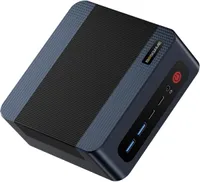
Bosgame M4
Built around the same platform as the T1, the Bosgame M4 is a more traditional NUC design.
While it doesn’t have a metal case, the M4 ticks every other box for a successful NUC design. The asking price is low, the performance is good, and it’s a highly flexible system that can perform many tasks. Little to dislike here.
Check out my Bosgame M4 review




 English (US) ·