Harrison Ford’s 88% Rotten Tomatoes Action Sci-Fi Found a Way to Use Him Perfectly
4 weeks ago
23
Image via Warner Bros. Pictures
Published May 1, 2026, 8:12 PM EDT
Jeffrey is a freelance features writer at Collider. He is an MPA-accredited entertainment journalist and a Tomatometer-approved critic based in the LA area. He graduated from the University of Texas at Austin with a Bachelor of Science in Radio, TV, & Film and a Bachelor of Arts in Theater.
Oscar-winning actor and Thirty Seconds to Mars frontman Jared Leto can be a divisive and polarizing figure with his performances. He's an actor known for his extreme commitment to method acting and his well-documented acts of reportedly intense method-acting behavior on set on the set of Suicide Squad, where he was featured as The Joker. Even Jeff Bridges reportedly shared during the San Diego Comic-Con 2025 panel for Tron: Ares that Leto always wanted to be referred to as Ares on set. Lately, Leto has been labeled by some criticsas box office poison in some of his latest starring roles, such as the lead character in Morbius, the villainous Top Hat Ghost in Haunted Mansion, and the eponymous Ares in Tron: Ares. However, a different sci-fi blockbuster and sequel understood how to perfectly utilize Leto's talents. It's time to revisit Leto’s performance as Niander Wallace in 2017's Blade Runner 2049.
Image via Warner Bros. Pictures
Director Denis Villeneuve understood how to effectively utilize Leto's unique acting talents, casting him as the villainous CEO and technologist Niander Wallace in the 2017 sequel to the acclaimed sci-fi classic, Blade Runner. Considering the unique presence and energy Leto brings to his performances, his acting is always a case of less is more, and Villeneuve grasps that concept wonderfully well. Leto's Wallace only appears in the sequel in a total of two scenes throughout the movie, which significantly benefits the overall experience.
Essentially, Niander Wallace acts as the central antagonist in Blade Runner 2049, and he's one of the driving forces of the narrative. He tasks his Nexus-9 replicant, Luv (Sylvia Hoeks), to recover the child of the MIA former Blade Runner, Rick Deckard (Harrison Ford), and the departed Nexus-7 replicant, Rachael (Sean Young). Wallace wants Deckard and Rachel's child, believing it holds the key to unlocking replicant reproduction, viewing them as little more than human slaves, and to expand his efforts with interstellar colonization. Meanwhile, the Blade Runner, K (Ryan Gosling), believes he might be Deckard's child, while his boss, Lt. Joshi (Robin Wright), wants the child destroyed, presuming that the proof of Replicant reproduction could shatter the world's order.
K and Deckard are thrust into the middle of Lt. Joshi and Wallace's race to find the child first. Although Leto only appears in two sequences throughout the movie's runtime, the viewer can constantly feel his presence and influence. As the CEO of the Wallace Corporation, he's one of the most powerful men in the world in the movie's present time of 2049. Wallace's company creates many concepts and ideas that appear throughout the movie, through the Nexus-9 replicants, the synthetic proteins that Sapper Morton (Dave Bautista) is farming at the beginning of the movie, and even the hologram A.I. partner, Joi (Ana de Armas), who acts as K's companion and conscience. Wallace and the Wallace Corporation have their hands in everything, and his influence throughout the world is immense.
Jared Leto’s Most Effective Villain Role Still Comes From One Sci-Fi Sequel
Despite appearing in only two scenes in Blade Runner 2049, Leto achieves maximum impact with them. Leto's performance as the idiosyncratic tech CEO plays well to his strengths, as he portrays a character suffering from a god-complex, which Leto's Wallace displays in powerful form in his first scene, where he kills a newly-born female replicant. To Wallace, the Replicants are little more than tools, a means to an end, and the movie explores themes of Replicant prejudice and subjugation. During his scenes, Wallace proves to be a neglectful, uncaring, and exploitative "creator," with a megalomaniacal streak.
Although Deckard's meeting with Wallace is Wallace's last appearance in the movie, the character doesn't need to appear beyond that point. Blade Runner 2049 provides just enough of Wallace to get the qualities and circumstances of the character across without wearing out his welcome. He serves as a strong antagonist with a significant impact and presence throughout the story despite his minimal screentime.
The ‘Blade Runner 2049’ Trick That Makes Jared Leto Terrifying
Image via Warner Bros. Pictures
Between the character's vacant gaze (due to blindness), his grandiose attitude, and his god complex, Leto brings a natural eeriness to his performance. Additionally, Leto imbues his performance with a weird sense of uneasiness, which is quite evident when Wallace meets Deckard for the first time. Even Deckard appears nervous and uneasy in Wallace's presence. Even though Wallace is blind, it appears that his mere gaze causes Deckard to tremble and quake with fear—as if he can see right through you.
Blade Runner 2049 ultimately figured out the perfect way to utilize Jared Leto. He provides an overarching, unsettling, and pervasive presence throughout the movie that culminates well in his two onscreen appearances, and Wallace's influence is felt even when he's not onscreen. It will be interesting to see if Leto will encounter similar success later this year, portraying a more villainous turn as Skeletor in Masters of the Universe, as he did in Blade Runner 2049.

 Image via Warner Bros. Pictures
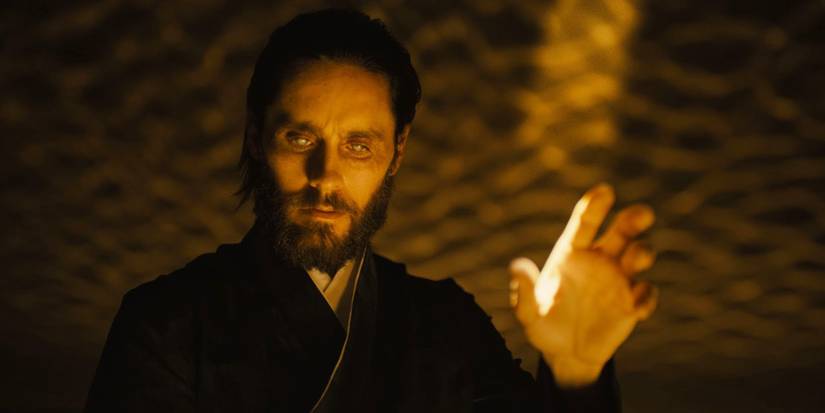 Image via Warner Bros. Pictures
 Image via Warner Bros. Pictures








 English (US) ·