
 3 weeks ago
72
3 weeks ago
72
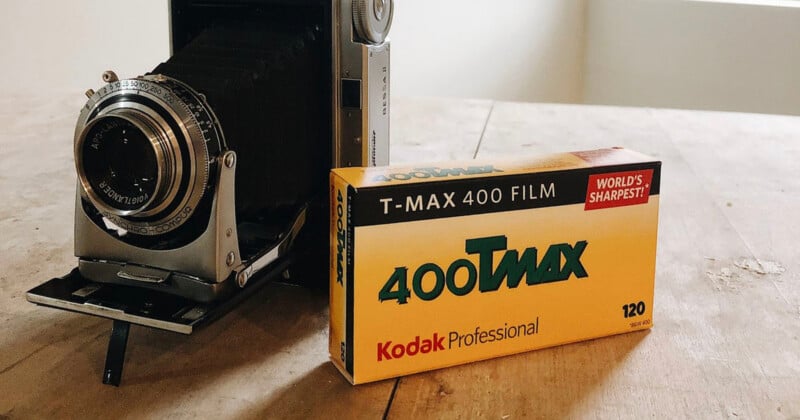
TMax 400 came into the world in 1986, at the same time as its slower speed brother. You can think of them as near identical twins, in fact. Since its introduction, TMax 400 has helped define a whole new generation of black and white films with its tabular grain structure, high resolution, and sharp image details.
Like TMax 100, TMax 400 uses a tabular grain structure that allows the silver crystals in the film emulsion to have more light-catching surface area without necessarily being larger in grain size. In addition, the film grains themselves are arranged in a smoother pattern, so even as the grain of the film necessarily has to get a bit larger to accommodate the faster speed, the smoother pattern means the human eye notices the increased grain size less. All of this works to create a very smooth looking film in both of the TMax emulsions.
 Our National Manager at Blue Moon Camera, Annie Buckles with her Hasselblad. | Hasselblad 500C/M
 Local artist Bijijoo at his home with his collection of baby dolls. | Hasselblad 500C/M
Along with the smooth, fine grain, TMax 400 also boasts excellent sharpness and extremely high resolution. TMax 400 actually has the same 200 lines/mm resolving power as its slower counterpart! That is a pretty amazing accomplishment.
The film is faster, and thus grainier, but it resolves just as well as a film two stops slower than it. So even if you are shooting it in 35mm, you can expect your images to have plenty of fine detail and will likely be held back only by the limitations of your lens and not the capabilities of your film.
 My son Owen near Director Park in downtown Portland. | Olympus XA
 St. Johns Bridge | Olympus XA
Along with those aforementioned qualities there are a couple of other things TMax 400 does that you should know about. First off, it pushes up to ISO 1600 really well. Yes, you can expect increased grain and contrast, but the film is quite capable of stepping up when needed and nicely fills the speed gap between it and the ultra-high speed TMax P3200 (which itself can be shot quite nicely as low as ISO 800).
 Manhattan Bridge from Brooklyn | Hasselblad 500C/M
 Eiffel Tower, Paris | Hasselblad 500C/M
In other words, if you have a roll of TMax 100, TMax 400, and TMax P3200 in your camera bag, you could handle any situation requiring film speeds between ISO 25 to 12,800 just through pushing and pulling of one of these three films. That is an incredible range of versatility that should not be overlooked. Break out of that box speed mentality!
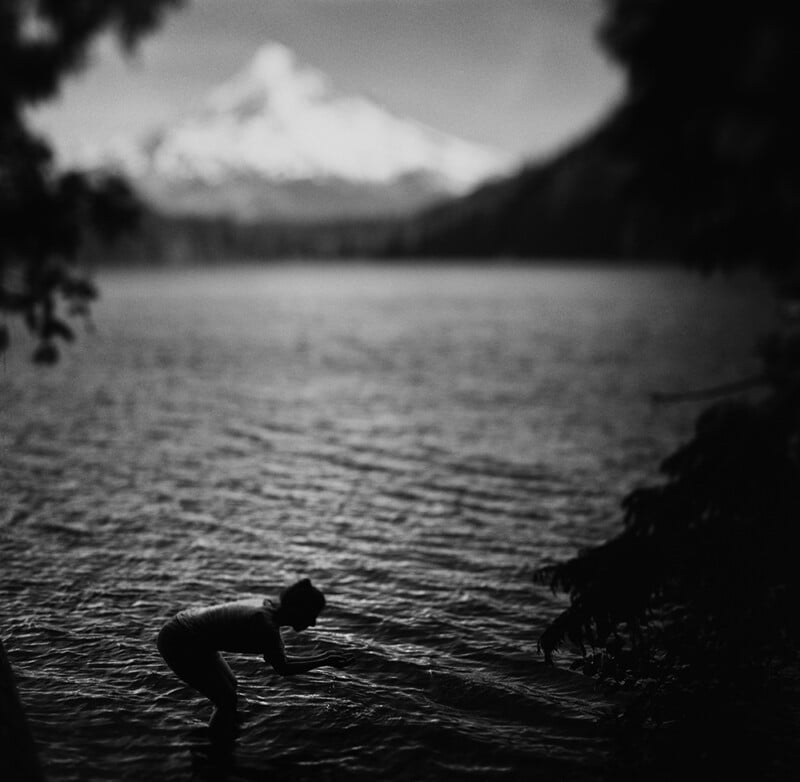 Lost Lake and Mt. Hood | Flexbody
 Portrait of Blue Moon employee Jackson Keller with his Pentax 67. | Hasselblad 500C/M
Furthermore, TMax 400 comports itself quite admirably in the reciprocity failure department making it a very strong choice for long exposures. Per Kodak’s data sheets, you need to kick in 1/3 of a stop of extra exposure starting at 10 seconds. Put another way, you could forego any reciprocity compensation for up to 10 second exposures and not see any detrimental impact on your final images.
After 10 seconds, the film starts to need a bit of extra help and by the time you reach 100 seconds (roughly a minute and a half) you should be adding 1.5 stops. So that 100 second exposure becomes a 300 second exposure (five minutes). While not great, this is not bad either. Many films hit that +1 stop extra exposure needed benchmark much sooner than TMax 400 does.
And that is our pitch for TMax 400. TMax 400 is a great carry-around film that will allow you to handle most lighting conditions you will encounter, all the while giving you really smooth, sharp and detailed images. We sometimes like to bemoan the death of certain films and talk about favorite film stocks of yore that are no longer with us, but the truth is, we have some really amazing film stocks still available right now on the market that we should be using more than we already do. TMax 400 is one of those films. Overlook it no longer!
 Lake Agnes, above Lake Louise in Banff National Park, Alberta. | Hasselblad 500C/M
 The grounds at Versailles | Hasselblad 500C/M
If you pay a visit to our online shop today, or our brick and mortar store in Portland, Oregon if you are lucky enough to live nearby, you will find TMax 400 discounted and on sale for today only. How is that some incentive to pick up a roll? (Sorry, we are keeping Ektapan 400 out of this week’s feature.)
And if you are new to our Film Friday series and wondering just what the heck it is, well let us quickly tell you! Every week we take a different film in our inventory and give it a feature that includes a full Film Friday review done by us, plenty of sample images and a discount to help entice you to either try it or to stock up. We started this several years ago as a means of getting away from just using the same three to five film stocks and we have since made it a point to feature practically every film we carry, no matter how esoteric. So join us weekly to see a different film and enjoy some analog inspiration!
Image credits: Zeb Andrews, Blue Moon Camera and Machine
This story is brought to you by Blue Moon Camera and Machine in Portland, OR. Blue Moon offers film, development services, printing, and even an ever rotating line of film cameras and lenses. PetaPixel Members receive 10% off all lab services with Blue Moon: Join today!







 English (US) ·