
 6 hours ago
17
6 hours ago
17
Canon today announced the EOS R6 V, a new full frame mirrorless camera built around video capture, alongside the RF 20-50mm f/4 L IS USM PZ lens and a set of accessories aimed at solo creators and small productions. The R6 V is the first V-series body to use a 32.5-megapixel full frame sensor, and it slots into Canon's lineup as a video-first counterpart to the still-focused R6 Mark III.
The body uses a 32.5-megapixel full frame CMOS sensor with a maximum image resolution of 6,960 x 4,640 paired with the DIGIC X processor. Native photo ISO runs from 100 to 64,000, expandable to 50 to 102,400, with a stated dynamic range of more than 15 stops in Canon Log 2. Video ISO is native 100 to 25,600, with the base ISO shifting depending on the selected color space. Continuous shooting tops out at 40 fps using the electronic shutter, and a pre-continuous mode captures an additional 20 frames before the shutter is fully pressed.
On the video side, the R6 V records 7K open gate 3:2 raw at up to 29.97 fps, 7K DCI raw light at up to 59.94 fps, oversampled 4K up to 59.94 fps, uncropped 4K up to 120 fps, and 2K up to 180 fps with a 1.13x crop. Internal options include 12-bit raw, 10-bit XF-HEVC S/H.265, and 8/10-bit XF-AVC S/H.264. The full-size HDMI port outputs 4:2:2 or ProRes raw to compatible Atomos Ninja recorders at 7K (6,960 x 3,672) at 25 or 29.97 fps. Available gamma curves include Canon Log 2, Canon Log 3, HDR-HLG, HDR-PQ, and Rec.709, with a dedicated color button for switching between profiles, including 14 user-assignable slots.
Stabilization comes from in-body sensor-shift IS coordinated with optical IS in compatible RF and RF-S lenses, rated at up to 7.5 stops of correction at the image center. A five-axis Movie Digital IS function is also available for handheld work. Autofocus uses Canon's Dual Pixel CMOS AF II system, carried over from the R6 Mark III, with subject detection for people, animals, and vehicles, and a Register People Priority feature that holds up to 10 individuals for prioritization in crowded scenes.
Physically, the R6 V drops the viewfinder entirely and uses a 3-inch, 1,620,000-dot vari-angle touchscreen LCD with a rotating user interface for vertical shooting. An active cooling system is built into the body to support extended recording, with Canon citing two or more hours in 7K raw light. The camera includes an integrated power zoom lever, a tally lamp, dual 1/4"-20 threaded mounts on the bottom and side, a hot shoe, and a body built from aluminum, magnesium alloy, and polycarbonate. It weighs 1.3 lb (598 g) for the body alone and 1.5 lb (688 g) with battery and card. Dimensions are listed as 141.8 x 83.3 x 79.7 mm.
Storage is handled through one CFexpress Type B slot (supporting cards up to 8 TB) and one SD/SDHC/SDXC UHS-II slot for redundancy, sub-recording, or proxies. Connectivity includes a full-size HDMI port, USB-C 3.2 Gen 2 for power, 10 Gb/s data transfer, and UVC/UAC streaming, separate 3.5mm microphone and headphone jacks, a 2.5mm remote port, Wi-Fi 5, and Bluetooth 5.1. The R6 V records 4-channel 24-bit LPCM audio or 2-channel 16-bit AAC audio, and supports UVC/UAC IP streaming at up to 4K 59.94p. Power comes from a single Canon LP-E6P battery rated at 2,130 mAh.
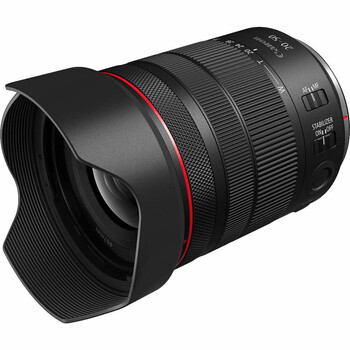
The companion RF 20-50mm f/4 L IS USM PZ is Canon's first L-series lens with built-in power zoom, switchable between manual and powered operation from a single zoom ring. It offers a constant f/4 aperture across the range, an internal zoom design intended to keep the center of gravity stable for gimbal use, and remote power zoom control through the Canon Camera Connect app or Bluetooth remotes including the BR-E2 and BR-E1.
Canon also introduced three new accessories. The BR-E2 Wireless Remote Control is a Bluetooth Low Energy remote with lever-operated zoom and exposure compensation, compatible with the R6 V and other EOS and PowerShot cameras released from August 2022 onward (excluding the EOS R100). The HG-200TBR Multi-Function Tripod Grip combines a tripod and hand grip for horizontal and vertical shooting and includes the BR-E2. The AD-M1 Macro Lite Adapter Set includes a mount ring, micro lite adapter, and flash head mount for macro work. Canon is also releasing three creator kits: the Creator Accessory Kit II (DM-E100 microphone, HG-200TBR, BR-E2), the PowerShot V1 Video Creator Kit, and the EOS R50 V Video Creator Kit.
Key Specs
- 32.5-megapixel full frame CMOS sensor (6,960 x 4,640), 34.2-megapixel actual
- Canon RF mount
- DIGIC X image processor
- Photo ISO: native 100 to 64,000, expandable to 50 to 102,400
- Video ISO: native 100 to 25,600 (base varies by color space)
- 15+ stops dynamic range in Canon Log 2
- 7K30 open gate 3:2 raw (6,960 x 4,640) internal recording
- 7K60 DCI raw light (6,960 x 3,672) internal recording
- 4K up to 120 fps uncropped
- 2K/1080p up to 180 fps with 1.13x crop
- 7K (6,960 x 3,672) at 25/29.97 fps 4:2:2 or ProRes raw output via HDMI
- 12-bit raw, 10-bit XF-HEVC S/H.265, 8/10-bit XF-AVC S/H.264
- Gamma: Canon Log 2, Canon Log 3, HDR-HLG, HDR-PQ, Rec.709
- 40 fps continuous shooting (electronic shutter) with 20-frame pre-capture
- Electronic rolling shutter, 1/8000 to 30 seconds
- C-RAW, HEIF, JPEG stills at 12-bit
- Dual Pixel CMOS AF II with people, animal, and vehicle detection
- Register People Priority for up to 10 individuals
- Coordinated in-body sensor-shift IS rated up to 7.5 stops, plus 5-axis Movie Digital IS
- 3-inch, 1,620,000-dot vari-angle touchscreen LCD
- No viewfinder
- Built-in active cooling fan (2+ hours of 7K raw light recording)
- Integrated power zoom lever, dedicated color mode button, tally lamp
- Dual card slots: CFexpress Type B (up to 8 TB) and SD UHS-II
- Full-size HDMI, USB-C 3.2 Gen 2, 3.5mm mic and headphone jacks, 2.5mm remote
- Wi-Fi 5 (802.11ac), Bluetooth 5.1
- UVC/UAC streaming up to 4K 59.94p
- 4-channel 24-bit LPCM or 2-channel 16-bit AAC audio
- 1/4"-20 mounts on bottom and side for horizontal and vertical tripod use
- Aluminum, magnesium alloy, and polycarbonate construction
- Operating range: 32 to 104°F (0 to 40°C), up to 85% humidity
- Canon LP-E6P battery, 2,130 mAh
- 141.8 x 83.3 x 79.7 mm
- 1.3 lb / 598 g (body), 1.5 lb / 688 g (with battery and card)
Why This Matters for Photo and Video Creators
The R6 V lands at a price point and feature set that puts real production tools within reach of solo shooters, small crews, and hybrid creators. Internal 7K raw recording, 4K 120 fps without a crop, and 7K ProRes raw output through HDMI are specifications that, even a generation ago, lived in cameras priced well above the $2,499 body price. For documentary work, wedding films, branded content, and YouTube production, that combination of resolution, frame rate flexibility, and codec options reduces the need to crop, upscale, or compromise in the edit.
The decision to remove the viewfinder and reshape the body around video controls clarifies who the camera is for. Photographers who need a hybrid tool will still find a competent stills camera here, with 40 fps burst shooting, Dual Pixel CMOS AF II, and 12-bit raw capture, but the ergonomic priorities have shifted. The rotating user interface, side tripod thread, tally lamp, integrated zoom lever, and active cooling all point toward sustained handheld and gimbal shooting, vertical capture for social platforms, and longer recording sessions without thermal limits. For a creator running a one-person operation, these are the details that determine whether a camera is workable on a six-hour shoot or just on paper.
The RF 20-50mm f/4 L IS USM PZ is the other half of this story. A constant aperture, internal zoom, power-zoom L-series lens designed for gimbal balance and remote operation gives the R6 V a native partner for the kind of work the camera is built around. Coordinated stabilization between the body and lens, combined with remote zoom control over Bluetooth or the Camera Connect app, is the configuration that makes solo operation on a slider, tripod, or gimbal genuinely practical rather than just possible.
Pricing and Availability
The Canon EOS R6 V body is expected in late June at an estimated $2,499. The kit with the RF 20-50mm f/4 L IS USM PZ is $3,699, and the Stop Motion Animation Firmware configuration is $2,599.00. The RF 20-50mm f/4 L IS USM PZ alone is $1,399.00, also in late June. The BR-E2, HG-200TBR, and AD-M1 are slated for late June at $69.99, $159.99, and $179.99, respectively. The Creator Accessory Kit II, PowerShot V1 Video Creator Kit, and EOS R50 V Video Creator Kit are expected in early July at $249.99, $1,279.00, and $1,199.00.
The R6 V is a meaningful repositioning for Canon's mid-tier full frame lineup. By splitting the R6 family into a stills-oriented Mark III and a video-oriented V variant, Canon is acknowledging that the hybrid camera is no longer a single product, but a category that increasingly demands purpose-built tools. Whether that strategy pays off will depend on how the R6 V holds up in real production, but on specifications alone, it is one of the most aggressive video cameras Canon has released at this price.

 English (US) ·