
 6 hours ago
18
6 hours ago
18
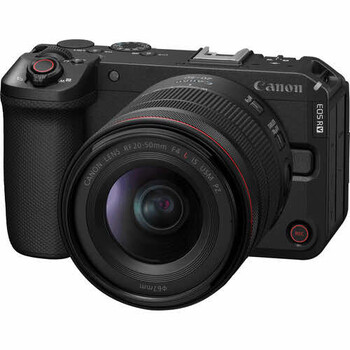
Alongside the EOS R6 V camera body, Canon today announced the RF 20-50mm f/4 L IS USM PZ, the first L-series lens from Canon to include built-in power zoom without requiring an external accessory. The lens is aimed at video shooters and hybrid creators working on gimbals, sliders, and handheld setups, and serves as the native companion to the video-focused EOS R6 V.
The 20-50mm focal range covers ultra wide angle through standard, with a constant f/4 maximum aperture across the zoom range to keep exposure consistent during pulls. The optical formula is 13 elements in 11 groups, including three aspherical and three UD elements intended to control distortion and chromatic aberration across the zoom range. Canon also notes that focus breathing is tightly controlled, which is the kind of specification that matters more for video than for stills.
The headline feature is the dual nano USM power zoom. A wide-to-tele rocker on the lens drives the zoom electronically, and the same zoom ring can be switched between manual and powered operation. When paired with the EOS R6 V, the camera's menu exposes separate speed controls for the barrel and the lever, as well as different speeds for standby and recording. The internal zoom design keeps the lens length fixed throughout the range, which Canon says minimizes shifts in the center of gravity, an important consideration for gimbal balance.
For remote operation, the lens supports power zoom control through the Canon Camera Connect app and Bluetooth remotes including the BR-E2 and BR-E1, which makes solo operation on a tripod or slider workable without touching the camera. Autofocus is handled by a nano USM motor, and the lens includes optical image stabilization rated at six stops. On a body with coordinated IS like the R6 V, that stabilization combines with the sensor-shift system for additional correction during handheld work.
The barrel is built for working conditions: the front element features a fluorine coating, and the lens body is rated as dust and weather resistant. The 67mm front filter thread is standard across many of Canon's recent compact RF lenses, which simplifies filter sharing across kits. At 0.93 lb (0.42 kg), it is light enough for extended handheld shooting and small gimbals.
Key Specs
- Focal length: 20 to 50mm
- Maximum aperture: f/4 (constant across zoom range)
- Lens mount: Canon RF
- Format coverage: full frame
- Optical design: 13 elements in 11 groups
- Three aspherical elements and three UD elements
- Dual nano USM power zoom with switchable manual zoom on the same ring
- Internal zoom design for stable center of gravity
- Nano USM autofocus motor
- Optical image stabilization rated at six stops
- Coordinated IS with compatible RF/RF-S bodies
- Suppressed focus breathing for video
- Fluorine front element coating
- Dust and weather resistant construction
- 67mm front filter thread
- Remote power zoom via Canon Camera Connect app, BR-E2, or BR-E1
- Weight: 0.93 lb (0.42 kg)
Why This Matters for Photo and Video Creators
Power zoom lenses have historically been a compromise category. Cinema-style servo zooms are large, expensive, and slow to focus, while consumer power zooms tend to be plastic, slow, and short on optical quality. The RF 20-50mm f/4 L IS USM PZ is Canon's attempt to put a true L-series build and optical formula behind a power zoom mechanism, and the spec sheet reads accordingly: a constant f/4 aperture, internal zoom, weather sealing, six stops of stabilization, and controlled focus breathing.
For solo video creators, that combination unlocks a workflow that has been difficult to achieve with stills lenses. Smooth, repeatable zoom pulls without touching the lens are possible from a remote or from the camera body, which means a single operator can run a locked-off interview shot, an over-the-shoulder, or a moving subject without breaking frame to rack the zoom by hand. Internal zoom means the lens does not extend or shift weight during a move, which keeps a gimbal balanced through an entire shot rather than just at one end of the zoom range.
The 20-50mm range itself is a deliberate choice. It is wider than the typical 24-70mm standard zoom and shorter at the long end, which favors wide environmental work, vlogging, walking shots, interviews in tight rooms, and B-roll where context matters more than reach. Paired with the EOS R6 V, the lens lines up with the kind of work the camera is built for: handheld and gimbal-driven storytelling, vertical capture for social, and self-operated productions.
The lens is also a meaningful addition to the RF system more broadly. Until now, photographers and videographers wanting a power zoom on an RF body had limited options, and most required adapted cinema glass or compromise consumer lenses. A native L-series option, even one with a relatively modest focal range, signals that Canon intends to keep building out video-first glass for the V-series lineup.
Pricing and Availability
The Canon RF 20-50mm f/4 L IS USM PZ is expected to ship in late June at an estimated $1,399.00. It is also available bundled with the EOS R6 V body as a kit at $3,699.00.
The RF 20-50mm f/4 L IS USM PZ is not a lens that will appeal to every shooter. Its 20-50mm range is narrow by traditional standards, and the f/4 aperture is conservative for low-light work. But for the creator the lens is built for, the one running a camera, a microphone, and a gimbal alone, with a tight schedule and no second operator, it solves real problems that conventional zoom lenses do not. Whether it earns a place in working kits will come down to how the power zoom feels in practice and how the optics hold up across the range, but on paper it is one of the more thoughtful video-first lens designs Canon has produced.




 English (US) ·