
 4 hours ago
8
4 hours ago
8

Caira Camera by Camera Intelligence, which is formerly Alice Camera, made headlines last year when it announced that it would be integrating Google Nano Banana directly into its imaging pipeline, allowing users to make wholesale changes to photos and alter reality. After blowback, Caira is dialing its generative editing way back.
Speaking to PetaPixel at the CP+ show in Yokohama, Japan, last month, Camera Intelligence’s CEO Vishal Kumar explained that it listened to feedback after it announced the generative editing features and made adjustments in kind.
“When we first announced the generative editing feature in October, it was an extremely raw, early, novel, and nebulous concept. We were not expecting to get everything perfectly right. But, it was being considered from a point of view that many people outside the camera industry find it challenging and overwhelming to navigate and maximize the benefits of editing tools like Lightroom and Photoshop,” Kumar says.
“We saw our Generative Editing feature (currently using Nano Banana) as a way to achieve and mimic complex post-production techniques, in real-time using simple, natural language prompts – techniques previously only possible through software editing workflows on laptops, i.e., Adobe.”
Not long after it announced these generative features, Camera Intelligence supplied preview units to Tony Northrup, Jimmy Cheng, and Emily Lowrey for testing.
“Even though we put guardrails in place, that prototype essentially had a completely open access to Nano Banana. In the end, we found that the ‘open access prompt window’ was a bit too scary because most people just said the first thing that came to their mind, which was usually something vague or silly, instead of actually prompting in the way we thought they would. We learned from the feedback provided by these creators, all of the YouTube comments, and we also held workshops with a small group of creators at our offices in London.”
Kumar says that based on that feedback, Camera Intelligence went back to the drawing board and decided the best course of action moving forward would be to curate the generative editing experience more overtly.
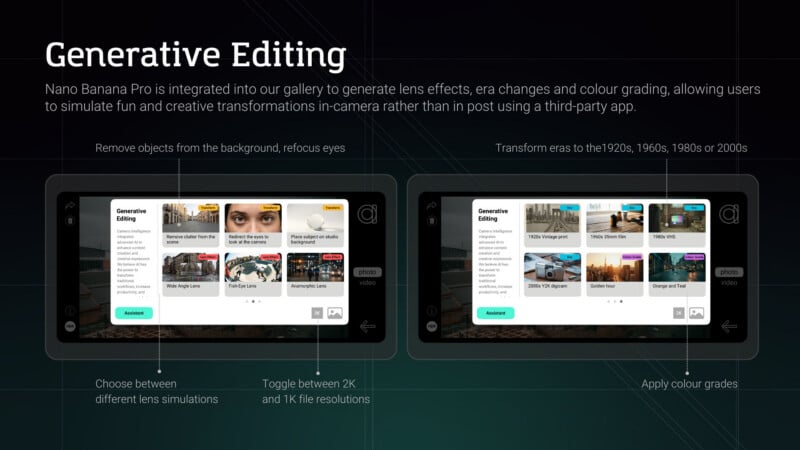
“We have removed the ‘open access prompt window’ for now, and we have created 12 highly specific buttons and templates. For example, we now have a button that removes clutter from photos — a generative fill feature many photographers use in Adobe. We also have era transformations; you can transform the photo back to the 2000s, 1980s, 1960s, and 1920s, similar to the Instax Mini Evo Cinema Instant Camera — but they use hardware, we emulate this using software/AI. Every month, we will try to add one more new button based on our community’s crowdsourced feedback.”
Kumar says that the goal of integrating generative AI into Caira was only ever about making fun and useful additions to a user’s experience, and not creating fictional AI images that make viewers question reality.
‘We believe the real world is beautiful and interesting, and that real memories should be preserved.’
“We’re actually wholeheartedly against AI slop,” Kumar says.
“We believe the real world is beautiful and interesting, and that real memories should be preserved. However, we are willing to take the risk and test the waters to explore this technology’s possibilities,” he continues. “We’re learning and iterating, and we’re committed to working with our customers, users, and community who will help us drive this new technology forward in positive ways.”
Caira Camera’s Actual Camera Improvements
While generative AI is the attention-grabbing feature of the Caira Camera, Kumar’s team has also been developing novel computational photography features, blending the benefits of interchangeable lens cameras and smartphones in unique ways.
PetaPixel spoke with Camera Intelligence CTO Liam Donovan, who explained that the company is adding several new features designed for photographers — none of which use generative AI.
Caira Camera JPEGs have a hidden gain map embedded into them, which enables their compatibility with HDR displays, a feature that is still uncommon in standalone cameras. Donovan also says that it has a new low-light mode that merges stacks of rapidly captured handheld photos with varying exposures, which are then combined into one, reducing noise and delivering low-light performance that rivals that of much larger sensors.
“When using stacking in our camera, it doesn’t freeze the viewfinder; you can continuously take stacked photos one after another. We can do this because we use a powerful Qualcomm Snapdragon processor, which is much more powerful than anything on a traditional mirrorless camera,” Donovan says.
Stacking photos like this isn’t a new idea — smartphones have done it for years. What makes it novel is this integration with a larger sensor behind an interchangeable lens. In 2022, PetaPixel spoke with Qualcomm about why camera manufacturers don’t use its technology, and the company said there wasn’t any reason why they couldn’t. Camera Intelligence stands to be the prime example of what happens when a standalone camera sensor is combined with Qualcomm’s tech.
“All of the processing for our imaging pipelines is run in software on our powerful Qualcomm Snapdragon processor. This enables rapid iteration and incorporation of the latest computational photography techniques via software updates,” Donovan continues.
Camera Intelligence has the goal of continuing to use this stacking algorithm and evolving it over time. The company also wants to add handheld super-resolution, which will increase the camera’s resolution from 11 megapixels to 44 megapixels. This feature is currently in early testing inside the company.
“Many features of the camera, including white-balancing, autofocus, and tone-mapping, are implemented using small but sophisticated neural networks running in real-time on the camera,” Kumar adds.
“For example, our autofocus uses a small neural network to determine how to move the lens to bring an image into focus, rather than using traditional contrast or phase detection techniques. These networks offer significant improvements over traditional techniques, but they are architecturally distinct from modern LLMs and possess zero generative or hallucinatory capabilities. We have a strong commitment that all on-camera processing is strictly predictable, repeatable, and free from generative AI. All generative AI features are fully optional and exist exclusively as post-processing techniques.”
Image credits: Camera Intelligence







 English (US) ·