
 2 weeks ago
10
2 weeks ago
10
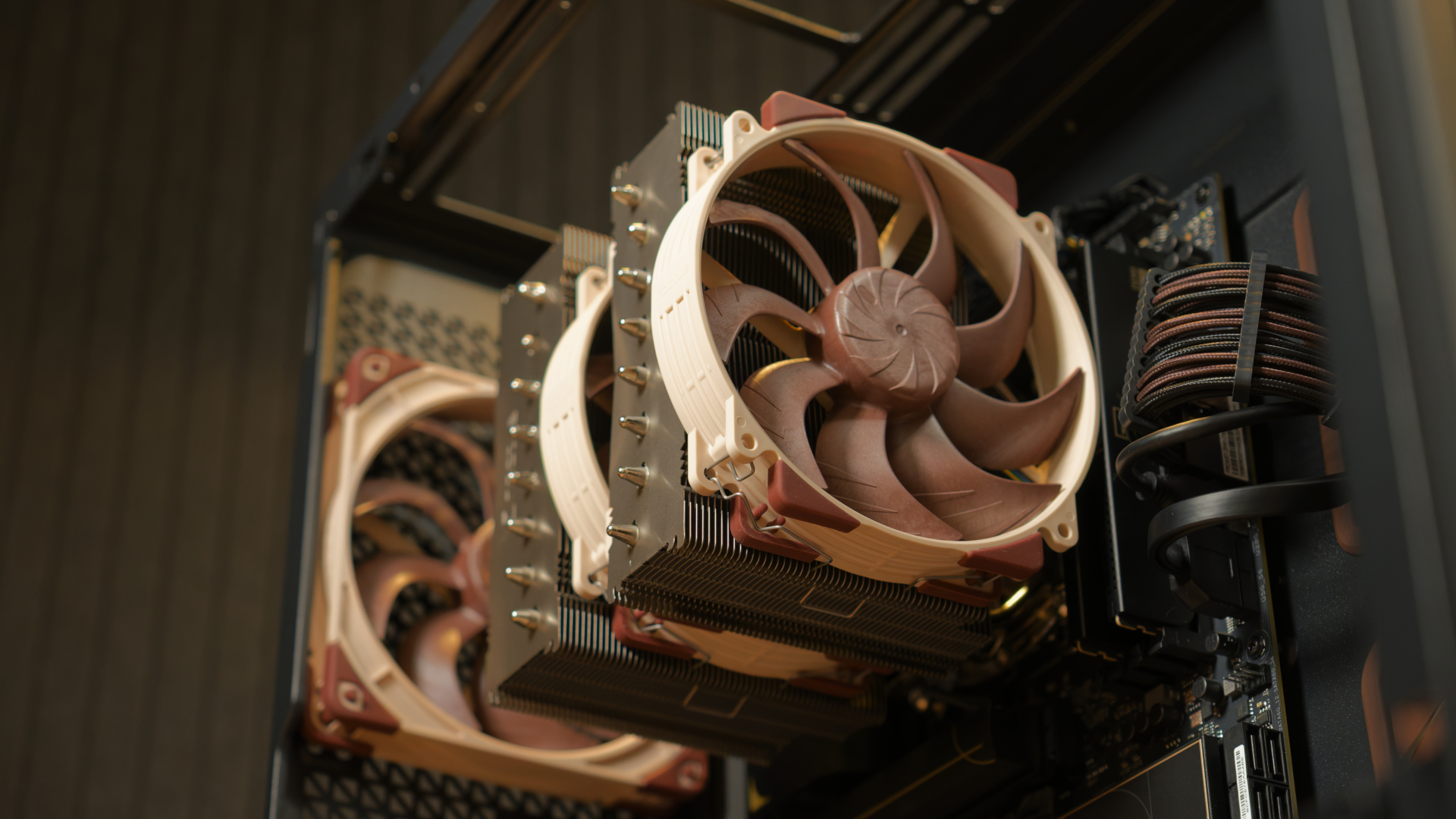
Noctua is known for building some of the world’s quietest and most reliable cooling fans. The brand is a partnership between the Austrian RASCOM and Taiwanese Kolink; RASCOM handles marketing, sales, and product management, whereas Kolink handles manufacturing, and together they handle product development. We delved into the interesting history of the brand late last year.
You most likely know Noctua for their signature brown and beige fans, but not everyone digs these colors – many of us prefer our fans in plain black, and although Noctua is happy to make these nowadays, their development isn’t something that happens overnight.
To manage expectations, Noctua keeps a published roadmap with the brand’s upcoming products, which is updated a few times per year. The most recent is from January 2026, and it details the products we can expect in Q1, Q2, and Q3 of this year.
Article continues below
Reliable Fans, Unreliable Roadmap
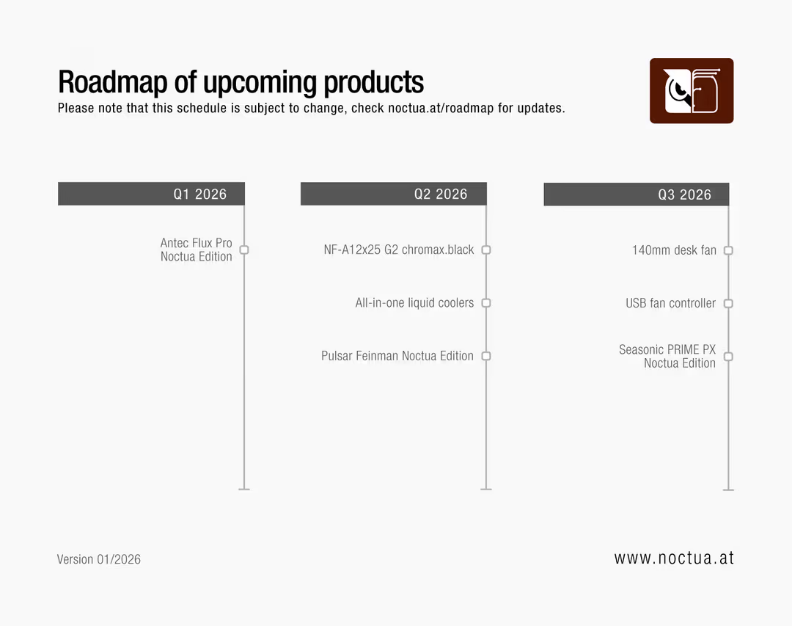
Now, before we dig into the details of Noctua’s roadmap, a disclaimer: The company is notoriously unreliable when it comes to sticking to its published roadmap. This is not without reason, however.
You see, there’s something you should know about Noctua: The brand prides itself on building quality products. Inevitably, this comes with unforeseen issues, and Noctua consequently finds itself delaying the launch of products to meet its own quality standards. There's more to it than just that, of course. Noctua didn't publish a roadmap until a few years ago, after facing much criticism from the public.
Q2 2026: Noctua is getting into water cooling
Noctua just released the Flux Pro Noctua Edition in partnership with Antec in March, which we’ve already built a system into. The Flux Pro case is made by Antec, and the Noctua Edition is the first case ever built to feature Noctua branding and a host of Noctua fans. But it's in Q2 where things start to get even more interesting.
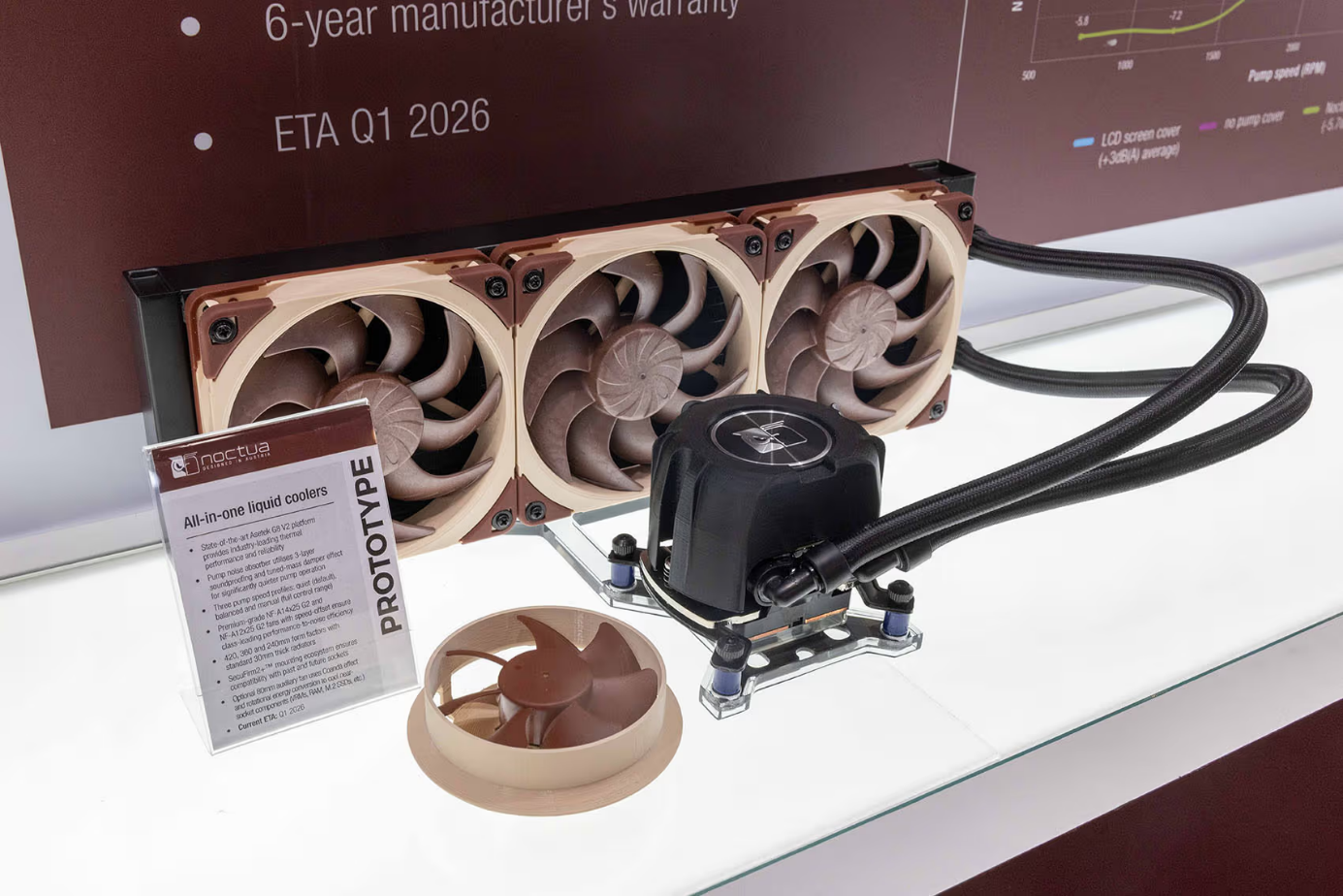
Just like the brand was firmly against producing black fans for a long time, Noctua has also been firmly against liquid cooling. The reason is simple: pump noise.
Noctua has nothing against the power of liquid cooling. But when you pair the excellent NF-A12x25 G2 with a liquid cooler, under load the pump speed has to ramp up significantly, meaning its noise will stand out above the rest of the system. This is not an issue for PCs with cheaper fans (or not one most people care much about, anyway), but certainly an issue in a system designed for silence. But the market wants what the market wants. Noctua has been all about partnerships lately, and for building its very own liquid cooler, it teamed up with Asetek.
Asetek's history isn’t all too popular with the enthusiast community, but no one can deny that the company does have formidable experience making all-in-one liquid coolers. They’ll be pulling the EMMA (Gen 8) V2 platform out for optimal thermal and acoustic performance, and Noctua has made a handful of significant design choices that should make the pump significantly less obtrusive than other AIOs, among which is a tuned mass damper – similar to what the Taipei 101 skyscraper uses to keep the building upright in earthquakes, but much, much smaller.
Noctua has been talking about making its own liquid cooler for quite some time, and unlike many partnerships it has engaged in, the AIO will be a fully Noctua-branded product. With the Noctua brand always comes an industry-leading 6-year warranty. Reliability is often an issue with cheap AIOs, but with Noctua backing the product, I reckon we can be confident that Asetek’s new platform is due to stand the test of time.
The Noctua AIO will come in 240mm, 360mm, and 420mm sizes, all in the industry-standard 30mm radiator thickness. There's no specific price or release date quite yet, so keep your eyes peeled for any announcements.
Q2 2026: Finally, a Black NF-A12x25 G2
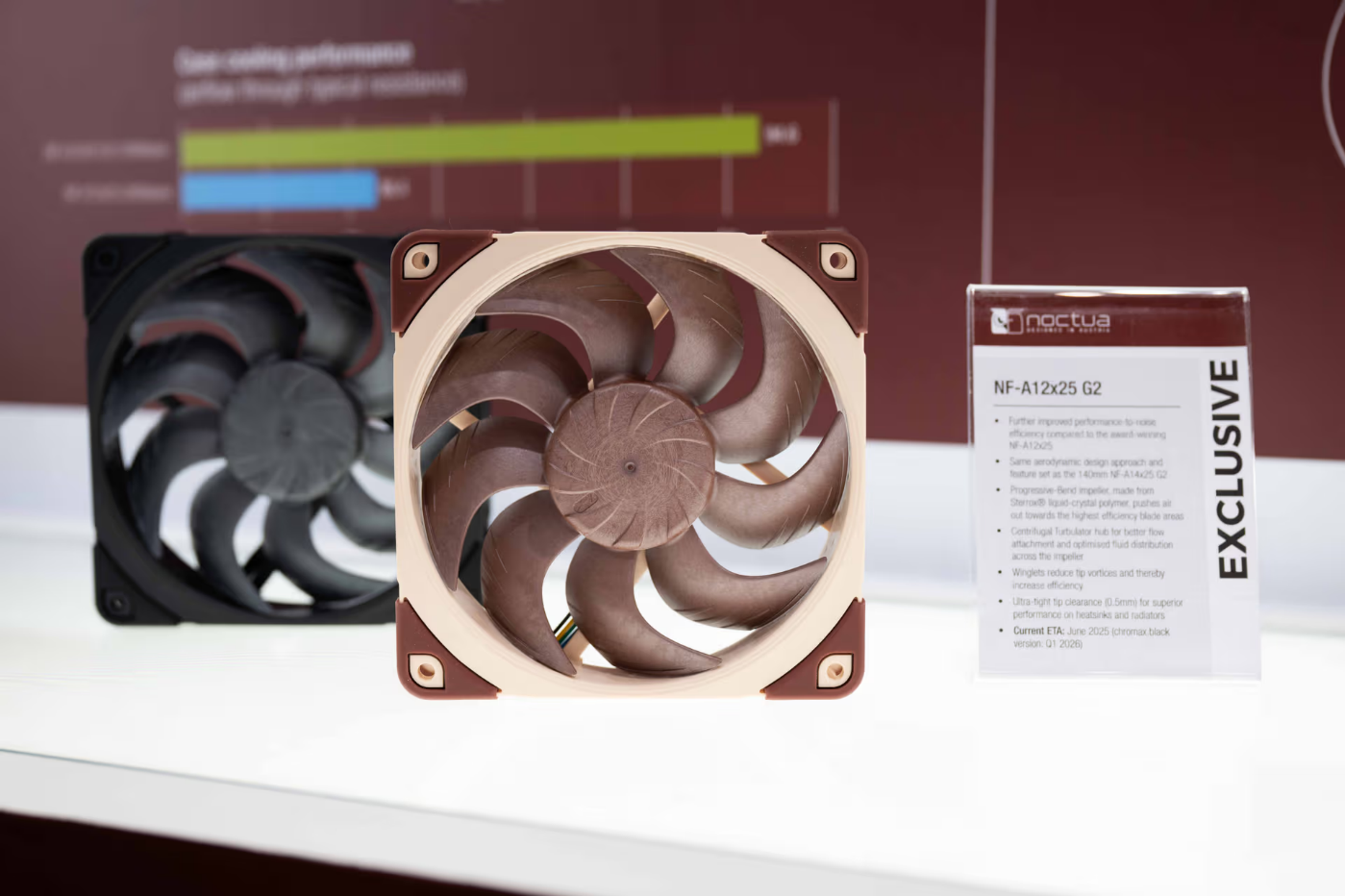
If you’ve been craving an NF-A12x25 G2, but don’t like the beige-and-brown colorway, your prayers will be answered: Noctua is unleashing the black variant of the NF-A12x25 G2 to the world in Q2 2026. Or at least, so says the roadmap.
The NF-A12x25 G2 is a fan that pushes the limits of what is physically possible in the 120mm x 120mm x 25mm form factor, and it does so by using Sterrox Liquid Crystal Polymer (LCP) for the impeller. This gives it extra tensile strength so that the blades don’t bow outwards at high duty, which is critical because the impeller is spaced at just 0.5mm from the frame.
But, the reason why it’s taken a while to come to market is that changing the color pigment in LCP has some funny ways of interacting with the molding process; you’d think, simply change the pigment, inject the substance into the same mold. Bob’s your uncle. But the reality isn’t that simple. With most fans, this wouldn’t be an issue, but due to the 0.5mm spacing, there is zero room for error.
Q2 2026: Pulsar Feinmann Noctua Edition
As a wrap for Q2, Noctua is teaming up with Pulsar for a Feinmann Noctua Edition gaming mouse. The Feinmann is a rather unique mouse — it’s built with a magnesium alloy shell that’s filled with holes to deal with sweaty hands. If you’re someone who suffers from Trypophobia, this mouse isn’t for you. But Noctua saw it and thought, “Hey, we can put a fan in there,” and so they did.
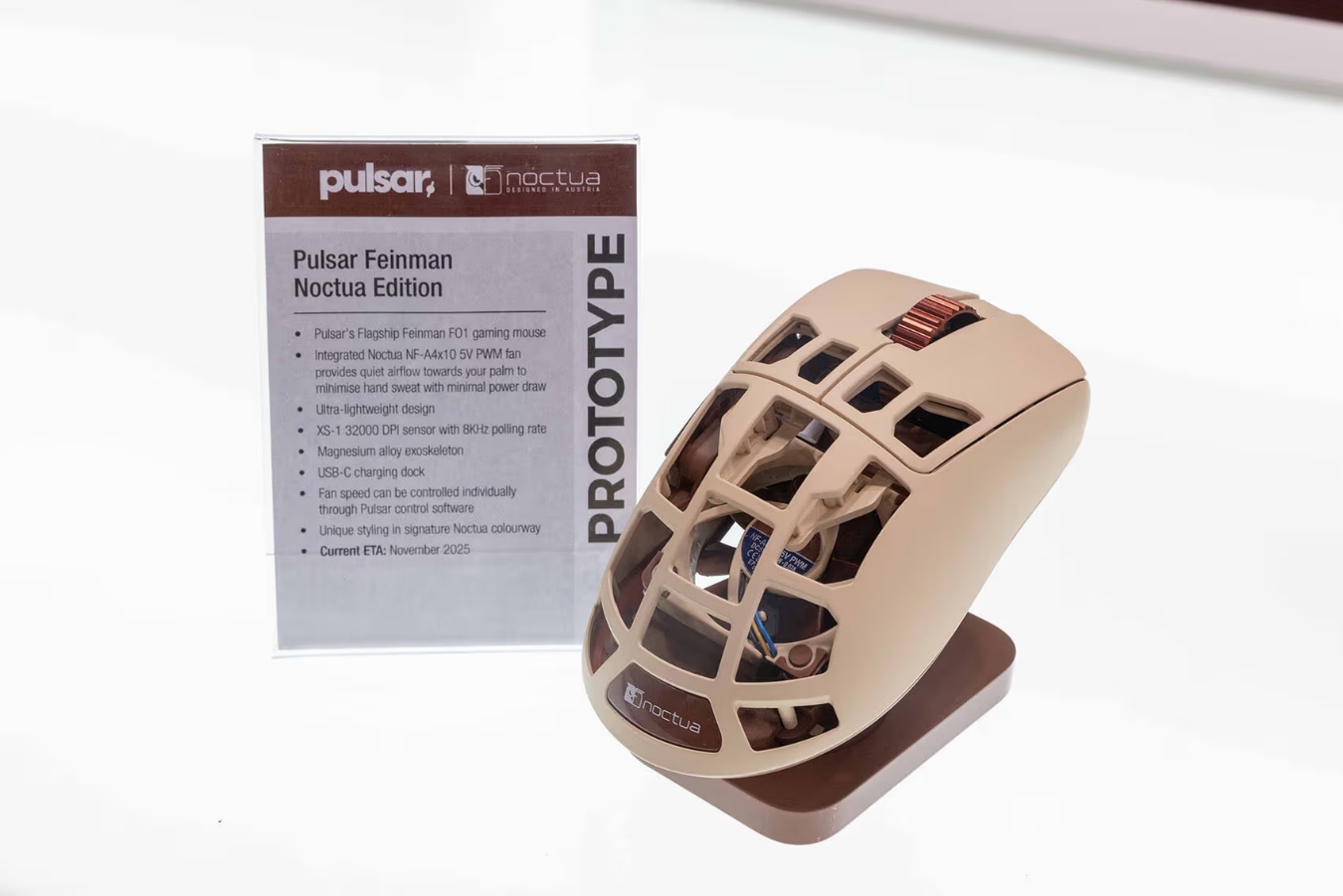
Due to the magnesium alloy shell, the Pulsar Feinmann is ultra light, weighing in at just 46 grams. The Noctua edition is probably a few grams heavier – the fan that’s due to be mounted inside weighs just under 9 grams without a cable. Even with that, less than 60 grams would still be extremely light. For context, anything under 100 grams is considered light. For comparison's sake, the Logitech MX Master 4 weighs in at 150 grams.
The sensor inside the mouse is the PixArt PAW3950, which offers a 39k DPI resolution, can cope with up to 50G acceleration, and tracks at up to 75 inches per second. With polling at 8,000 Hz, the Pulsar Feinmann is already an incredibly attractive gaming mouse as is.
Add some Noctua colorway touches, and this will be one of the most unique pointing devices to exist. Considering the original, non-Noctua edition costs $180, and adding some Noctua tax, it wouldn’t be surprising if this mouse costs north of $250.
As with other Noctua collaboration products, expect limited production of the mouse. The chances are that over time, this will gain collector value among diehard Noctua enthusiasts.
Q3 2026: A desk fans & co-branded PSUs
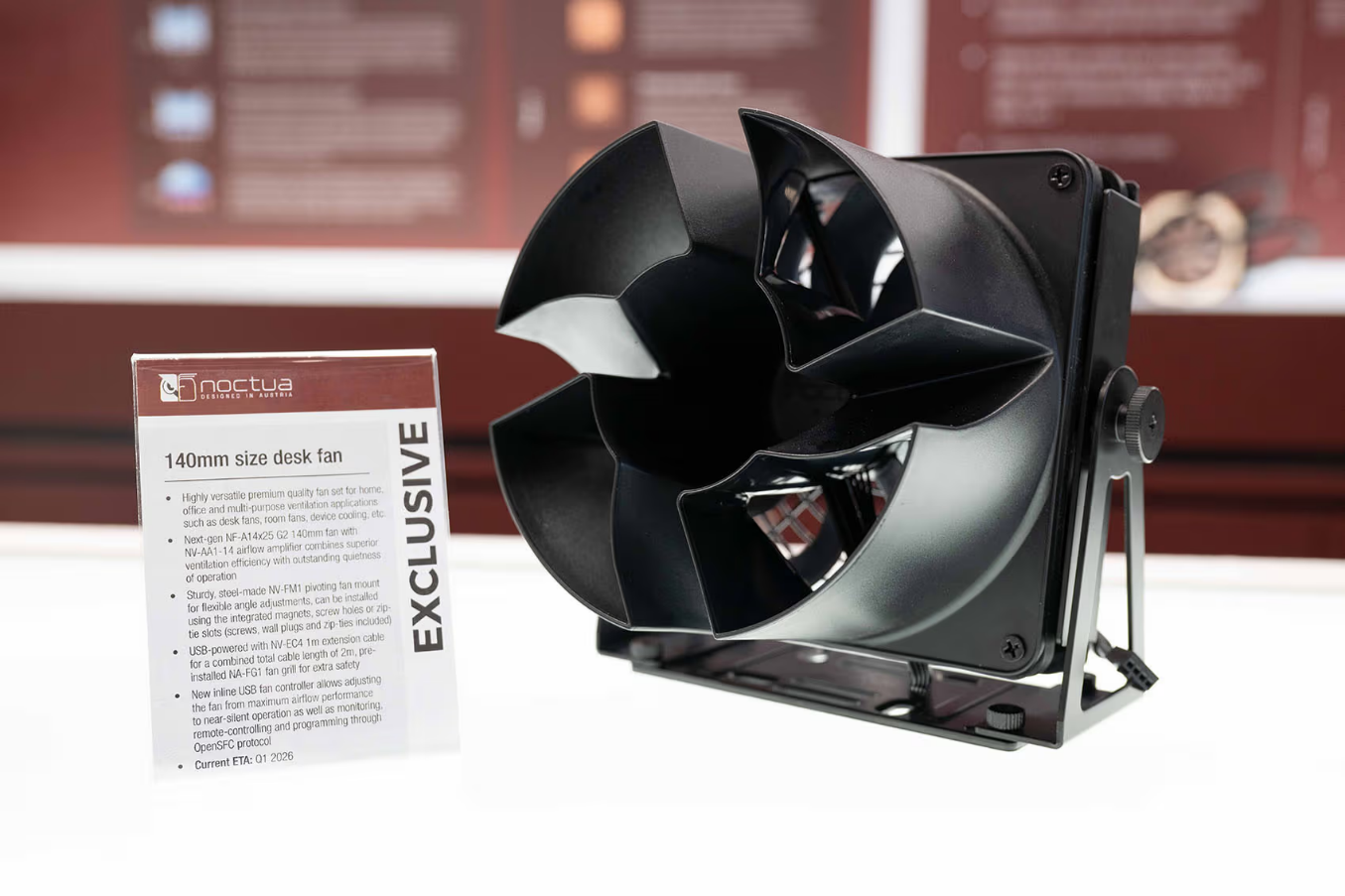
With all the releases slated for Q2, Q3 is set to be a little less exciting. We can expect a 140mm desk fan, a USB fan controller to pair it with, and last but not least, a Seasonic Prime PX Noctua Edition power supply.
The advent of the Seasonic Prime PX Noctua Edition is particularly interesting, as it brings a Noctua Edition power supply to a more mainstream power envelope.
Currently, Noctua is already selling a PSU in partnership with Seasonic – the Prime TX-1600 Noctua Edition, which, as its name implies, is a very beefy unit capable of delivering 1,600 watts nominal. That is a huge amount of power, and not everyone needs this.
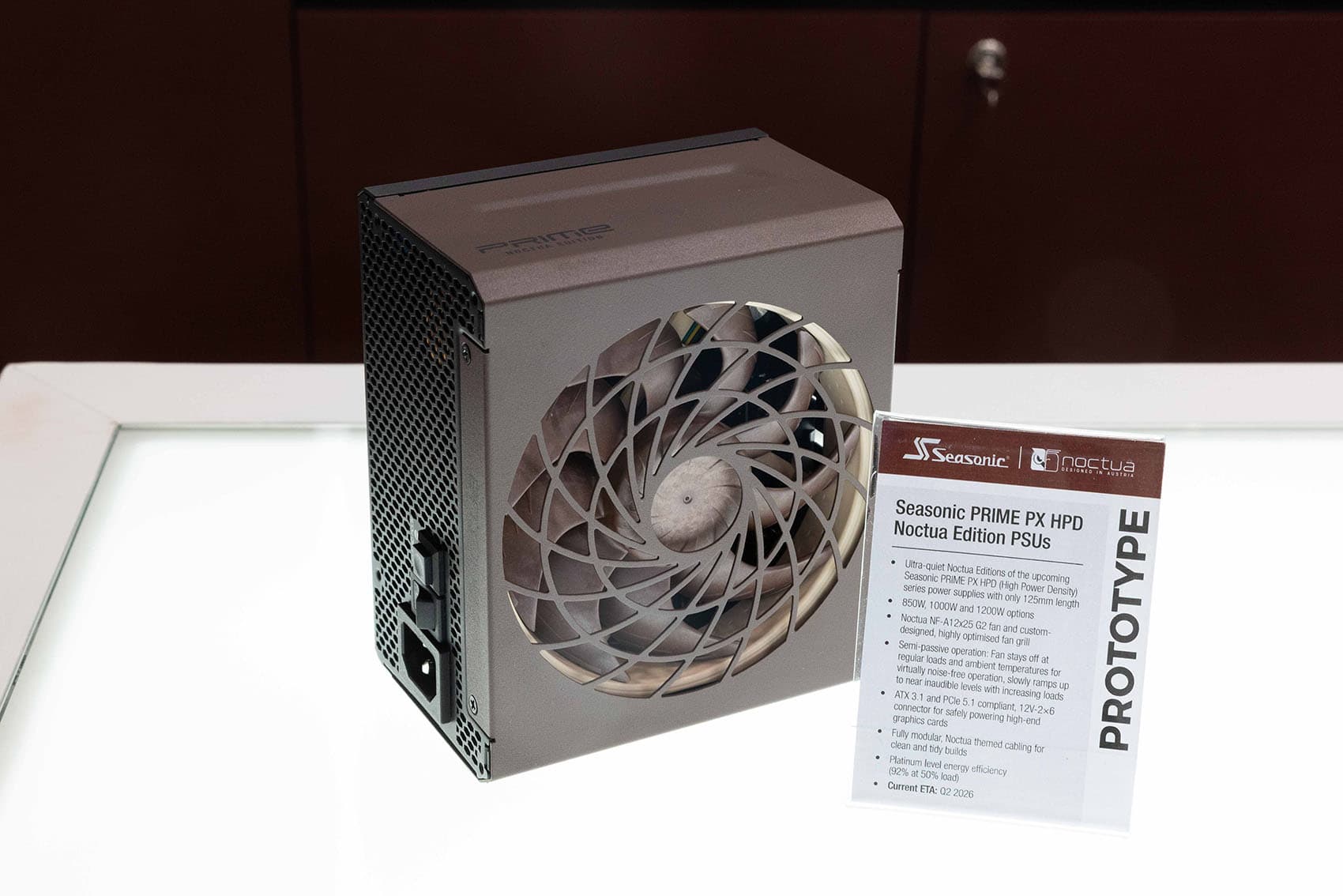
The Prime PX HPD series will come in envelopes of 850 W, 1,000 W, and 1,200 W, which is much more appropriate for the masses.
To give some context to this statement, Even The Stout Owl, a fully handmade wooden PC with 100% Noctua G2 fans, which packs a Core Ultra 9 285K, 96 GB of DDR5 CUDIMM memory, 4 TB of SSD space, and a Noctua RTX 5080, only typically pulls around 500 watts under real-world loads. With synthetic loads, this figure gets pushed to 800-810 watts, meaning even that PC could make do with the smallest PSU of the lot.
But keep in mind that PSUs operate at peak efficiency around 50% load (generally speaking, this is a good rule of thumb to go by), which gives a good argument for slightly oversizing a PSU. Oversize too far, and you’ll end up with unnecessarily higher idle draw and never reach peak efficiency. For more on PSU bottlenecks and sweetspots, we've done our own testing last year with the RTX 5090.
The Prime PX series is also a short power supply, barely fitting a 120mm fan. This makes them fit in pretty much all but the smallest cases. Of course, the Noctua-Edition Prime PX’s will also come with an NF-A12x25 G2 fan installed, a brown shroud with Noctua’s signature intake-noise-reducing shape, and Noctua-themed cabling.
The Thermosiphon is still MIA, for now
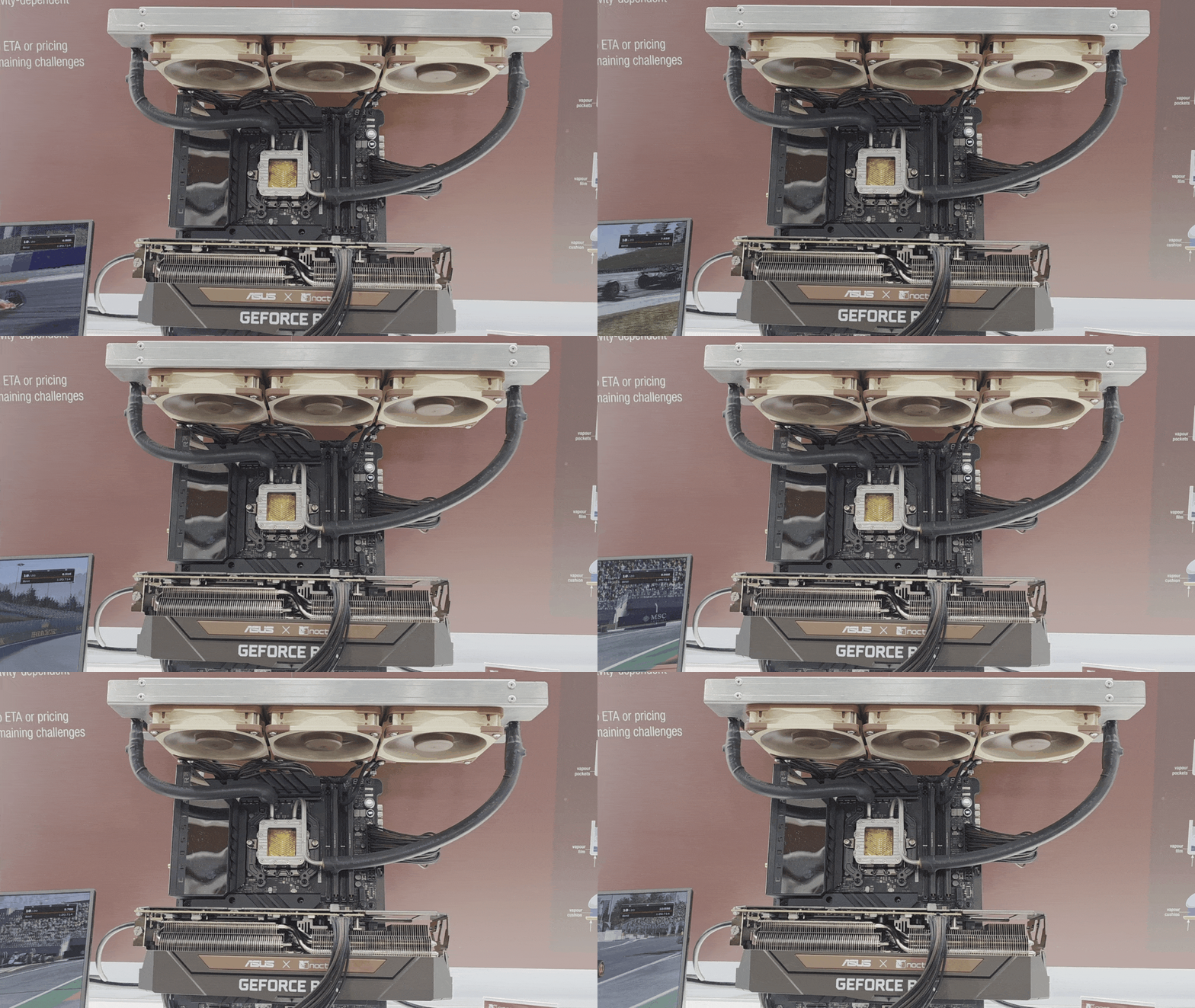
One of Noctua's most anticipated products is the elusive thermosiphon cooler.
With Noctua’s take on pump noise, a thermosiphon cooler would be the perfect outcome, as it would need a pump. Instead of being filled with water, a thermosiphon cooler is filled with a phase-changing coolant, which boils when subjected to heat from the CPU, and condenses when cooled in the radiator.
Except unlike a heatpump or air-conditioner, this doesn’t happen under the mighty force of a compressor – rather, the coolant is one that’s engineered to evaporate and condense at temperatures typically seen in PCs, rising from the boil, and falling back down by gravity as a liquid – a passive, gravity-driven cycle. This is similar to the process that happens in heatpipes.
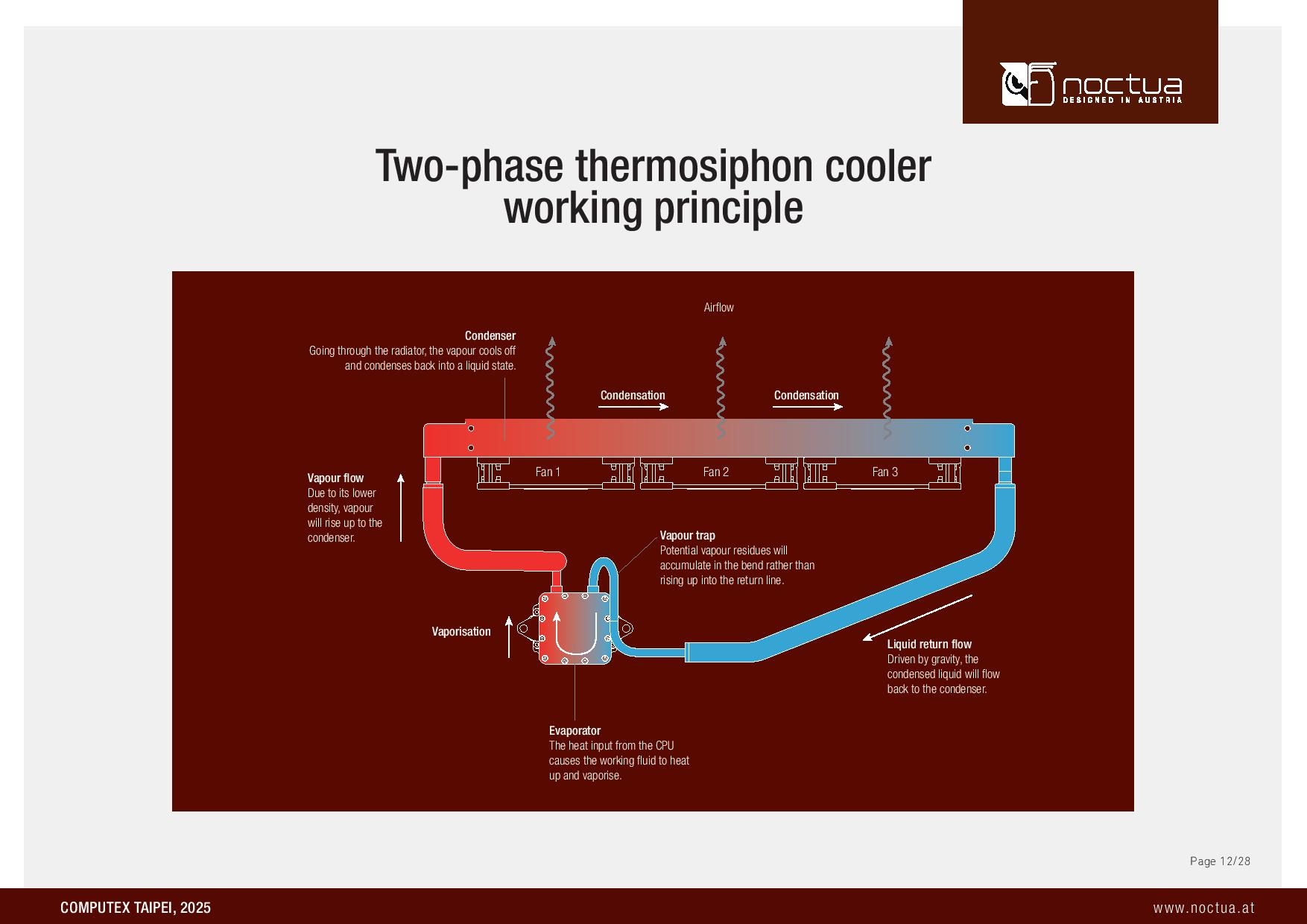
For something as complex as this, it’s no surprise we can’t find the thermosiphon cooler on the roadmap. It was first demoed at Computex in 2024, but has been in the works long before then, according to our own sources. The thermosiphon cooler is something Noctua is developing in partnership with Calyos, which has experience building computer cases that act as passive heatsinks, driven by phase-change cooling.
With the complexities of developing a product such as a phase-change cooler, Noctua has said that the thermosiphon cooler will not be listed on the roadmap until it is near completion, nor will it give a rough ETA.
The curious case of the disappearing NH-D12
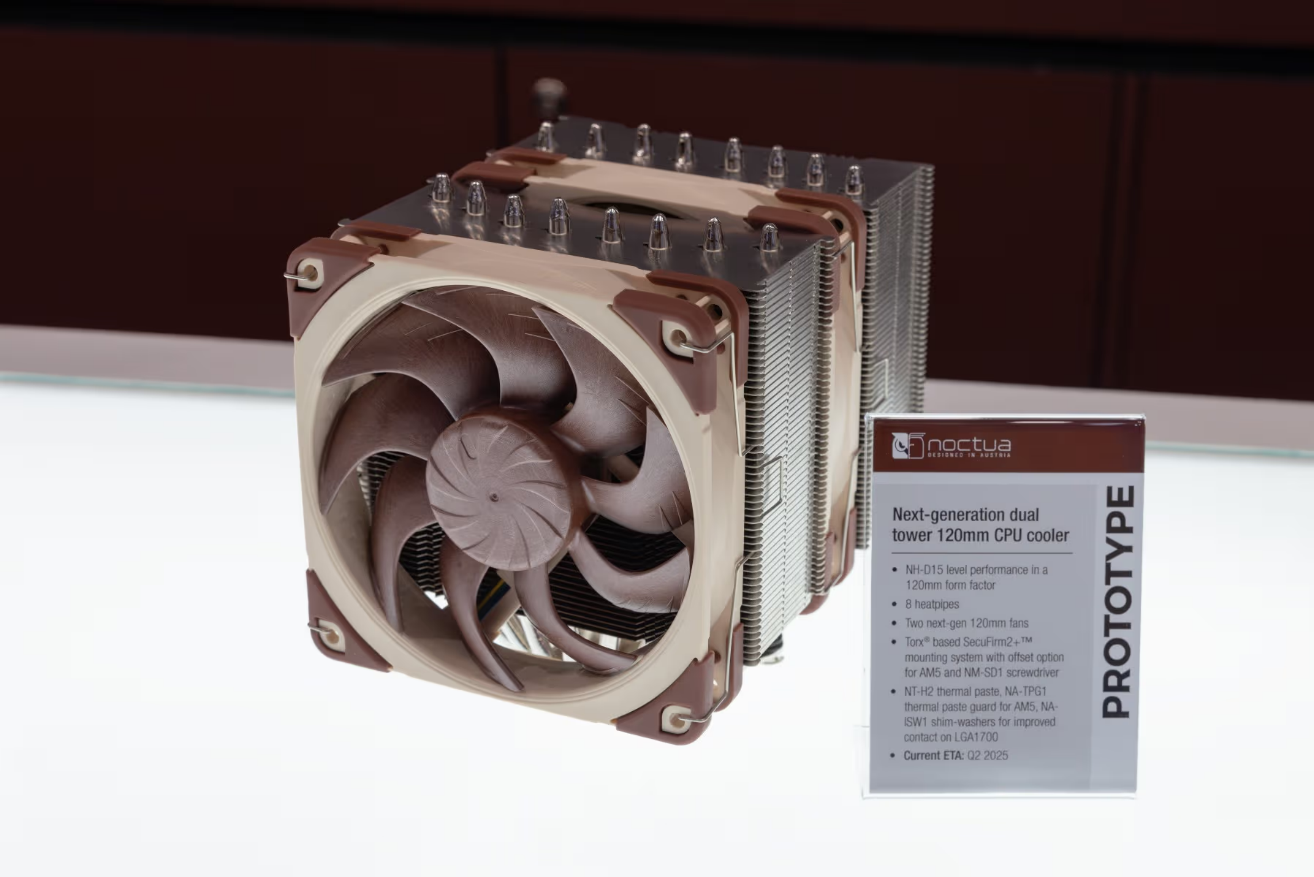
Also demonstrated at Computex in 2024 was Noctua’s first full-size, dual-tower 120mm CPU cooler. Noctua has been around for 20 years, and in all that time, it has never built a dual-tower, dual-120mm-fan CPU cooler that uses standard square-frame fans.
Yes, the legendary NH-D15 and the new NH-D15 G2 are phenomenal coolers – but they’re huge, and with the round-frame fans, they look a bit incohesive, lacking clearly-defined boundaries. Of course, one of the reasons it may have disappeared off the roadmap is the limited situations in which a D12 may be needed – for space-restricted applications, Noctua already builds the D12L, a low-profile variant, and where there is enough space, the D15 will offer superior performance.
All that said, Noctua had stated that the prototype D12 offered D15-level performance in a 120mm form factor. However, being a smaller cooler, it’d have to cost less than the D15, and we don’t imagine Noctua is in the market to cannibalize its own product portfolio.
The NH-D12 was revealed in June 2024, and at the time, it had a release window of Q2 2025. It’s now a year later, and it’s nowhere to be seen on Noctua’s roadmap.
As Noctua's roadmap evolves, and we get a better understanding of what's on offer, be sure to check back on this page for updates. Who knows, we might even have the NH-D12 back on the roadmap.



 English (US) ·