
Westerns hook you in a different rhythm than most genres. And they have a pretty niche audience I must say. So for instance, unless you’re watching the best ones, it’s hard to sit through a western anyway unless you love the whole cowboy vibe. They do not always sprint. The great ones know how to stalk. You are watching pressure ripen through the slightest quirks of the genre and that’s the beauty of it.
These 10, however, are the kind of westerns that you would sit through and actually enjoy them regardless of whether you like the genre or not. That’s how good they are and how well they hook. And they are not all fast in the same way. Some are tense. Some are grand. Some are brutal. Some are funny in dry, lethal little bursts. But they all understand propulsion.
10 'Open Range' (2003)
 Image via Touchstone Pictures
What I love about Open Range is how confidently it lets its pace breathe without ever letting your attention wander. That is a hard balance, and it gets it exactly right. The early sections are full of ordinary frontier routines, men living out on the land, eating, talking, moving cattle, handling small tensions before they curdle into bigger ones. But none of that feels like stalling. It feels like the movie quietly teaching you what kind of life is being threatened. Boss Spearman (Robert Duvall) and Charley Waite (Kevin Costner) are are men who have made a working moral arrangement with the world, and once that arrangement gets violated by Denton Baxter’s (Michael Gambon) cruelty, the film starts humming with contained anger.
And that anger is what keeps the whole movie hooked into you. Duvall gives Boss such lived-in authority, while Costner makes Charley feel like a man who has spent a long time trying not to become the version of himself violence keeps calling back into existence. The romance thread never drags the movie down either, because it is tied to the larger question of whether a man like Charley can ever belong to ordinary life again. Then that final gunfight justifies every bit of the slow-burn structure.
9 '3:10 to Yuma' (2007)
 Image via Lionsgate
This movie is one of the best examples of a western understanding that movement itself can be suspense. Get Ben Wade (Russell Crowe) to the train. That is the engine. Such a simple goal, and it gives the whole film shape immediately. The beauty is that the shape keeps getting more complicated the longer it runs. Dan Evans (Christian Bale) is trying to hold onto his own idea of himself in front of his son, his debt, his humiliation, and his half-broken place in the world. Ben is not just a prisoner either. He is funny, intelligent, observant, dangerous, and weirdly interested in the weaknesses of the men around him. So the film keeps turning the escort plot into an emotional duel.
3:10 to Yuma never lets either man flatten into an easy type. Dan and Ben’s scenes together are the movie’s real action, even before the bullets start flying. Then once the final race to Contention begins, the film becomes almost unbearably tight. The movie is so exciting by then — the moral stakes have become inseparable from the physical ones.
8 'The Magnificent Seven' (1960)
 Image via United Artists
The Magnificent Seven hooks you because it understands one of cinema’s oldest pleasures: assembling the right people for the wrong job under the right amount of pressure. The village is under threat. The bandits keep returning. Protection must be bought somehow. Then the film starts bringing in these gunmen, each with a distinct rhythm, ego, sadness, or streak of fatalism, and suddenly you are in a community-building story, a men-in-search-of-purpose story, and a “what does skill mean once the world has stopped paying for it honorably” story. That is rich fuel.
And the film never loses momentum because every phase has its own charge. The recruitment is fun. The training and defense preparation are fun. The uneasy bond between the villagers and the gunmen deepens things without killing pace. Calvera (Eli Wallach) is also a huge reason the movie moves so well, because he gives the threat personality without turning him into a cartoon. You understand exactly why the villagers are terrified of his return. Then the final stand lands because the film has done the essential western work: it has made protection costly and belonging temporary. You stay hooked because the movie keeps asking what these men are actually fighting for once the paycheck becomes the least interesting answer.
7 'High Noon' (1952)
 Image via United Artists
This one is all tension design. There is almost no wasted motion in High Noon. The film follows a marshal (Gary Cooper) who learns that a man he once sent away is coming back on the noon train, revenge is clearly the mission, and instead of riding out, he stays and tries to gather help from a town that keeps finding more respectable ways to abandon him. That setup is brilliant because it turns suspense into moral exposure. The danger is not just Frank Miller (Ian MacDonald) arriving. The danger is time revealing who the town really is. Every clock shot is not just countdown mechanics. It is accusation.
Cooper’s Will Kane does not feel invincible or swaggering. He feels tired, uneasy, stubborn, and almost humiliated by how badly he needs support from people who keep retreating into excuses. That emotional exposure is what keeps the film hooked into you so hard. The church debate, the deputies backing off, the new bride caught between principle and love, all of it tightens the noose.
6 'Tombstone' (1993)
 Image via Hollywood Pictures
There is a reason Tombstone remains so insanely rewatchable. It has that rare big-cast western electricity where every entrance feels like it might start another movie you would also happily watch. Wyatt Earp (Kurt Russell) is looking for something like peace or at least profitable semi-retirement, and the film knows how funny and doomed that sounds in a place like Tombstone.
The town is already humming with vice, swagger, gang pressure, and men whose personalities seem too large for civilization to contain comfortably. That means the movie never struggles to generate momentum. It is already overheated before the shooting properly starts. And then Doc Holliday (Val Kilmer) gives the whole film a pulse too alive to ignore. He does not just steal scenes. He changes the rhythm of them. Suddenly wit, death drive, loyalty, sickness, elegance, and self-destruction are all in the room at once. Russell is excellent because he keeps Wyatt grounded enough that the larger-than-life material still has a spine. What keeps the movie hooked from start to finish is how well it knows escalation. It never feels like random cowboy incident. It feels like a town moving toward inevitable combustion, and every joke, romance, betrayal, and gunfight is feeding that combustion.
5 'The Proposition' (2005)
 Image via Sony Pictures Releasing
The Proposition hooks you like a fever. It is not fun in the same register as some of the others on this list, but it is so tense and so poisoned from the beginning that it becomes impossible to look away. The proposition itself is already a perfect piece of western cruelty: capture or kill your older brother and your younger brother lives. That is savage story architecture. It turns family, law, colonial authority, masculine violence, and moral compromise into one single blade. Then the Australian frontier setting makes everything even harsher.
What makes the film so gripping is that nobody gets to remain clean inside the premise. Captain Stanley (Ray Winstone) is trying to perform civilization through force. Charlie Burns (Guy Pearce) is caught between survival and blood. Arthur Burns (Danny Huston) is less a man than a dreadful magnetic center pulling everyone toward him. The movie is full of heat, flies, dust, and this awful sense that the social order being imposed is already rotten at the root. You stay hooked because the film keeps asking who will finally become monstrous first, and the answer keeps spreading.
4 'Unforgiven' (1992)
 Image via Warner Bros.
This film hooks you by making you wait for violence while teaching you, scene by scene, exactly why violence should no longer be trusted. That is one of the hardest tricks in the genre, because western audiences are trained to anticipate the gunfighter’s return, the old killer riding again, the legend proving itself one more time. Unforgiven knows that expectation is sitting there and uses it against you. William Munny (Clint Eastwood) does not come back into the story as some cool dormant monster waking up. He comes back as a tired farmer, a failing widower, a man telling himself he is not that man anymore while money, need, pride, and old reflexes begin pulling at him.
And every character deepens that pull. The Schofield Kid (Jaimz Woolvett) is all fantasy and nerves. Ned Logan (Morgan Freeman) brings memory and decency. Little Bill Daggett (Gene Hackman) is civilization as bullying performance, a man convinced that order justifies any ugliness if he is the one imposing it. The movie keeps widening the emotional cost of violence long before the final eruption arrives. So when the saloon sequence finally happens, it lands with the force of reckoning rather than payoff. That is why the movie is so gripping. It understands that suspense in a western can come not only from what might happen, but from dreading what will happen once a man stops pretending he left his old self behind.
3 'The Wild Bunch' (1969)
 Image via Warner Bros.
The Wild Bunch grabs you immediately because it feels like a world already coming apart before the plot has properly started. Pike Bishop (Sam Peckinpah) opens with children watching scorpions consumed by ants, then erupts into one of the most chaotic and violent openings in western history, and the film never lets the sensation of collapse leave your body after that. The Bunch are not just outlaws on one last score. They are men out of time, dragging old codes through a modernizing world that no longer has room for their kind of criminal honor or even their kind of brutality. That gives every movement in the story an undertow of extinction.
And the movie keeps you hooked because it understands contradiction so well. These men are cruel, loyal, funny, exhausted, pathetic, dangerous, and occasionally noble in ways that never cancel out the rest. Pike Bishop (William Holden) is the center of that contradiction, a leader carrying enough self-knowledge to understand the life is doomed and still unable to imagine another one. The train robbery, the border politics, the Angel situation, the final walk, all of it works because the movie keeps turning momentum into destiny. You are not just watching a gang movie but a species of man head toward its own ritual end.
2 'Django Unchained' (2012)
 Image via The Weinstein Company
Djano Unchained stays entertaining from start to finish because it has one of the most powerful propulsion systems any western has ever built: love plus revenge plus liberation. Django (Jamie Foxx) is not just trying to survive the frontier or outdraw another man or protect a town. He is trying to get his wife back from hell. That gives everything, every conversation, every deception, every bit of comic cruelty, and every gunshot a bigger emotional engine. Quentin Tarantino knew how to exploit that engine. The film can be funny, grotesque, suspenseful, indulgent, outrageous, and still never lose the clean forward movement of Django getting closer to Candieland and closer to the world that stole Broomhilda from him.
And what makes the movie so sticky is how well its different tones feed each other rather than cancel each other out. Dr. King Schultz (Christoph Waltz) gives the film such verbal lightness and moral complexity that he turns every explanatory scene into play. Calvin Candie (Leonardo DiCaprio) is a perfect late-film accelerator because he makes the house itself feel like a theater of violence pretending to be sophistication. Then Foxx keeps Django’s emotional line clean enough that the whole movie never drifts into pure showboating. Yes, it has that modern western swagger. Of course it does. But it also has focus, and that focus is what makes the entertainment feel complete rather than scattered.
1 'The Good, the Bad and the Ugly' (1966)
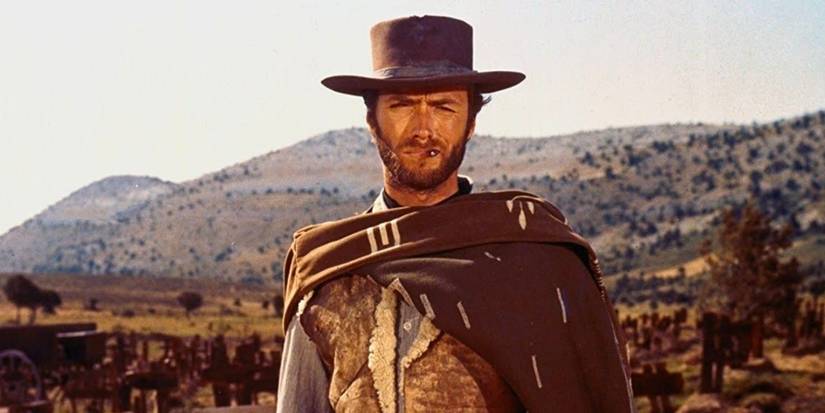 Image via United Artists
The Good, the Bad, and the Ugly may be the most gloriously sustained piece of western entertainment ever made. Not the saddest. Not the most morally profound. Not the most intimate. The most sustained. It is almost absurd how completely it keeps hold of you for its entire running time. Leone understands that a western can be huge and leisurely and still never feel slack if every scene is charged correctly. Blondie (Clint Eastwood), Tuco (Eli Wallach), and Angel Eyes (Lee Van Cleef) are not just three men in a hunt for buried gold. They are three perfectly calibrated narrative energies. One cool and withholding. One frantic and shameless and weirdly lovable. One deathly patient and professional in the ugliest way. Put them into the same story and the film almost cannot stop generating momentum.
And then there is the scale. Civil War wreckage, prison camps, desert crossings, betrayals, reunions, shifting alliances, the bridge sequence, the cemetery, the score, every part of the movie keeps enlarging the journey without losing the dirty little pleasure of wanting to know who gets the money and how. That is the secret of its greatness as entertainment. It is epic, yes, but it never stops being mischievously invested in character friction and game mechanics. Then the final three-way showdown arrives and somehow pays off not just the plot, but the entire accumulated rhythm of the movie. That is why it sits at the top. It does not merely hold your attention. It owns it.
Collider Exclusive · Oscar Best Picture Quiz
Which Oscar Best Picture
Is Your Perfect Movie?
Parasite · Everything Everywhere · Oppenheimer · Birdman · No Country
Five Oscar Best Picture winners. Five completely different visions of what cinema can be — and what it can do to you. One of them is the film that was made for the way your mind works. Ten questions will figure out which one.
🪜Parasite
🌀Everything Everywhere
☢️Oppenheimer
🐦Birdman
🪙No Country for Old Men
FIND YOUR FILM →
01
What kind of film experience do you actually want? The best movies don't just entertain — they leave something behind.
ASomething that pulls the rug out — that makes me think I'm watching one kind of film and then reveals I'm watching another entirely. BSomething overwhelming — funny, sad, absurd, and genuinely moving, all at once. CSomething grand and weighty — a film that makes me feel the full scale of what I'm watching. DSomething formally daring — a film that pushes what cinema can even do. ESomething lean and relentless — pure tension with no wasted frame.
NEXT QUESTION →
02
Which idea grabs you most in a film? Great films are driven by a central obsession. What's yours?
AClass, inequality, and what people are willing to do when desperation meets opportunity. BIdentity, family, and the chaos of trying to hold your life together when everything is falling apart. CGenius, moral responsibility, and the catastrophic weight of a decision you can never take back. DEgo, legacy, and the terror of becoming irrelevant while you're still alive to watch it happen. EEvil, chance, and whether moral order actually exists or if we just tell ourselves it does.
NEXT QUESTION →
03
How do you like your story told? Form is content. The way a story is shaped changes what it means.
AGenre-twisting — I want it to start in one lane and migrate into something completely different. BMaximalist and genre-blending — comedy, action, drama, sci-fi, all in one ride. CEpic and non-linear — cutting between timelines, building a mosaic of cause and consequence. DA single unbroken flow — I want to feel like I'm living it in real time, no cuts to safety. ESpare and precise — every scene doing exactly what it needs to do and nothing more.
NEXT QUESTION →
04
What makes a truly great antagonist? The opposition defines the protagonist. What kind of opposition fascinates you?
AA system — invisible, structural, and almost impossible to fight because it has no single face. BThe self — the ways we sabotage, abandon, and fail the people we love most. CHistory — the unstoppable momentum of events that no single person can stop or redirect. DThe industry — the machinery of culture that chews up talent and spits out irrelevance. EPure, implacable evil — a force so certain of itself it becomes almost philosophical.
NEXT QUESTION →
05
What do you want from a film's ending? The final note is the one that lingers. What do you want it to sound like?
AShock and inevitability — a conclusion that recontextualises everything that came before it. BEarned emotion — I want to cry, laugh, and feel genuinely hopeful, even if the world is a mess. CDevastation and grandeur — an ending that makes me sit in silence for a few minutes after. DAmbiguity — something that leaves enough open that I'm still thinking about it days later. EBleakness — an honest refusal to pretend the world is tidier than it actually is.
NEXT QUESTION →
06
Which setting pulls you in most? Where a film takes place shapes everything — mood, stakes, what's even possible.
AA gleaming modern city with a hidden underside — beauty masking rot, wealth masking desperation. BA collapsing suburban life that opens onto something infinite — the multiverse of a single ordinary person. CThe corridors of power and science at a world-historical turning point — where decisions echo for decades. DThe grimy, alive chaos of New York and Hollywood — fame as both destination and trap. EVast, indifferent landscape — desert and highway where violence arrives without warning or reason.
NEXT QUESTION →
07
What cinematic craft impresses you most? Every great film has a signature — a technical or artistic element that makes it unmistakable.
AProduction design and mise-en-scène — every frame composed to carry meaning beneath the surface. BEditing and tonal control — the ability to move between registers without losing the audience. CScore and sound design — music that becomes inseparable from the dread and awe of what you're watching. DCinematography as performance — the camera not recording events but participating in them. ESilence and restraint — what's left unsaid and unshown doing more work than any dialogue could.
NEXT QUESTION →
08
What kind of main character do you root for? The protagonist is the lens. Who you choose to follow says something about you.
ASomeone smart and resourceful who makes increasingly dangerous decisions under pressure. BSomeone overwhelmed and ordinary who turns out to be capable of something extraordinary. CA brilliant, tortured figure whose gifts and flaws are inseparable from each other. DA self-destructive artist whose ego is both their superpower and their undoing. EA quiet, principled person trying to make sense of a world that has stopped making sense.
NEXT QUESTION →
09
How do you feel about a film that takes its time? Pace is a choice. Some films sprint; others let tension accumulate slowly, deliberately.
AI love a slow build when I know the payoff is going to be seismic — patience for a devastating reveal. BGive me relentless momentum — I want to feel breathless and emotionally spent by the end. CEpic runtime doesn't scare me — if the material demands three hours, give me three hours. DI want it to feel propulsive even when nothing is technically happening — restless energy throughout. EDeliberate and unhurried — I want dread to accumulate in the spaces between the action.
NEXT QUESTION →
10
What do you want to feel walking out of the cinema? The best films leave a mark. What kind of mark do you want?
AUnsettled — like I've just seen something I can't fully explain but can't stop thinking about. BMoved and energised — like the film reminded me what actually matters and gave me something to hold onto. CHumbled — like I've been in the presence of something genuinely important and overwhelming. DExhilarated — like I've just seen cinema doing something it's never quite done before. EHaunted — like a cold, quiet dread that stays with me for days.
REVEAL MY FILM →
The Academy Has Decided Your Perfect Film Is…
Your answers have pointed to one Oscar Best Picture winner above all others. This is the film that was made for the way your mind works.
Parasite
You are drawn to films that operate on multiple levels simultaneously — that begin in one genre and quietly, brilliantly migrate into another. Bong Joon-ho's Parasite is a film about class, desire, and the architecture of inequality that manages to be darkly funny, deeply suspenseful, and genuinely shocking across a single extraordinary running time. Your instinct is for cinema that hides its true intentions until the moment it's ready to reveal them. Parasite is exactly that — a film that rewards close attention and punishes assumptions, right up to its devastating final image.
Everything Everywhere All at Once
You want it all — and this film gives you all of it. The Daniels' Everything Everywhere All at Once is one of the most maximalist films ever made: action comedy, multiverse sci-fi, family drama, existential crisis, and a genuinely earned emotional core that sneaks up on you amid the chaos. You are someone who responds to ambition, who doesn't want cinema to choose between being entertaining and being meaningful. This film refuses that choice entirely. It is overwhelming by design, and its overwhelming nature is precisely the point — because the feeling of being crushed by infinite possibility is exactly what it's about.
Oppenheimer
You are drawn to cinema on a grand scale — films that understand history not as a backdrop but as a force, and that place their characters inside that force and watch what happens. Christopher Nolan's Oppenheimer is a film about the terrifying gap between what we can do and what we should do, told with the full weight of one of the most consequential moments in human history behind it. You want your films to feel important without feeling self-important — to earn their ambition through sheer craft and the gravity of their subject. Oppenheimer does exactly that. It is enormous, complicated, and refuses easy comfort.
Birdman
You are drawn to films that foreground their own construction — that make the how of the filmmaking part of the what it's about. Alejandro González Iñárritu's Birdman, shot to appear as a single continuous take, is cinema examining itself through the cracked mirror of a fading actor's ego. You respond to formal daring, to the feeling that a film is doing something that probably shouldn't be possible. Michael Keaton's performance and Emmanuel Lubezki's restless camera create something genuinely unlike anything else — a film that is simultaneously about creativity, relevance, self-destruction, and the impossibility of ever truly knowing if your work means anything at all.
No Country for Old Men
You are drawn to cinema that trusts silence, that refuses to explain itself, and that treats dread as a form of meaning. The Coen Brothers' No Country for Old Men is a film about the arrival of a new kind of evil — implacable, arbitrary, and utterly indifferent to the moral frameworks we use to make sense of the world. It is one of the most formally controlled films ever made, and its controlled restraint is what makes it so terrifying. You want your films to haunt you, not comfort you. You are not interested in resolution if resolution would be dishonest. No Country for Old Men is honest in a way that most cinema never dares to be.
↻ RETAKE THE QUIZ







 English (US) ·