
 Image via Warner Bros.

Published May 28, 2026, 7:21 PM EDT
Michael John Petty is a Senior Author for Collider who spends his days writing, in fellowship with his local church, and enjoying each new day with his wife and daughters. At Collider, he writes features, reviews, recaps, and conducts interviews. In addition to writing about stories, Michael has told a few of his own. His novella, The Beast of Bear-tooth Mountain, was released in 2023. His Western short story, The Devil's Left Hand, received the Spur Award for "Best Western Short Fiction" from the Western Writers of America in 2025. Michael currently resides in North Idaho with his growing family.
Sign in to your Collider account
In honor of John Wayne's 119th birthday earlier this week, Fawesome TV has put together a list of some of the Duke's greatest Western hits, free of charge. From his collaborations with John Ford and Howard Hawks, spanning from the black-and-white era to true-blue Technicolor, the streaming platform allows for anyone to celebrate his decades-long Hollywood career through the month of May — and the month is almost over.
While some of these pictures will no doubt remain on the platform throughout June as well, Fawesome TV has only guaranteed that its "John Wayne collection" — which includes more films than we could list here — will be highlighted through the rest of this month. So, it's time to saddle your horses and get out on the open trail, because there's no better time to revisit these Western adventures than this weekend. Even better, Fawesome TV doesn't require a subscription — the app itself is entirely free.
10 'El Dorado' (1966)
 Image via Paramount Pictures
Director Howard Hawks famously described El Dorado as "no story, just characters," and that's certainly what audiences got. Robert Mitchum starred opposite Wayne as the pair played old friends, Sheriff J.P. Harrah and gunman Cole Thornton, respectively. El Dorado is the typical Western fare, as the two men defend a local rancher from a rival cattleman trying hard to encroach on their land and take it as their own. It's an age-old story, but one that continues to entertain.
Wayne and Mitchum were an unlikely on-screen pair, but "the big two" (as the poster referred to them) leaned into their respective Western styles for this Hawks picture. While often forgotten compared to some of Wayne's other '60s features, it's a Western worth the watch for those hoping for something that's equal parts different and the same from the Duke's typical material. James Caan also stars.
9 'She Wore a Yellow Ribbon' (1949)
 Image via RKO Radio Pictures
Although not John Ford's finest collaboration with the Duke, She Wore a Yellow Ribbon has long been praised by Western aficionados. When Captain Nathan Brittles (Wayne) is about to retire from his post in the U.S. Cavalry, conflict with a nearby band of Indians impedes his resignation. Forced to deliver the remaining women from Fort Starke to safety, Brittles finds himself in a bind.
Ironically, Ford didn't initially want Wayne to star in the picture due to his particular brand of "acting." However, the Duke surprised everyone involved, and delivered a fine performance in the end. Though certainly not Ford and Wayne's most popular picture, it's full of flirtatious romance and a complex leading man that keep the whole thing moving firmly long.
8 'Angel and the Badman' (1947)
 Image via Republic Pictures
One of the few popular John Wayne films to be available in the public domain, Angel and the Badman was written and directed by James Edward Grant, and featured the Duke as the title "badman." Of course, wounded gunslinger Quirt Evans isn't so bad, especially not when his Quaker "angel," Penny Worth (Gail Russell), nurses the gunman back to health. Forced to choose between his guns and his love, Quirt is brought to the end of himself as trouble closes in.
Angel and the Badman was the first Western that the Duke produced himself. Unlike many of his other pictures at the time, it was an intimate drama that challenged the macho gunslinger attitude and is far more dramatic than it is action-packed. But don't let that fool you, it's a great film — one that's slated to be remade later this year.
7 'Big Jake' (1971)
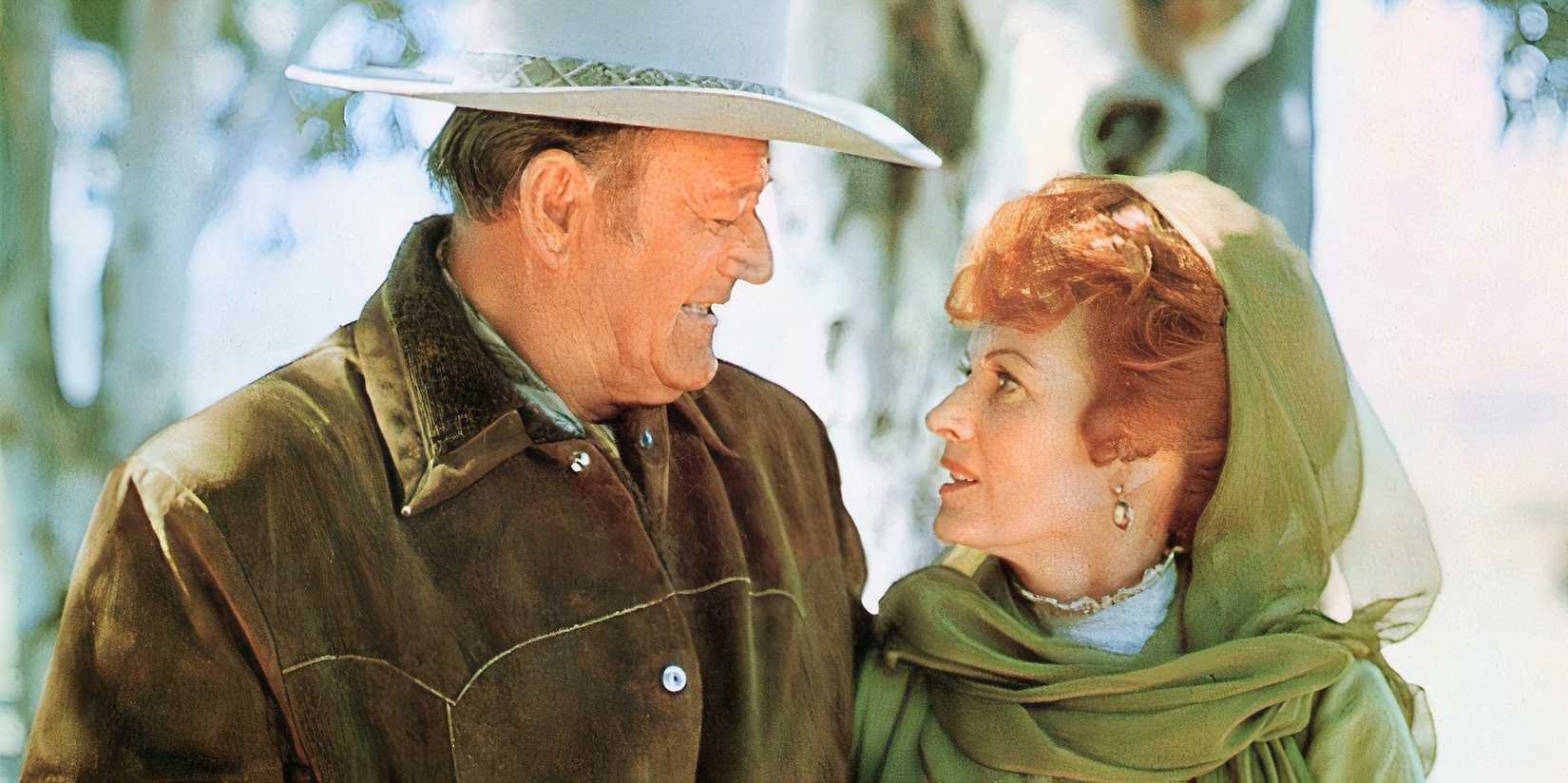 Image via Paramount Pictures
Near the tail end of the Duke's career, Wayne decided to make motion pictures a whole family affair. With his sons by his side both behind-the-scenes and on-camera, he starred as the title hero in George Sherman's Big Jake. When outlaw John Fain (played by Have Gun — Will Travel star Richard Boone) kidnaps Jacob McCandles' grandson, the old cowboy comes out of his exile to bring his wife, Martha (Maureen O'Hara), back the light in her life.
Big Jake was a bit controversial for Wayne at the time because it was the Western star at his most violent. After criticizing films like The Wild Bunch for their overly gory nature, Wayne's "Big Jake" kills a man with a pitchfork. Seriously. Of course, by today's standards, Big Jake is still probably pretty tame, and a solid horse opera perfect for an evening in.
6 'Fort Apache' (1948)
 Image via RKO
Another one of Wayne and Ford's earlier Westerns, Fort Apache remains beloved by many nearly 80 years later. The first installment of the pair's unofficial "Cavalry" trilogy (which continued with She Wore a Yellow Ribbon and concluded with Rio Grande), the film followed Wayne as Captain Kirby York who is paired with Lieutenant Colonel Owen Thursday (Henry Fonda) in dealing with the local Apache tribe. The problem is, Thursday wants nothing to do with the Indians while York has come to respect them.
This is probably partly why Fort Apache still boasts such a high audience score. Not only is the film a classic Western in every sense, but it was notable in its portrayal of Native Americans, offering them a human dignity and respect that other pictures had not. Though Ford had a complicated history in his depictions of Indians on the screen, Fort Apache was a step in the right direction — and, of course, Wayne is great here as always.
5 'True Grit' (1969)
 Image via Paramount Pictures
The Western that earned the Duke his Oscar, True Grit is a stunning picture that, for many, is the definitive John Wayne adventure. When U.S. Marshal Rooster Cogburn (Wayne) is hired by young Mattie Ross (Kim Darby) to hunt down her father's killer, the pair are soon joined by Texas Ranger La Boeuf (Glen Campbell). Together, they hunt Tom Chaney (Jeff Corey) across the turbulent American West.
Wayne loved Rooster Cogburn so much that he was the only character he ever reprised on the big screen. While the cash-grab sequel is a bit lackluster by comparison, the original True Grit is a masterwork of Western filmmaking that was certainly worth that Academy Award. Of all the Duke's most popular characters, Rooster may be his best.
4 'The Cowboys' (1972)
 Image via Warner Bros.
While Wayne would conclude his on-screen tenure in 1976 with The Shootist, his initial "passing the torch" film, The Cowboys, is arguably his best Western send-off. When Montana rancher Wil Andersen (Wayne) hires a bunch of boys to help him drive cattle across the state, he teaches them to become men on the open trail. Along the way, the cowboys are stalked by the merciless Asa Watts (Bruce Dern), who quickly sets his sights on Andersen's property.
One of only a few Wayne-led pictures to spawn a television continuation, The Cowboys was mighty controversial in its day for being one of the only films to, well, if you haven't seen it yet, we won't spoil it for you. Let's just say that this Mark Rydell film is a bit shocking toward the end, and certainly got audiences talking after leaving the theater. It may just do the same for you.
3 'Stagecoach' (1939)
 Image via United Artists
The Western that put John Wayne on the map, Stagecoach is an excellent John Ford film that helped elevate horse operas from B-picture fodder to A-list material. From the moment Wayne's "Ringo Kid" arrives on the scene, we know that this film is something special. Ford caught lightning in a bottle with this one, and as the small band of unlikely travelers ride across Apache territory, things go haywire in no time.
Few Westerns are as important to the overall genre as Stagecoach, and it was with this film that the Duke found his true calling. Sure, he had starred in Old West pictures before, but this film brought everything to a bigger level. No longer was the Western simply mindless entertainment, it was now a genuine romantic and emotionally complex genre. To this day, it's still one of the best.
2 'Rio Bravo' (1959)
 Image via Warner Bros.
Arguably one of Howard Hawks' finest achievements as a filmmaker, Rio Bravo was his and Wayne's answer to High Noon, a film neither particularly cared for. Rather than watching a lone lawman beg for help from those he'd sworn to protect, the pair believed that Wayne's Sheriff John T. Chance ought to demand help, with an eclectic group of deputies around him to protect their small Texas town. The results more than speak for themselves as Wayne is paired with the likes of Dean Martin, Ricky Nelson, Walter Brennan, and Angie Dickinson.
Rio Bravo has enough action, suspense, romance, and overall Western flair to fascinate, entertain, and rouse audiences. In many respects, it's Wayne's perfect lawman picture, proving that he can play the sheriff just as well as the soldier, the gunslinger, or the wounded old vet. A Western masterpiece that keeps getting better, Rio Bravo is a must-see for Duke fans everywhere.
1 'The Searchers' (1956)
 Image via Warner Bros.
Of course, even Rio Bravo must bend the knee to both John Wayne and John Ford's greatest motion picture. The Searchers is everything you could hope for in a Western. When former Confederate soldier Ethan Edwards (Wayne) returns home to find his family murdered by Comanches and niece missing, he partners up with Martin Pawley (Jeffrey Hunter) to track her down across the wild frontier. For years, they obsessively search for young Debbie (Natalie Wood), at risk of losing themselves in the pursuit.
Wayne stated on many occasions that The Searchers was his favorite of his films, and it's often been considered one of the greatest movies ever made. That's why we ranked it #1 on our list of the 20 greatest Western masterpieces. It really is that good, and if there's one film to revisit in honor of the Duke this May, it would undoubtedly be this one.
Collider Exclusive · Oscar Best Picture Quiz
Which Oscar Best Picture
Is Your Perfect Movie?
Parasite · Everything Everywhere · Oppenheimer · Birdman · No Country
Five Oscar Best Picture winners. Five completely different visions of what cinema can be — and what it can do to you. One of them is the film that was made for the way your mind works. Ten questions will figure out which one.
🪜Parasite
🌀Everything Everywhere
☢️Oppenheimer
🐦Birdman
🪙No Country for Old Men
FIND YOUR FILM →
01
What kind of film experience do you actually want? The best movies don't just entertain — they leave something behind.
ASomething that pulls the rug out — that makes me think I'm watching one kind of film and then reveals I'm watching another entirely. BSomething overwhelming — funny, sad, absurd, and genuinely moving, all at once. CSomething grand and weighty — a film that makes me feel the full scale of what I'm watching. DSomething formally daring — a film that pushes what cinema can even do. ESomething lean and relentless — pure tension with no wasted frame.
NEXT QUESTION →
02
Which idea grabs you most in a film? Great films are driven by a central obsession. What's yours?
AClass, inequality, and what people are willing to do when desperation meets opportunity. BIdentity, family, and the chaos of trying to hold your life together when everything is falling apart. CGenius, moral responsibility, and the catastrophic weight of a decision you can never take back. DEgo, legacy, and the terror of becoming irrelevant while you're still alive to watch it happen. EEvil, chance, and whether moral order actually exists or if we just tell ourselves it does.
NEXT QUESTION →
03
How do you like your story told? Form is content. The way a story is shaped changes what it means.
AGenre-twisting — I want it to start in one lane and migrate into something completely different. BMaximalist and genre-blending — comedy, action, drama, sci-fi, all in one ride. CEpic and non-linear — cutting between timelines, building a mosaic of cause and consequence. DA single unbroken flow — I want to feel like I'm living it in real time, no cuts to safety. ESpare and precise — every scene doing exactly what it needs to do and nothing more.
NEXT QUESTION →
04
What makes a truly great antagonist? The opposition defines the protagonist. What kind of opposition fascinates you?
AA system — invisible, structural, and almost impossible to fight because it has no single face. BThe self — the ways we sabotage, abandon, and fail the people we love most. CHistory — the unstoppable momentum of events that no single person can stop or redirect. DThe industry — the machinery of culture that chews up talent and spits out irrelevance. EPure, implacable evil — a force so certain of itself it becomes almost philosophical.
NEXT QUESTION →
05
What do you want from a film's ending? The final note is the one that lingers. What do you want it to sound like?
AShock and inevitability — a conclusion that recontextualises everything that came before it. BEarned emotion — I want to cry, laugh, and feel genuinely hopeful, even if the world is a mess. CDevastation and grandeur — an ending that makes me sit in silence for a few minutes after. DAmbiguity — something that leaves enough open that I'm still thinking about it days later. EBleakness — an honest refusal to pretend the world is tidier than it actually is.
NEXT QUESTION →
06
Which setting pulls you in most? Where a film takes place shapes everything — mood, stakes, what's even possible.
AA gleaming modern city with a hidden underside — beauty masking rot, wealth masking desperation. BA collapsing suburban life that opens onto something infinite — the multiverse of a single ordinary person. CThe corridors of power and science at a world-historical turning point — where decisions echo for decades. DThe grimy, alive chaos of New York and Hollywood — fame as both destination and trap. EVast, indifferent landscape — desert and highway where violence arrives without warning or reason.
NEXT QUESTION →
07
What cinematic craft impresses you most? Every great film has a signature — a technical or artistic element that makes it unmistakable.
AProduction design and mise-en-scène — every frame composed to carry meaning beneath the surface. BEditing and tonal control — the ability to move between registers without losing the audience. CScore and sound design — music that becomes inseparable from the dread and awe of what you're watching. DCinematography as performance — the camera not recording events but participating in them. ESilence and restraint — what's left unsaid and unshown doing more work than any dialogue could.
NEXT QUESTION →
08
What kind of main character do you root for? The protagonist is the lens. Who you choose to follow says something about you.
ASomeone smart and resourceful who makes increasingly dangerous decisions under pressure. BSomeone overwhelmed and ordinary who turns out to be capable of something extraordinary. CA brilliant, tortured figure whose gifts and flaws are inseparable from each other. DA self-destructive artist whose ego is both their superpower and their undoing. EA quiet, principled person trying to make sense of a world that has stopped making sense.
NEXT QUESTION →
09
How do you feel about a film that takes its time? Pace is a choice. Some films sprint; others let tension accumulate slowly, deliberately.
AI love a slow build when I know the payoff is going to be seismic — patience for a devastating reveal. BGive me relentless momentum — I want to feel breathless and emotionally spent by the end. CEpic runtime doesn't scare me — if the material demands three hours, give me three hours. DI want it to feel propulsive even when nothing is technically happening — restless energy throughout. EDeliberate and unhurried — I want dread to accumulate in the spaces between the action.
NEXT QUESTION →
10
What do you want to feel walking out of the cinema? The best films leave a mark. What kind of mark do you want?
AUnsettled — like I've just seen something I can't fully explain but can't stop thinking about. BMoved and energised — like the film reminded me what actually matters and gave me something to hold onto. CHumbled — like I've been in the presence of something genuinely important and overwhelming. DExhilarated — like I've just seen cinema doing something it's never quite done before. EHaunted — like a cold, quiet dread that stays with me for days.
REVEAL MY FILM →
The Academy Has Decided Your Perfect Film Is…
Your answers have pointed to one Oscar Best Picture winner above all others. This is the film that was made for the way your mind works.
Parasite
You are drawn to films that operate on multiple levels simultaneously — that begin in one genre and quietly, brilliantly migrate into another. Bong Joon-ho's Parasite is a film about class, desire, and the architecture of inequality that manages to be darkly funny, deeply suspenseful, and genuinely shocking across a single extraordinary running time. Your instinct is for cinema that hides its true intentions until the moment it's ready to reveal them. Parasite is exactly that — a film that rewards close attention and punishes assumptions, right up to its devastating final image.
Everything Everywhere All at Once
You want it all — and this film gives you all of it. The Daniels' Everything Everywhere All at Once is one of the most maximalist films ever made: action comedy, multiverse sci-fi, family drama, existential crisis, and a genuinely earned emotional core that sneaks up on you amid the chaos. You are someone who responds to ambition, who doesn't want cinema to choose between being entertaining and being meaningful. This film refuses that choice entirely. It is overwhelming by design, and its overwhelming nature is precisely the point — because the feeling of being crushed by infinite possibility is exactly what it's about.
Oppenheimer
You are drawn to cinema on a grand scale — films that understand history not as a backdrop but as a force, and that place their characters inside that force and watch what happens. Christopher Nolan's Oppenheimer is a film about the terrifying gap between what we can do and what we should do, told with the full weight of one of the most consequential moments in human history behind it. You want your films to feel important without feeling self-important — to earn their ambition through sheer craft and the gravity of their subject. Oppenheimer does exactly that. It is enormous, complicated, and refuses easy comfort.
Birdman
You are drawn to films that foreground their own construction — that make the how of the filmmaking part of the what it's about. Alejandro González Iñárritu's Birdman, shot to appear as a single continuous take, is cinema examining itself through the cracked mirror of a fading actor's ego. You respond to formal daring, to the feeling that a film is doing something that probably shouldn't be possible. Michael Keaton's performance and Emmanuel Lubezki's restless camera create something genuinely unlike anything else — a film that is simultaneously about creativity, relevance, self-destruction, and the impossibility of ever truly knowing if your work means anything at all.
No Country for Old Men
You are drawn to cinema that trusts silence, that refuses to explain itself, and that treats dread as a form of meaning. The Coen Brothers' No Country for Old Men is a film about the arrival of a new kind of evil — implacable, arbitrary, and utterly indifferent to the moral frameworks we use to make sense of the world. It is one of the most formally controlled films ever made, and its controlled restraint is what makes it so terrifying. You want your films to haunt you, not comfort you. You are not interested in resolution if resolution would be dishonest. No Country for Old Men is honest in a way that most cinema never dares to be.
↻ RETAKE THE QUIZ




 English (US) ·