
 Image via Warner Bros.
Published Jun 13, 2026, 2:53 PM EDT
Marcel is a writer who is passionate about most movies and series. He will watch anything that's good. He is a content manager by day and a videographer when needed. Marcel used to work at a major streaming service based in Asia Pacific as a Content Specialist and was the Distribution Manager for a local movie distribution company.
Sign in to your Collider account
Disaster movies live and die by their climaxes. Audiences can forgive thin characters, questionable pseudo-science, and even the occasional cheesy dialogue if the final act delivers the kind of spectacle and emotional payoff that makes the entire journey worthwhile. Some disaster movies hit the gas early but then fumble their endings. That's why those films, which will remain unnamed for now, are not on this list.
Here, we take a look at the best climaxes in the disaster movie genres. Of course, movies by the disaster film connoisseur Roland Emmerich are included, but you will also find some movies that may not belong to the hall of fame of disaster movies on this list, simply because they executed what they set out to do in the climax. From the destruction of an ancient city to a world-ending prophecy, these are the disaster movies that absolutely nailed their final act.
10 'Pompeii' (2014)

In the climax of Pompeii, Mount Vesuvius finally erupts and fully unleashes its destruction on the ancient city of Pompeii. The film's hero, Milo (Kit Harrington) is in the middle of a gladiator battle as fire and as engulfs the city. As the eruption intensifies, Milo and her lover Cassia (Emily Browning) attempt to escape the collapsing arena and burning city while earthquakes break the ground beneath them. Nevertheless, the destruction was too massive for them to escape.
Audiences who go to see Paul W.S. Anderson's Pompeii only want one thing: destruction on a grand level. The film postponed the sequence with its uneventful mix of Titanic and Gladiator. When the disaster hits, it is a great spectacle. As history tells us, the city was beyond saving and the film depicts its destruction and desperation perfectly. Everything else in the story does not matter at this point. The Mount Vesuvius eruption is the final boss for the characters to escape. The climax of this film is worth sitting through the lackluster story that came before.
9 'San Andreas' (2015)

Rescue helicopter pilot Ray Gaines (Dwayne Johnson) is trying to reach his daughter Blake (Alexandra Daddario), who is trapped in a collapsing building with her boyfriend in the climax of San Andreas. A massive earthquake triggers a tsunami that is heading towards the city, which would for sure destroy the building. Ray's estranged wife, Emma (Carla Gugino), also joins the rescue to save her.
San Andreas knows exactly what the audience wants. The movie is already filled with destruction sequences up until this point. Nothing groundbreaking, but still intense and entertaining. The film smartly raises the stakes by having earthquake, tsunami and collapsing skyscrapers altogether for the climax. The film's most effective weapon is the emotional journey. By anchoring everything in a simple family rescue story, it immediately resonates with the audience. The final climactic rescue is also relentless, playing with our expectations through its editing and pacing.
8 'The Poseidon Adventure' (1972)
 Image via 20th Century Fox
The climax of The Poseidon Adventure peaks as the surviving passengers make one final attempt to escape the capsized ship before it fully sinks. The group led by Reverend Scott (Gene Hackman) pushes toward the ship’s hull after walking through flooded sections of the ship. They must climb through a partially submerged engine room, where they can either fall to the rising water or get drowned.
The Poseidon Adventure is a non-stop survival journey. The survivors are left on their own to overcome a seemingly impossible environment. As they move through corridors, each obstacle becomes more and more difficult and hostile, just like in a game. The ensemble cast is fantastic, which sells the danger even more. The characters are constantly forced to make difficult choices, and the finale is the final hurdle before audiences can let out a huge exhale. The film was remade by Wolfgang Petersen in 2006, but this original film remains superior.
7 'Deep Impact' (1998)
 Paramount Pictures
In the climax of Deep Impact, the massive Ele coment fragment approaches, the American and Russian joint crew aboard the Messiah spacecraft led by Captain Tanner (Robert Duvall) attempt a last-ditch nuclear detonation to change its path. On Earth, massive tsunami waves engulf coastlines, forcing the people like Leo Beiderman (Elijah Wood) and his family to escape towards higher ground.
The film is overshadowed by the similar Armageddon, but it still has its own merits. The intercutting between the story in space and on Earth makes the climax so good and effective. The sacrifice of the Messiah crew gives the film a sense of desperation and inevitability while the sequences on Earth brings hope and emotional satisfaction that is more relatable as audiences. Unlike more chaotic disaster films, Deep Impact leans into inevitability, and that restraint makes the final moments more impactful. The emotional weight comes not from stopping the disaster, but from witnessing how people choose to face it.
6 '2012' (2009)
 Image via Sony Pictures Releasing
After escaping earthquakes and the Yellowstone eruption, Jackson Curtis (John Cusack) and his family finally find themselves on the launchpad of massive arks departing from the Himalayas in the final boss of disaster movies, 2012. Without a ticket, Curtis' family and a Russian billionaire's family had to go through the dangerous parts of the arks, and must overcome more disasters before reaching safety in the post-apocalyptic Earth.
Directed by master of disaster movies Roland Emmerich, 2012 was designed to be the disaster film to end all disaster films. The movie had no shortage of memorable destruction sequences. However, the climax of the film is confined to close spaces in the ark, only focusing on the characters that we have followed throughout the film. It is an interesting choice, but an effective one in terms of character arcs and story. For cinephiles, this movie might be cheesy but for the general audience, the final sequences are emotional and highly intense. It is no wonder that the film was the fifth highest-grossing film of 2009.
5 'Twister' (1996)
 Image via Warner Bros. Pictures
Estranged couple Jo (Helen Hunt) and Bill (Bill Paxton) finally encounter the elusive massive F5 tornado in the climax of Twister. They deploy their experimental sensor device, Dorothy, directly into the storm’s path to record its activity. However, the tornado intensifies, and they drive through everything to avoid colliding with it. In the end, Jo and Bill had to hide and tie themselves to an old structure so that they would be safe.
Twister is the kind of film that hits the gas from the very beginning and never really stops for a break. This climax continues the film's amazing momentum. The film turns weather into an active antagonist, and the final sequence feels like a direct confrontation with nature itself. While it also creates a larger spectacle, the climax also serves as the emotional resolution between Jo and Bill, as well as Jo's childhood trauma of seeing her father sucked by a tornado. The film's cutting-edge technology (the flying cow!) and its pure thrills make it a classic until today.
4 'The Towering Inferno' (1974)
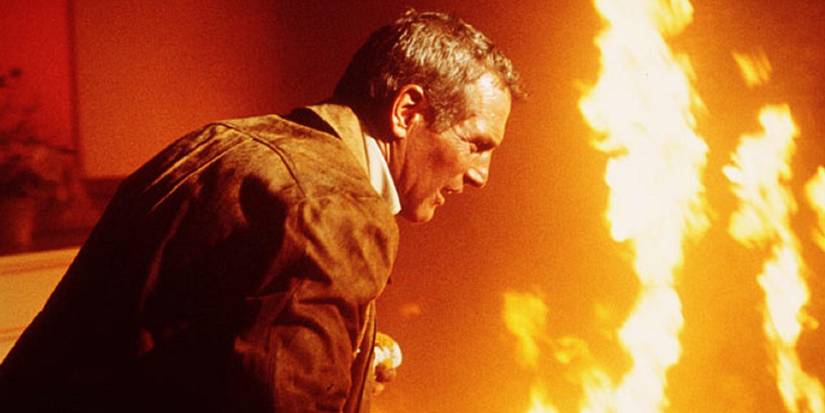 Image via 20th Century Studios
The climactic sequence of The Towering Inferno sees the titular burning skyscraper becomes an engulfed in fire from top to bottom. As the fire reaches the upper floors, the final stretch focuses on the rescue attempts led by the building architect Doug Roberts (Paul Newman) and the firefighters led by Chief O'Hallorhan (Steve McQueen). As the structure starts to collapse, the remaining survivors had to find ways to suppress the fire and buy time for the helicopter rescue.
The Towering Inferno has one of the most iconic star-studded ensemble cast that also includes Fred Astaire, Faye Dunaway, and even O.J. Simpson. Unlike many movies and shows today, the film is unafraid to kill the characters, making the stakes really high and everything extra dangerous. Despite all the carnage, the geography and space of the building are clear and it is easy to follow all these characters as they try to escape. It is one of the most relentless disaster films ever made, and remains a gold standard in this genre. This film also inspired the novel that became Die Hard.
3 'Armageddon' (1998)
 Image via Touchstone Pictures
In the climax of Armageddon, the drilling team led by Harry Stamper (Bruce Willis) struggles on the asteroid’s surface. Everything goes wrong as the equipment fails and explosions ripple across the asteroid. Meanwhile, the citizens of Earth are waiting in terror as the asteroid gets closer and closer. The final emotional peak comes when Harry stays on the asteroid to manually trigger the bomb, ensuring Earth’s survival while saying goodbye to his daughter over a video link.
With Michael Bay at the helm, Armageddon has no shortage of explosive moments. However, Bay also pairs them with an unapologetic emotional intensity. The film leans fully into scale and sentiment, but the sacrifice at the center grounds the chaos in something personal. It works because the film makes the mission feel progressively more impossible, so the final decision lands as both heroic and inevitable. Once Aerosmith's I Don't Want To Miss A Thing plays, you don't remember that you complained about how silly the premise was. It's the highest grossing film of 1998 and arguably one of Bay's best films.
Collider Exclusive · Oscar Best Picture Quiz
Which Oscar Best Picture
Is Your Perfect Movie?
Parasite · Everything Everywhere · Oppenheimer · Birdman · No Country
Five Oscar Best Picture winners. Five completely different visions of what cinema can be — and what it can do to you. One of them is the film that was made for the way your mind works. Ten questions will figure out which one.
🪜Parasite
🌀Everything Everywhere
☢️Oppenheimer
🐦Birdman
🪙No Country for Old Men
FIND YOUR FILM →
01
What kind of film experience do you actually want? The best movies don't just entertain — they leave something behind.
ASomething that pulls the rug out — that makes me think I'm watching one kind of film and then reveals I'm watching another entirely. BSomething overwhelming — funny, sad, absurd, and genuinely moving, all at once. CSomething grand and weighty — a film that makes me feel the full scale of what I'm watching. DSomething formally daring — a film that pushes what cinema can even do. ESomething lean and relentless — pure tension with no wasted frame.
NEXT QUESTION →
02
Which idea grabs you most in a film? Great films are driven by a central obsession. What's yours?
AClass, inequality, and what people are willing to do when desperation meets opportunity. BIdentity, family, and the chaos of trying to hold your life together when everything is falling apart. CGenius, moral responsibility, and the catastrophic weight of a decision you can never take back. DEgo, legacy, and the terror of becoming irrelevant while you're still alive to watch it happen. EEvil, chance, and whether moral order actually exists or if we just tell ourselves it does.
NEXT QUESTION →
03
How do you like your story told? Form is content. The way a story is shaped changes what it means.
AGenre-twisting — I want it to start in one lane and migrate into something completely different. BMaximalist and genre-blending — comedy, action, drama, sci-fi, all in one ride. CEpic and non-linear — cutting between timelines, building a mosaic of cause and consequence. DA single unbroken flow — I want to feel like I'm living it in real time, no cuts to safety. ESpare and precise — every scene doing exactly what it needs to do and nothing more.
NEXT QUESTION →
04
What makes a truly great antagonist? The opposition defines the protagonist. What kind of opposition fascinates you?
AA system — invisible, structural, and almost impossible to fight because it has no single face. BThe self — the ways we sabotage, abandon, and fail the people we love most. CHistory — the unstoppable momentum of events that no single person can stop or redirect. DThe industry — the machinery of culture that chews up talent and spits out irrelevance. EPure, implacable evil — a force so certain of itself it becomes almost philosophical.
NEXT QUESTION →
05
What do you want from a film's ending? The final note is the one that lingers. What do you want it to sound like?
AShock and inevitability — a conclusion that recontextualises everything that came before it. BEarned emotion — I want to cry, laugh, and feel genuinely hopeful, even if the world is a mess. CDevastation and grandeur — an ending that makes me sit in silence for a few minutes after. DAmbiguity — something that leaves enough open that I'm still thinking about it days later. EBleakness — an honest refusal to pretend the world is tidier than it actually is.
NEXT QUESTION →
06
Which setting pulls you in most? Where a film takes place shapes everything — mood, stakes, what's even possible.
AA gleaming modern city with a hidden underside — beauty masking rot, wealth masking desperation. BA collapsing suburban life that opens onto something infinite — the multiverse of a single ordinary person. CThe corridors of power and science at a world-historical turning point — where decisions echo for decades. DThe grimy, alive chaos of New York and Hollywood — fame as both destination and trap. EVast, indifferent landscape — desert and highway where violence arrives without warning or reason.
NEXT QUESTION →
07
What cinematic craft impresses you most? Every great film has a signature — a technical or artistic element that makes it unmistakable.
AProduction design and mise-en-scène — every frame composed to carry meaning beneath the surface. BEditing and tonal control — the ability to move between registers without losing the audience. CScore and sound design — music that becomes inseparable from the dread and awe of what you're watching. DCinematography as performance — the camera not recording events but participating in them. ESilence and restraint — what's left unsaid and unshown doing more work than any dialogue could.
NEXT QUESTION →
08
What kind of main character do you root for? The protagonist is the lens. Who you choose to follow says something about you.
ASomeone smart and resourceful who makes increasingly dangerous decisions under pressure. BSomeone overwhelmed and ordinary who turns out to be capable of something extraordinary. CA brilliant, tortured figure whose gifts and flaws are inseparable from each other. DA self-destructive artist whose ego is both their superpower and their undoing. EA quiet, principled person trying to make sense of a world that has stopped making sense.
NEXT QUESTION →
09
How do you feel about a film that takes its time? Pace is a choice. Some films sprint; others let tension accumulate slowly, deliberately.
AI love a slow build when I know the payoff is going to be seismic — patience for a devastating reveal. BGive me relentless momentum — I want to feel breathless and emotionally spent by the end. CEpic runtime doesn't scare me — if the material demands three hours, give me three hours. DI want it to feel propulsive even when nothing is technically happening — restless energy throughout. EDeliberate and unhurried — I want dread to accumulate in the spaces between the action.
NEXT QUESTION →
10
What do you want to feel walking out of the cinema? The best films leave a mark. What kind of mark do you want?
AUnsettled — like I've just seen something I can't fully explain but can't stop thinking about. BMoved and energised — like the film reminded me what actually matters and gave me something to hold onto. CHumbled — like I've been in the presence of something genuinely important and overwhelming. DExhilarated — like I've just seen cinema doing something it's never quite done before. EHaunted — like a cold, quiet dread that stays with me for days.
REVEAL MY FILM →
The Academy Has Decided Your Perfect Film Is…
Your answers have pointed to one Oscar Best Picture winner above all others. This is the film that was made for the way your mind works.
Parasite
You are drawn to films that operate on multiple levels simultaneously — that begin in one genre and quietly, brilliantly migrate into another. Bong Joon-ho's Parasite is a film about class, desire, and the architecture of inequality that manages to be darkly funny, deeply suspenseful, and genuinely shocking across a single extraordinary running time. Your instinct is for cinema that hides its true intentions until the moment it's ready to reveal them. Parasite is exactly that — a film that rewards close attention and punishes assumptions, right up to its devastating final image.
Everything Everywhere All at Once
You want it all — and this film gives you all of it. The Daniels' Everything Everywhere All at Once is one of the most maximalist films ever made: action comedy, multiverse sci-fi, family drama, existential crisis, and a genuinely earned emotional core that sneaks up on you amid the chaos. You are someone who responds to ambition, who doesn't want cinema to choose between being entertaining and being meaningful. This film refuses that choice entirely. It is overwhelming by design, and its overwhelming nature is precisely the point — because the feeling of being crushed by infinite possibility is exactly what it's about.
Oppenheimer
You are drawn to cinema on a grand scale — films that understand history not as a backdrop but as a force, and that place their characters inside that force and watch what happens. Christopher Nolan's Oppenheimer is a film about the terrifying gap between what we can do and what we should do, told with the full weight of one of the most consequential moments in human history behind it. You want your films to feel important without feeling self-important — to earn their ambition through sheer craft and the gravity of their subject. Oppenheimer does exactly that. It is enormous, complicated, and refuses easy comfort.
Birdman
You are drawn to films that foreground their own construction — that make the how of the filmmaking part of the what it's about. Alejandro González Iñárritu's Birdman, shot to appear as a single continuous take, is cinema examining itself through the cracked mirror of a fading actor's ego. You respond to formal daring, to the feeling that a film is doing something that probably shouldn't be possible. Michael Keaton's performance and Emmanuel Lubezki's restless camera create something genuinely unlike anything else — a film that is simultaneously about creativity, relevance, self-destruction, and the impossibility of ever truly knowing if your work means anything at all.
No Country for Old Men
You are drawn to cinema that trusts silence, that refuses to explain itself, and that treats dread as a form of meaning. The Coen Brothers' No Country for Old Men is a film about the arrival of a new kind of evil — implacable, arbitrary, and utterly indifferent to the moral frameworks we use to make sense of the world. It is one of the most formally controlled films ever made, and its controlled restraint is what makes it so terrifying. You want your films to haunt you, not comfort you. You are not interested in resolution if resolution would be dishonest. No Country for Old Men is honest in a way that most cinema never dares to be.
↻ RETAKE THE QUIZ
2 'Independence Day' (1996)
 Image via 20th Century Studios
All the different storylines in Independence Day finally comes together in its climax. President Whitmore (Bill Pullman) coordinates global counterattack against the alien mothership while Captain Steven Hiller (Will Smith) and David Levinson (Jeff Goldblum) infiltrate the alien ship to upload a computer virus that will disable their defense systems. This triggers a full-scale battle in Earth's atmosphere to finally breach the ship's security.
After the President's memorable rousing speech, the film goes on a high and never lets go. After spending its entire runtime building disparate storylines, the climax feels like a collaboration rather than a single hero moment. Even the most out-of-place storyline involving an alleged alien abduction case becomes relevant and emotional in this climax. Roland Emmerich balances spectacle with timing as each sequence feeds into another until everything locks into place. Independence Day is such a deceivingly simple film when in reality, it's highly calculated and effective, so much so that even the sequel doesn't even come close.
1 'Titanic' (1997)
 Image via Paramount Pictures
Titanic's climax is the longest one among the films on this list. The titular ship hits the iceberg at around half of its runtime. From then on, Jack (Leonardo DiCaprio) and Rose (Kate Winslet) have to face Hockley's (Billy Zane) jealous rage and survive the ship's fateful disaster after being locked in the ship's third class. After the hull splits, chaos erupts across the stern as passengers scramble for lifeboats that are long gone or inaccessible. Jack and Rose’s final moments play out in the now infamous moment in the freezing ocean.
James Cameron's film is literally unmatched. The disaster is not just movie-scale, but it's probably an industrial scale destruction. Cameron details all the moments during the sinking, as people are trapped or trying to get to the lifeboats. It's a long and devastating climax, which makes the emotional beats hit harder. By the time the ship fully disappears, it feels like the audience themselves have also lived through the catastrophe and experienced loss. Of course, the film is awarded with eleven historic Oscar wins and remains beloved by audiences everywhere around the world

Titanic
Release Date December 18, 1997
Runtime 194 minutes
Director James Cameron
Writers James Cameron
-

Kate Winslet
Rose DeWitt Bukater
-





 English (US) ·