
 4 hours ago
47
4 hours ago
47
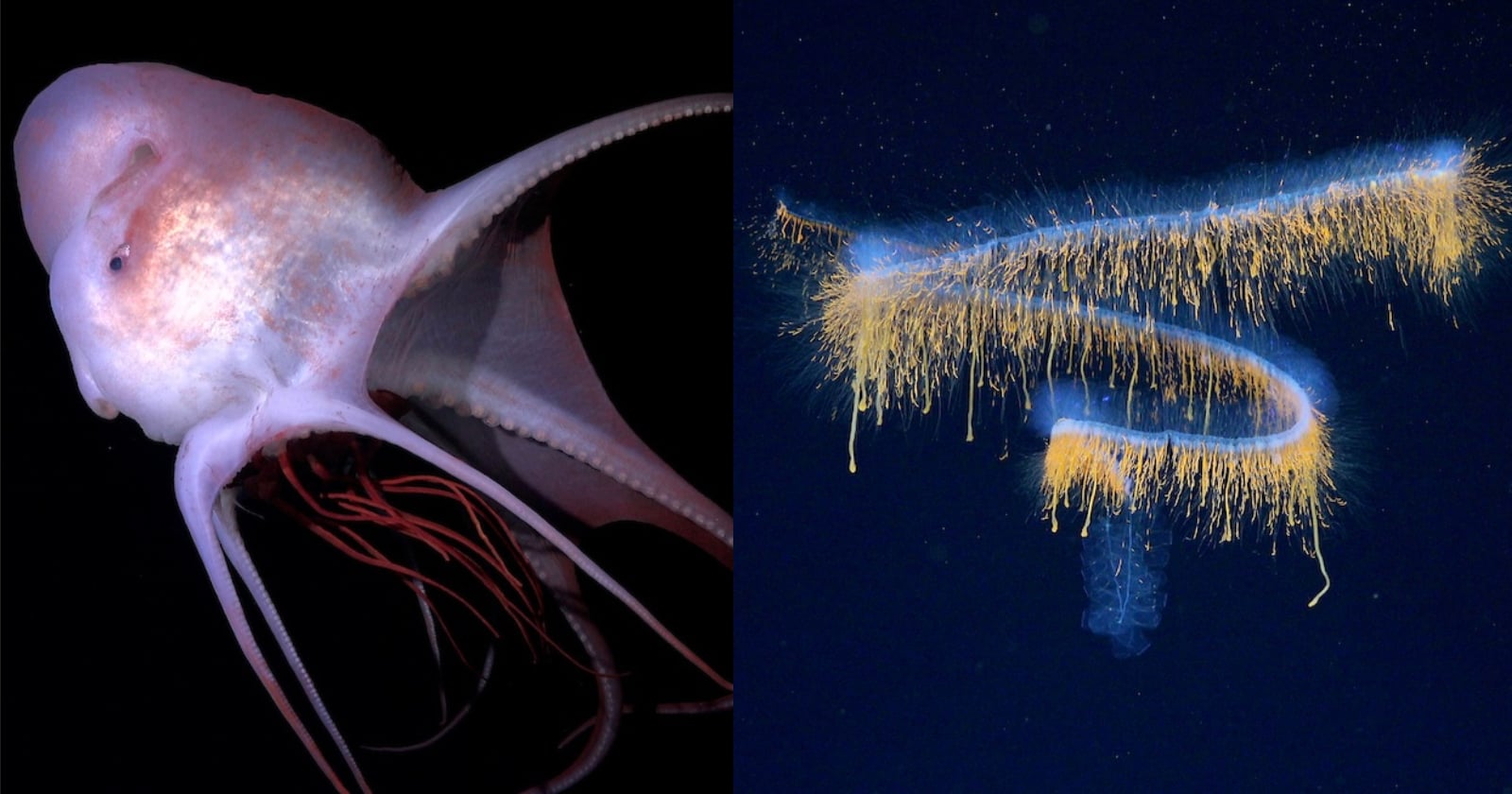
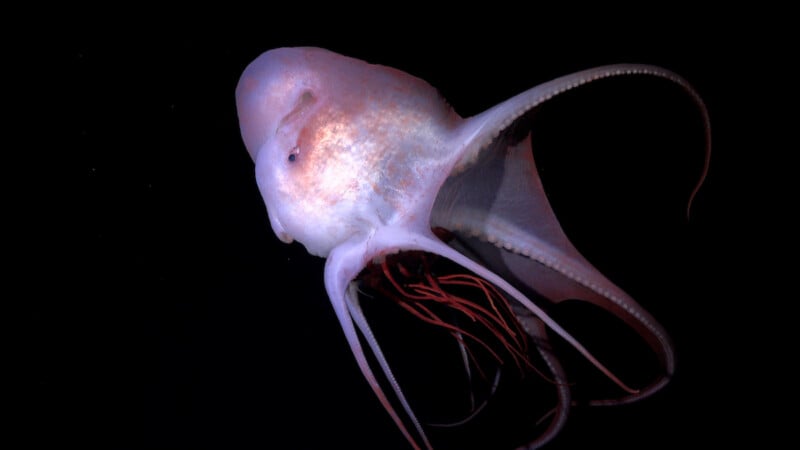 A female octopus (Haliphron atlanticus) consumes a jellyfish at 2624 meters depth. This species is rarely seen alive, and most of what is known about it has been determined from specimens caught in trawl nets.| Image credit: ROV SuBastian / Schmidt Ocean Institute
Scientists discovered and photographed 31 new deep-sea species — typically too delicate to document — in a matter of days using cutting-edge camera technology.
An international team of midwater specialists aboard the Schmidt Ocean Institute’s research vessel Falkor has identified more than two dozen previously unknown marine species during a two-week expedition in the tropical South Atlantic off the coast of Brazil.
The scientists used these advanced technologies to explore the Ocean’s midwater — the water between the sunlit layer and the seafloor — which is Earth’s largest and least explored habitable ecosystem.
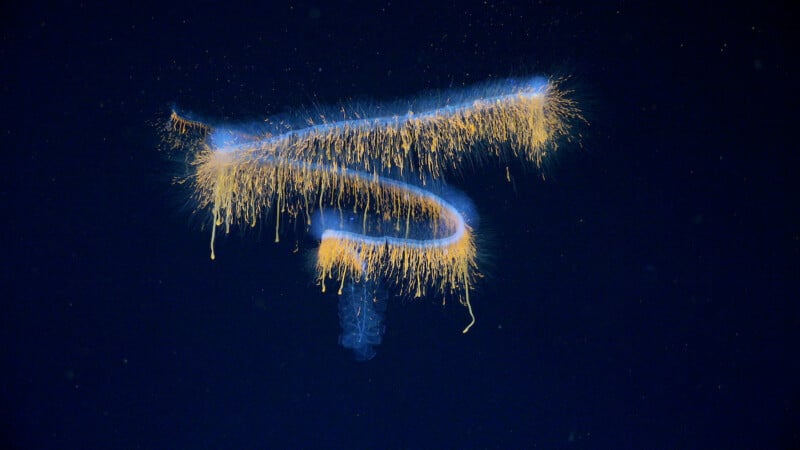 The team collected footage of this siphonophore at 552 meters depth. | Credit: ROV SuBastian / Schmidt Ocean Institute
The list of newly identified species includes an amphipod, a crustacean related to crabs and lobsters; a gossamer worm that moves faster than scientists expected given its body shape; nine jellyfish; seven siphonophores (colonial organisms related to jellyfish and corals); seven comb jellies, or ctenophores, known for the shimmering cilia they use to swim; four larvaceans, tadpole-like animals that live inside mucus “houses” and are more closely related to humans than to invertebrates; and two giant rhizarians, single-celled organisms that are visible to the naked eye.
The team also observed far greater diversity and abundance in midwater life than expected, including glass squid and a pelagic octopus feeding on a bright red jellyfish.
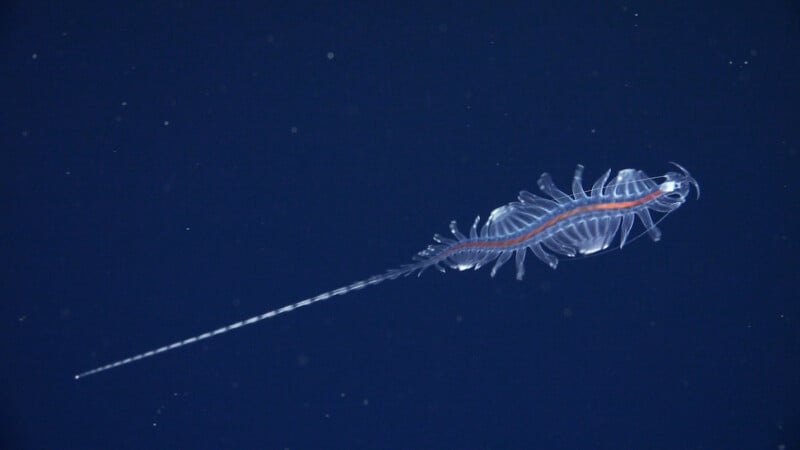 This is a new species from the genus Tomopteris, commonly known as gossamer worms. Little is known about their lives despite prior studies of their unusual, brilliant yellow bioluminescence. | Image credit: ROV SuBastian / Schmidt Ocean Institute
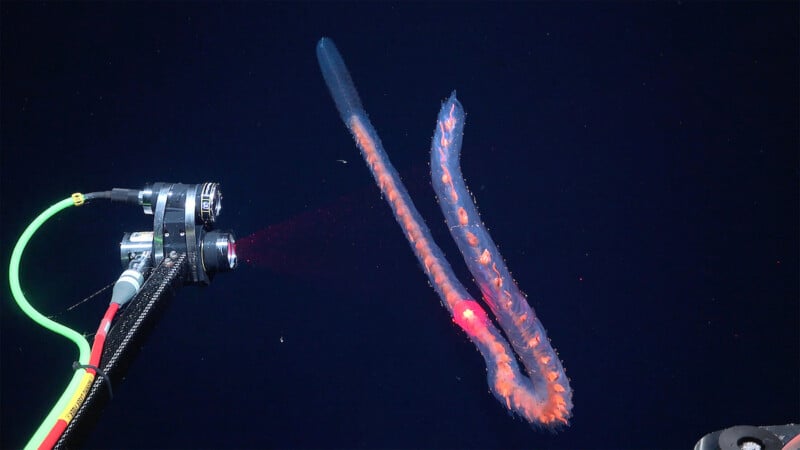 A siphonophore – a colonial marine invertebrate related to jellyfish – is scanned using Deep Particle Image Velocimetry (DeepPIV) at a depth of 930 meters | Image credit: ROV SuBastian / Schmidt Ocean Institute
“The largest habitat on Earth, the midwater, is filled with incredible animals we are only just starting to understand,” the expedition’s chief scientist, Dr. Karen Osborn of the Smithsonian National Museum of Natural History, says in a statement. “I continue to be fascinated by the fantastic variety of solutions they have evolved to survive in this formidable environment, and that drives me to keep asking questions about our ocean.”
Photographing the Ocean’s Most Fragile Subjects
A huge portion of Earth’s largest habitat — the deep midwater ocean — has remained largely unexplored, mostly because its animals are so fragile that traditional study methods can easily damage them. For photographers, it’s a bit like trying to document subjects that would be destroyed by the very act of photographing them.
To address this, researchers used three advanced imaging systems mounted on their remotely operated vehicle (ROV), SuBastian, to observe midwater species in their natural environment without collecting or disturbing them. While identifying and formally describing new species can normally take decades, the combination of these cutting-edge imaging and camera technologies allowed the team to confirm new species in just a few days rather than decades.
The study relied on DeepPIV (particle image velocimetry) and EyeRIS (remote imaging system), both developed by the Monterey Bay Aquarium Research Institute (MBARI), which use laser scanning to produce detailed 3D images of the organisms in a non-invasive way. They also used a shadowgraph camera developed by the Japan Agency for Marine-Earth Science and Technology, which captures high-contrast silhouettes that reveal subtle that subtle features and structural details that the laser-based systems may miss.
Image credits: All photos by Schmidt Ocean Institute.



 English (US) ·