
 3 hours ago
5
3 hours ago
5
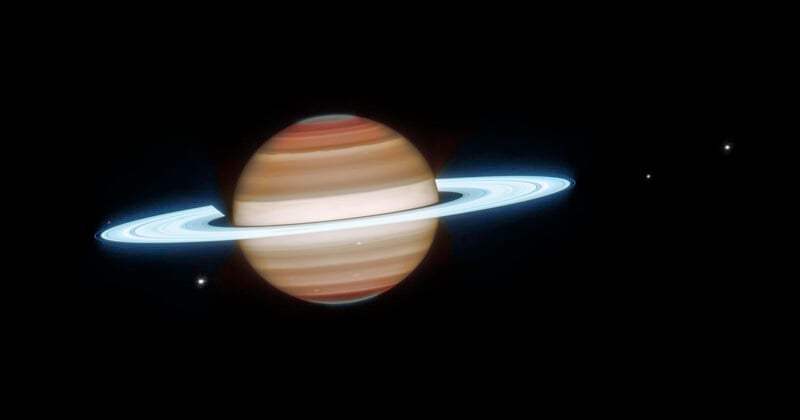
NASA’s James Webb Space Telescope (JWST) and Hubble Space Telescope joined forces to deliver the most comprehensive view of Saturn ever captured. JWST contributed infrared light data, peering at the planet’s surface, while Hubble’s visible light imagery showcases the gas giant’s atmosphere and cloud cover. Together, the strikingly different views deliver a greater understanding of Saturn and fantastic portraits, no less.
By observing Saturn in complementary wavelengths of light, Webb and Hubble revealed different, equally important details. Webb’s NIRCam, which captures photos in near-infrared and infrared wavelengths, was able to “slice” through Saturn’s thick atmosphere at multiple altitudes, “like peeling back the layers of an onion,” as NASA describes it. This lets researchers examine Saturn’s atmosphere in three dimensions, with each layer telling a different part of the planet’s story.
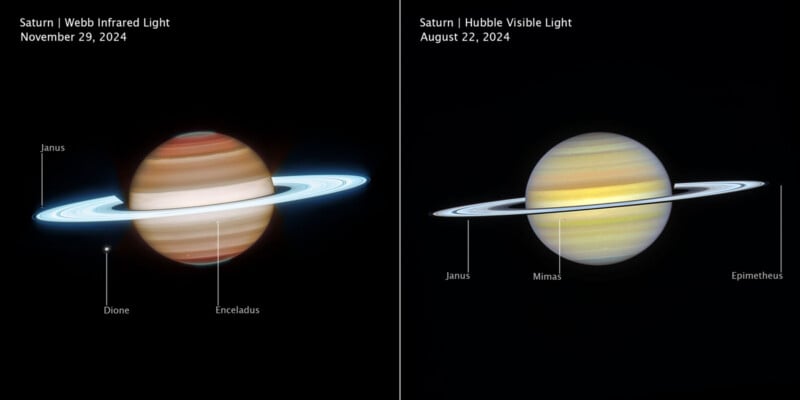 ‘Side-by-side views of Saturn from NASA’s James Webb Space Telescope (left) and Hubble Space Telescope (right) reveal the planet in infrared and visible light. Hubble highlights subtle cloud banding and color variations, while Webb’s infrared vision probes different atmospheric layers, bringing out storms, waves, and glowing ring structures in striking detail.’
In Webb’s images, Saturn’s famous “ribbon wave” jet stream “meanders across the northern mid-latitudes.” Below that, there are spots that reflect prior storms on the planet, including the Great Springtime Storm that raged from 2010 until 2012. There are other storms visible in the planet’s southern hemisphere in Webb’s photos.
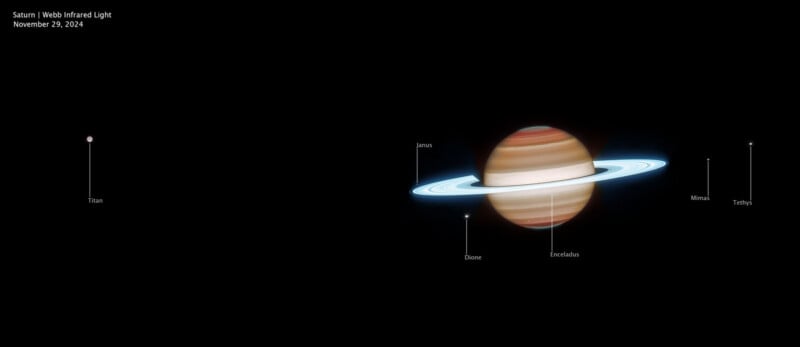 Webb also captured this wide image, which shows several of Saturn’s bigger moons, including Titan (far left), Janus, Dione, Enceladus, Mimas, and Tethys. These are just a handful of Saturn’s moons, though, as the planet has at least 285, the most of any planet in the Solar System.
Meanwhile, Hubble’s view of Saturn, captured in visible light by the venerable space telescope’s WFC3 instrument, shows the planet’s atmosphere, rather than its surface. Saturn’s iconic rings also look a bit different in visible light, since they reflect more sunlight in Webb’s infrared image than in Hubble’s visible light shot. The rings are made up of highly reflective water ice.
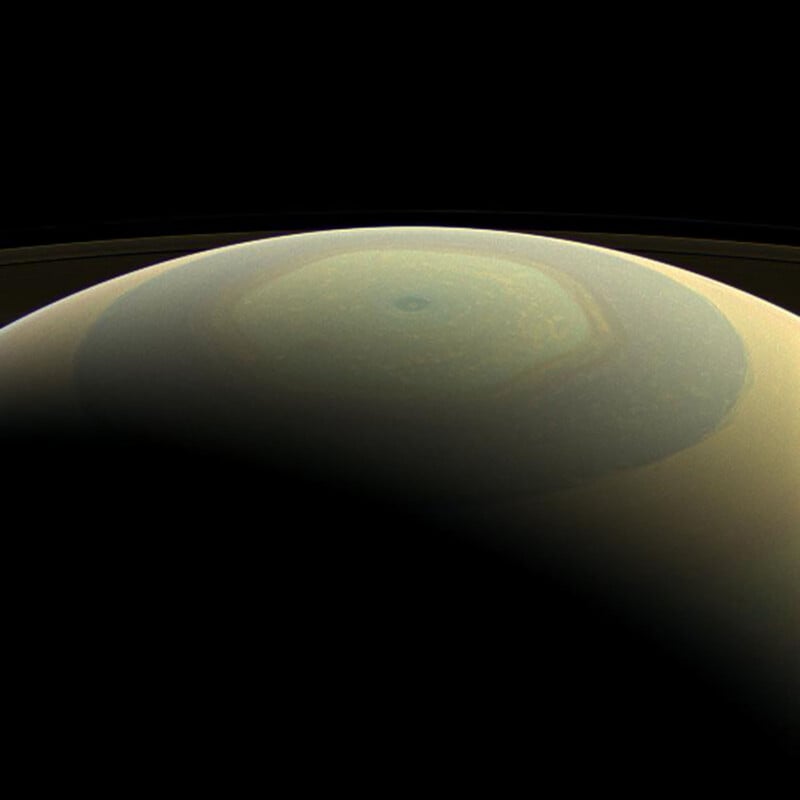 Although Hubble’s view of Saturn’s hexagon is quite faint, this 2013 shot by the NASA Cassini spacecraft delivers a great view. | Credit: NASA/JPL-Caltech/Space Science Institute
Hubble also captured the bizarre hexagon in the atmosphere at Saturn’s north pole. Initially discovered by Voyager in 1981, the persistent six-sided jet stream long perplexed scientists. There are viable explanations for the unusual shape, but it remains unsettled science. A leading theory today is that while Earth has conditions that prevent a jet stream here from forming a symmetrical shape, Saturn does not feature these limitations. The underlying physics are the same, of course, but the atmospheric conditions are not the same between Earth and Saturn. Scientists have been able to replicate hexagon fluid dynamics on Earth in laboratory conditions, alongside other polygonal shapes. As NASA remarks, perhaps Earth is the “oddball” planet, not Saturn.
Hubble’s very faint look at the hexagon-shaped jet stream on Saturn is “likely” the last high-resolution image people will get until the 2040s, since Saturn’s north pole is about to enter a 15-year dark winter.
For now, these fresh looks are the best and most complete ever captured of Saturn, and may remain so for quite some time.
Image credits: James Webb Space Telescope images: Image: NASA, ESA, CSA, STScI; Image Processing: Joseph DePasquale (STScI). Hubble Space Telescope images: NASA, ESA, STScI, Amy Simon (NASA-GSFC), Michael Wong (UC Berkeley); Image Processing: Joseph DePasquale (STScI)






 English (US) ·