
 3 weeks ago
44
3 weeks ago
44
May el-Toukhy’s Woman Unknown has scooped the Golden Lion at the Venice film festival, at an awards ceremony that also saw the Gaza documentary NAZA win the jury prize.
Set in the immediate aftermath of Danish liberation from Nazi occupation, the Egyptian-Danish director’s film tells the story of a young housemaid, Marie (Mathilde Arcel), who is about to marry her widowed employer but anxious about him discovering a shameful secret in her past: during the war, Marie had an intimate relationship with a German soldier.
The Guardian’s film critic hailed Woman Unknown as “elegantly appointed” in his review, likening it to Alfred Hitchcock’s Rebecca.
Arcel also won the festival’s best actress prize, the Volpi Cup, which puzzled some critics: usually, Venice doesn’t award more than one prize to a film. Speaking to the press after the ceremony, the jury president, Maggie Gyllenhaal, said they were able to make an exception because the jury’s vote for the Danish actor was unanimous. “She is going to blow our socks off,” she said.
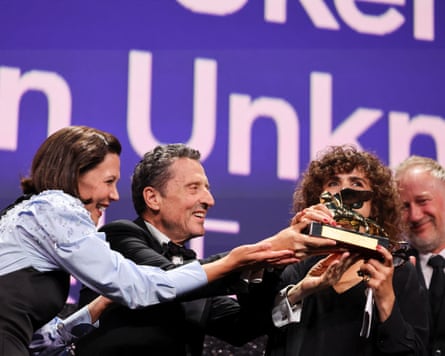
May el-Toukhy. Photograph: Yara Nardi/Reuters
In an emotional acceptance speech, El-Toukhy thanked Gyllenhaal for addressing the underrepresentation of female film-makers at the start of the festival. Woman Unknown was the only film in competition to be solely directed by a woman.
“This film has been incredibly challenging to make financially, logistically, emotionally,” El-Toukhy said. “And what kept me going was the urgent need to illuminate the unknown women of our common history, to make them known. And especially tonight, I feel like I succeeded in doing just that.”
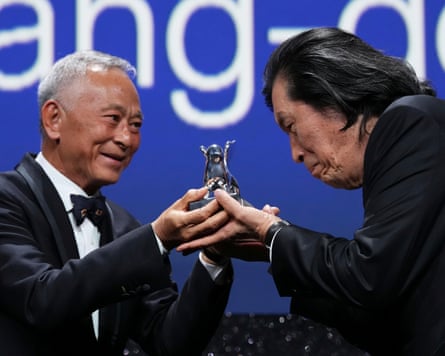
The runner-up grand jury prize went to the Korean director Lee Chang-dong’s Possible Love, a simmering tale of an unhappy married couple befriended by a documentary maker and her wealthy husband, which drew rave reviews.
The special jury prize, Venice’s equivalent of a bronze medal, went to Yuval Abraham and Rachel Szor’s documentary NAZA, about Israel’s AI-powered mass killing of civilians in Gaza.
The film, which was produced by the Guardian, is based on testimony from 24 Israeli military insiders who are interviewed anonymously at night on rooftops in Tel Aviv. It takes its title from an acronym used by the intelligence service to indicate how many civilians it expects to die in an airstrike on Gaza.
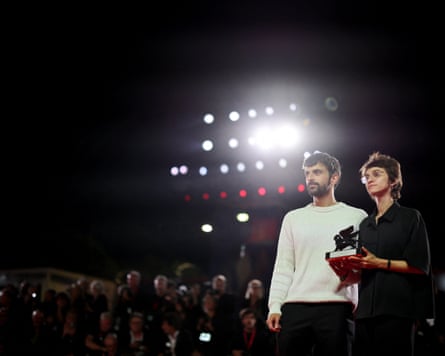
“It’s honestly not very easy to stand here, thinking of all the Israeli politicians and journalists who are now attacking this film and denying it without even seeing it,” Abraham said when accepting his prize. “So much is being done not to look at reality.”
The day after NAZA’s premiere, the Israeli military “categorically denied” the allegations made in the film.
The Russian director Ilya Khrzhanovsky won the Silver Lion for best director for the visually stunning DAU, a biopic of the Nobel prize-winning quantum physicist Lev Landau, who was pressured into working on the Soviet Union’s nuclear weapons programme.
The inclusion of Khrzhanovsky’s film in the Venice lineup was criticised by the Ukrainian government in the run-up to the festival, over its lead actor Teodor Currentzis’s refusal to condemn the full-scale invasion of Ukraine, and for having received funding from a Russian businessman who was later sanctioned by the US and Ukraine.
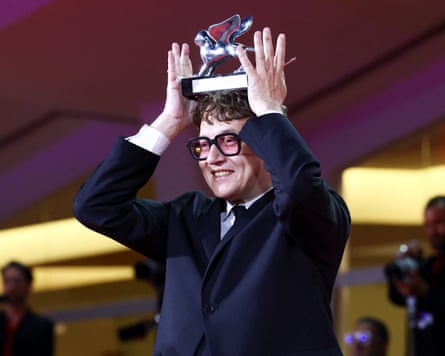
DAU was filmed in Kharkiv between 2008 and 2011, before the start of the conflict. At a press conference on the Lido, Khrzhanovsky said: “The only thing I can wish for is peace and success for the Ukrainian government to succeed in the best possible way, to save the country and to win this war.”
John Malkovich took home the Volpi Cup for best actor, for his role as an erratic veteran CIA agent whose cancer diagnosis leads him to question the morality of his profession, in Martin McDonagh’s Wild Horse Nine.
after newsletter promotion
The 72-year-old US actor was not present in Venice and accepted his award via a video link. “I am humbled to be chosen for this award, which has been given to so many wonderful actors over the past 83 iterations of the Venice film festival,” Malkovich said.
Full list of winners
Golden Lion for best film: Woman Unknown, directed by May el-Toukhy
Grand jury prize: Possible Love, directed by Lee Chang-dong
Silver Lion for best director: Ilya Khrzhanovsky for DAU
Special jury prize: NAZA, directed by Yuval Abraham and Rachel Szor
Best screenplay: Un bon petit soldat (A Good Little Soldier), Stéphane Brizé, Coralie Amédéo, Olivier Gorce
Volpi Cup for best actress: Mathilde Arcel in Woman Unknown
Volpi Cup for best actor: John Malkovich in Wild Horse Nine
Marcello Mastroianni award for best young actor: Malou Khebizi in 15/18 A Place to Heal
Armani Beauty audience award: Eu contez (I Matter), directed by Alina Șerban
Luigi De Laurentiis award for debut film: La maison du vent (House of the Wind), directed by Auguste Bernard Kouemo Yanghu







 English (US) ·