
 3 weeks ago
27
3 weeks ago
27
First things first: the best picture Oscar should go to Marty Supreme for the incredible job it has done in bringing new eyes to ping pong. A declining sport that has to be propped up by subsidy, this movie has single-handedly kept wiff waff alive even though no one cares about it any more. Kudos.
Next, a confession. I watched this film the day it came out and haven’t seen it since*. That day also happened to be my birthday, a big birthday, and I wasn’t entirely steady when I entered the cinema that evening. I have sketchy recollections of the middle section – the bit between the bath collapsing and the plane to Japan. I also didn’t really like it much; I found it inconsequential and a bit amoral and I instantly resolved to forget the words to 4 Raws Remix (sample lyric: “my life is an opera”) as a result.
I don’t believe my own personal failings should undermine the argument for giving this film the gong it so obviously desires. If we’re talking cinema (not marketing campaigns or merch drops, however captivating), then Josh Safdie has created a movie that has captured something of the world in 2026. Set as it may be in the 1950s, Marty Supreme could only have been made now. If we want to celebrate art that reflects the world we live in, then this is the one.
First, we have Marty Mauser himself. A character fizzing with “unearned self-confidence” (a spot-on description by Variety’s Peter Debruge), Mauser sees the world entirely in terms of what he wants out of it. Despite professing an all-encompassing passion for table tennis, his attention rarely focuses on it. Instead, it flits from one possible moment of gratification to the next, and Mauser pursues his appetites with no reflection on how they might impact others. Obviously, this sounds like the current president of the United States, but it’s also a bit all of us, especially the all of us that is manifested online.
The rapidity and frequency with which Mauser makes his jolting moves creates an antic sense that harks back to some of the greats of Hollywood, screwball comedies like It Happened One Night or Sullivan’s Travels. But it’s faster and more brittle than that, every act coming with its own thud of cortisol. The sense of being about to have a cardiac arrest while watching a movie is something Safdie and his brother Benny perfected in their two masterpieces, Good Time and Uncut Gems. It’s not pleasant but it’s a real feeling, an intense feeling and, in all honesty, for many people it will be sometimes reminiscent of living modern life.

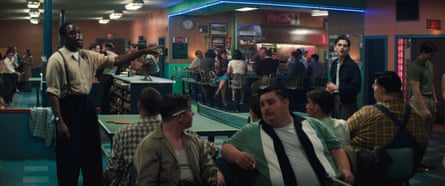
The pacing and characterisation are not the only things that make this movie too much. It’s the aesthetic, too. The recreated New York of the 1950s is an era many viewers will think they are familiar with, all sharp suits and dive bars (equally the London of the 50s, with its austere vibes). But Safdie, particularly through an emphasis on casting non-actors and people with, how shall I put it, unconventional Hollywood physiognomies, turns the familiar into its unsettling echo. It’s an effect only enhanced in cinematography, by the nominated Darius Khondji, that leans into intense closeups as another means to disrupt and disturb.
Again I put it to you that nostalgia with nightmarish undertones is something our contemporary culture is increasingly steeped in. Equally there is something thoroughly modern about the anachronistic elements of the movie. Whether it’s Tears for Fears songs as musical backdrop or Mauser and Tyler Okonma’s Wally ghost-riding the whip (that’s getting out your car and dancing as it continues to drive), there’s a cultural imposition on this historical drama; it’s then, but punched up by the now.
In a recent interview with the Guardian, Safdie said three periods of recent history – postwar America, the 1980s and today – represent different stages in what he sees as the receding of the American dream. Marty is an embodiment of this shift: less Holden Caulfield or Jim Stark, more Mr Beast or, heck, Timothée Chalamet. We can’t help but look at the past through our contemporary eyes, but this seems a more forceful imposition and creates something new as a result.
All this disjuncture is condensed into the final moment of the movie (spoiler alert). Marty returns from his jaunt to Japan just in time to see his newborn son in the maternity ward, though not the mother he treated largely as an afterthought. As he stands with his face pressed against the glass, a tear appears in his eye. Was this a last-ditch moment of redemption, a realisation on Marty’s part of what truly matters? Or was it simply another hit of dopamine before moving on to the next? Tradition would lead the viewer towards the former, but I left convinced it was the latter. I didn’t like that feeling, but this movie made me have it and that, as Chalamet has surely pointed out at some point in his never-ending promotional tour, is cinema.
*Why did I not watch it again this past week? Because I’m up a mountain reporting on the Winter Paralympics.




 English (US) ·