
Marvel Studios Animation
We may receive a commission on purchases made from links.
"X-Men '97" season 1 hit the ground running. The premiere, "To Me, My X-Men," ended by revealing the absent Professor X (Ross Marquand) had appointed Magneto (Matthew Waterson) to lead the X-Men in his absence. What could top the shock of the X-Men's greatest enemy joining them? Episode 2, "Mutant Liberation Begins," ended with a second Jean Grey (Jennifer Hale) arriving on the X-Men's doorstep.
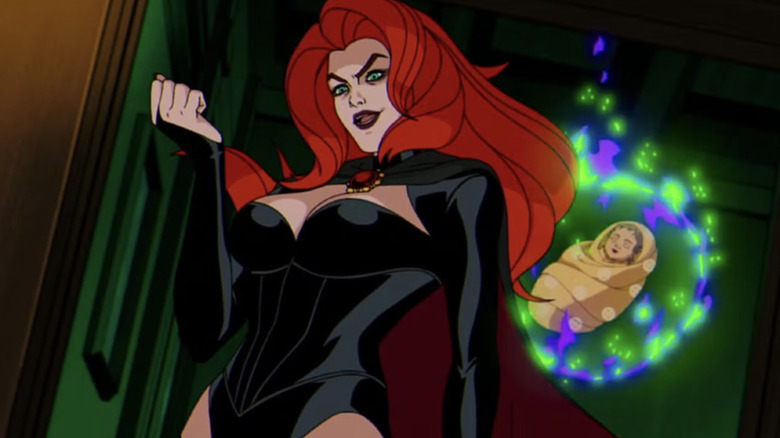
The following episode, "Fire Made Flesh," revealed this new Jean was actually the genuine article. The one seen in the first two episodes — who gave birth to her and Cyclops/Scott Summers' (Ray Chase) son, Nathan — was a clone, created by Mister Sinister (Christopher Britton). Since the original "X-Men," Sinister has been obsessed with Scott and Jean, thinking their combined DNA holds the potential to create the ultimate mutant. Under Sinister's influence, the cloned Jean, renamed Madelyne Pryor, becomes "the Goblin Queen" and unleashes a psychic vision of Hell and demons on the X-Men.
In "X-Men '97: The Art and Making of the Animated Series" by James Field, supervising animator Jeremy Polgar said that Madelyne demanded precise care from the animators:
"[The Goblin Queen] is so theatrical and controlled. Every pose she does has to land, which is very engaging but also requires more time to ensure that every motion and gesture feels powerful and intentional."
Madeylne's most fabulous pose in "Fire Made Flesh" features her sitting cross-legged on a demonic throne, taunting the X-Men and cackling as lightning strikes. The moment the creators felt needed to "elevate the Goblin Queen's stature," though, is when she debuts her new persona to the X-Men. Polgar worked closely with lead animator Naseer Pasha to sketch and bring that sequence, which cuts from a close-up of Madelyne's mouth to her moving her arms like she's on-stage, to life.
The Goblin Queen needed theatrical poses and dark colors
Marvel Studios Animation
As the Goblin Queen, Madelyne wears a black corset. Compared to Jean, the Goblin Queen's skin is pale (brought out by her red hair), she has darker and arched eyebrows, and sharp black fingernails. That allows for sassy and vicious expressiveness. Jennifer Hale dials up the camp to complement the exaggerated movements, too. Unlike the maternal Jean, the Goblin Queen relishes every syllable of her super-villain dialogue.
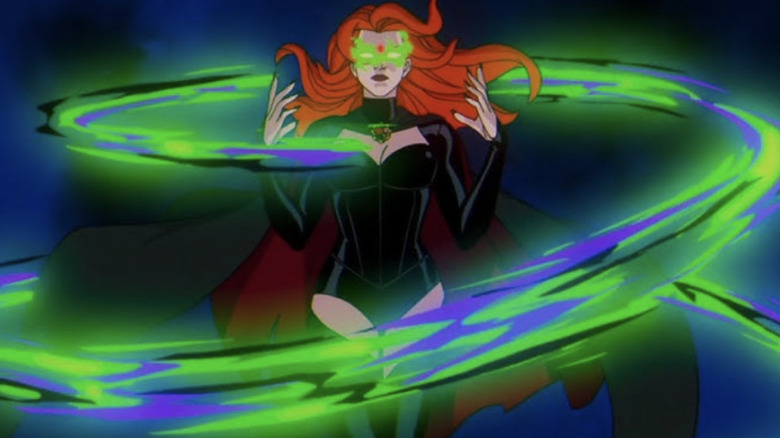
As Madelyne falls under Sinister's sway, her clothes melt away to reveal her Goblin Queen outfit in a stunning and fiery transformation sequence. Like Jean as the Phoenix, Madelyne's psychic powers manifest with fire. But rather than the Phoenix's scalding orange flames, unnatural green and purple fire emanates from the Goblin Queen. During her transformation, a ring of fire encircles Madelyne before engulfing her, as if burning away the woman she was to birth Sinister's Queen. The Goblin Queen swears the X-Men shall know her "inferno" as the fire surges, leaving a blank green frame.
Between these colors, her witchy powers, and her domineering attitude, the Goblin Queen winds up evoking Maleficent from Disney's game-changing 1959 animated film, "Sleeping Beauty." The green color coding continues during the episode, when the X-Men track Madelyne to Sinister's lair. The villain has set up shop in a church bathed in sickly green light; the mix of mad science and gothic horror resemble a set from a Hammer "Frankenstein" film.
In "X-Men '97: The Art and Making of the Animated Series," FX lead designer/supervisor Chris Graf said they wanted to "use a color combination we hadn't seen in the original ['X-Men'] animated series." He also noted the "creative challenge" of "discovering the correct mix of greens and purples across a variety of different offensive and defensive moves."
X-Men '97 elevated Jean Grey's fight scene animation
Marvel Studios Animation
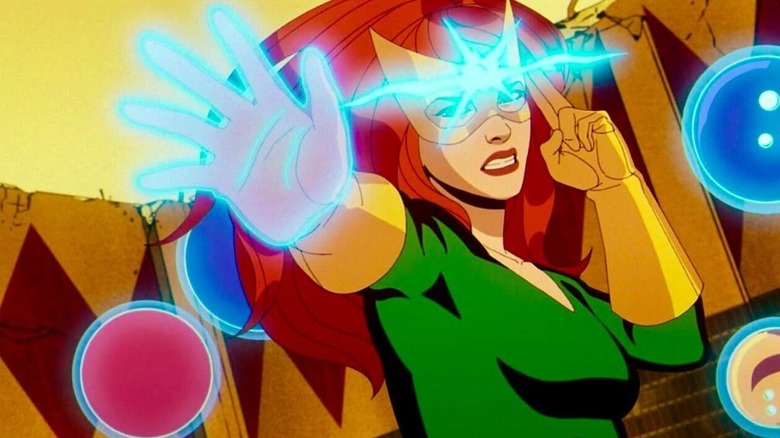
This alludes to an important part of "X-Men" fight choreography: color coding the psychic and telekinetic powers. Otherwise, it's impossible to track who is moving what object with their mind. Whereas Jean's powers glow a light blue, Madelyne's glow green.
This coloring becomes important when Madelyne duels Magneto in Sinister's lair; the church's stained glass windows provide ample ammo for both mutants. Magneto's powers are color-coded yellow; he holds out his hands and yellow ripples appear with a metallic echo. Any metal he throws at Madelyne likewise glows with a yellow outline. When Madelyne uses her powers, her hands seemingly burn with purple-green fire.
Madelyne vs. Magneto is one of the action highlights of "X-Men '97." It's far more fast-paced and brutal than any fight in the original "X-Men" (which had censors to worry about and a cheap animation budget). The camera often swings around and cuts rapidly to follow the jagged metal the fighters are throwing at each other. As Madelyne gets the upper hand, slicing Magneto's flesh with glass shards, the scene even shows blood.
Putting Jean Grey's clone into a one-on-one contest with Magneto, which she wins, also reflects how "X-Men '97" gives Jean herself her due. In the original series, Jean often stayed out of battles, and was rather frail when she did fight. "X-Men '97," though, understands how powerful her telekinesis is. In the season finale, "Tolerance is Extinction," Jean battles Sinister in an abandoned bowling alley. He taunts her ("Only I know where you end and Madelyne begins!"), but Jean tunes him out and unleashes telekinetic fury. As supervising producer/director Jake Castorena put it, "Bowling ball to the face for Sinister! I didn't know I needed to see that. I love how satisfying it is."







 English (US) ·