
 3 hours ago
5
3 hours ago
5
And how you can efficiently delete them to claw back storage on your device.

Mijansk786/Shutterstock
So, you're running out of storage on your Android phone. It happens, even if you periodically delete files and photos, especially if you've been porting your data from one phone to the next over the past few years. Apps, images, videos and big files you've downloaded and forgotten typically eat up most of your storage space, but there may be some files you don't even know are on your phone. We'll discuss how you can find them and delete them quickly and efficiently.
Apps
One of the most effective ways to free up space is, of course, to uninstall apps. To get an overview of all your apps and to make it easier to decide which ones to delete, go to Settings > Device Care > Storage > Apps. From there, you can see which applications are taking up the most space. Just tap on the app you want to remove and then hit Uninstall.
That said, you can can also just archive apps. Go through the same steps above, and instead of tapping Uninstall, tap Archive instead. Doing so deletes its core software files and temporary data from your phone but retains your login info and personal settings, so you can easily start using the app again after redownloading it.
Android has a feature called "auto-archive," which can automatically archive apps your rarely use when you run low on storage. If you try to install an app on a phone that has no more space, you'll see a pop-up window telling you about auto-archive and giving you the option to switch it on from there. You can also activate the feature anytime you want by going to the Play Storage and tapping on your profile photo at the top right corner. From there, go to Settings > General and then toggle on Automatically archive apps. Google says auto-archiving can free up "nearly 60 percent of an app's storage space, without removing the app presence or users' data from the device."
Images and videos
Screenshot by Mariella Moon (Google Photos)
If you don't care about backing up the media saved on your phone, you can go ahead and delete them all or manually select what you want to get rid of. You can do that in your phone's gallery, or by going to Storage in Settings > Images or Videos and selecting the files you want to remove. But if you want to preserve those memories, the easiest way to do that is to use Google Photos. The app can save cloud backups of your images and videos to your Google account.
All Google accounts come with up to 15GB of free cloud storage, shared across Photos, Drive, Gmail and the company's other services. Since that is, admittedly, tiny and might not be able to accommodate years' worth of images and videos, you may have to pay for a Google One subscription. Google One costs $2 a month for 100GB of storage or $3 a month for 200GB.
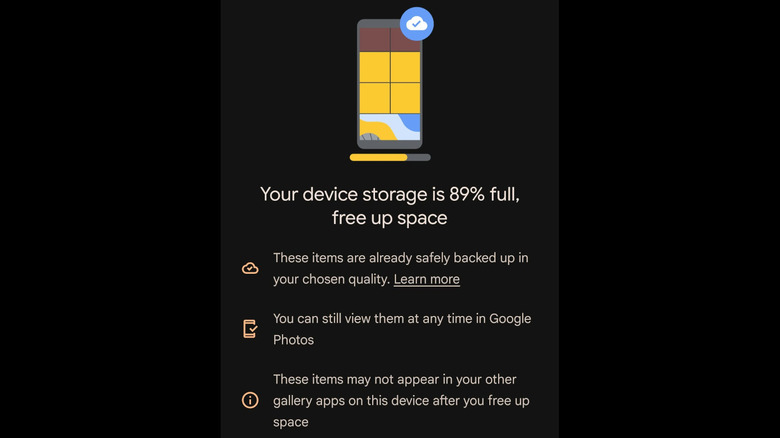
Once your images and videos are backed up on the cloud, you can tidy up your phone. In the Photos app, tap on your profile image and go to Free up space on this device. It will delete the items already backed up on the cloud in the quality you choose. You won't see those images in your other gallery apps anymore, but you can still view them in Google Photos.
You can also switch on Smart Storage to automatically clear up images that have already been backed up if it's available on your device. Go to your device Settings > Storage > Free up space. Then, tap the hamburger menu, find Settings from the options you see and switch on Smart Storage.
Other data
Screenshot by Mariella Moon (Google)
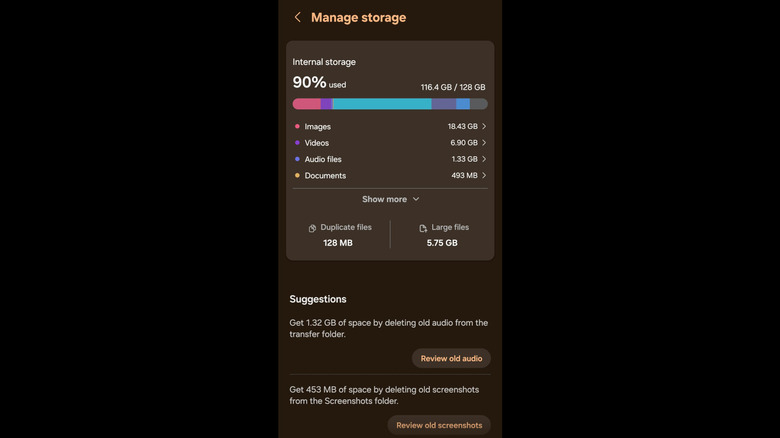
But what about the other stuff occupying your storage space, the ones that aren't as obvious as apps and images? Head over to Settings > Device Care > Storage again. You'll a section that says Duplicate files and another that says Large files. Tap on them to see a selection of files you can choose and delete. Scroll down, and you might see more suggestions on what to remove, such as old media files, old downloads, pre-edit image backups and app caches. Tap on each one to review the files you can dispose. You can also view your Storage details and tap on Other files to delete stuff you may have forgotten you had.
If you have streaming and social media apps, don't underestimate what a cache clearing can do. It could free up gigabytes of storage. You should also make it a habit to empty your trash. Go to Settings > Device Care > Storage and find the Trash or the Recycle bin folder to empty out.






 English (US) ·