
 1 day ago
13
1 day ago
13
I’ve been reviewing video tech long enough to remember the advent of 4K displays. In 2013, my first experience was with an Asus PQ321Q. It cost around $3,500, delivered 3840x2160 pixels at 60 Hz, and only worked with a handful of graphics cards that had a DisplayPort 1.2 output.
As prices dropped and choices multiplied, I saw that one of the most common searches on Tom’s Hardware was “budget 4K”. Even though you still need a powerful video card to game at 8.3 megapixels, most users want that high pixel density on their desktops.
The good news is that 4K monitors are no longer $3,500. The ViewSonic VX2730D-4K I’m reviewing here isn’t even $350. It’s $280 and works with many video cards. And it runs at 144 Hz with a dual-mode switch that lets you reach 288 Hz at 1080p resolution. And you get wide-gamut color and HDR on a 27-inch IPS panel with high contrast and high performance. Let’s take a look.
Latest Videos From

ViewSonic VX2730D-4K Specs
Swipe to scroll horizontally
Panel Type / Backlight | IPS / W-LED, edge array |
Screen Size / Aspect Ratio | 27 inches / 16:9 |
Max Resolution and Refresh Rate | 3840x2160 @ 144 Hz |
| Row 3 - Cell 0 | 1920x1080 @ 288 Hz |
| Row 4 - Cell 0 | FreeSync and G-Sync Compatible |
Native Color Depth and Gamut | 10-bit (8-bit+FRC) / DCI-P3 |
Response Time (GTG) | 2ms |
Brightness (mfr) | 250 nits |
Contrast (mfr) | 1,500:1 |
Speakers | 2x 2w |
Video Inputs | 1x DisplayPort 1.4 |
| Row 11 - Cell 0 | 2x HDMI 2.1 |
Audio | 3.5mm headphone output |
USB | None |
Power Consumption | 24w, brightness @ 200 nits |
Panel Dimensions WxHxD w/base | 24.2 x 15.4-20.2 x 8.8 inches (614 x 392-512 x 225mm) |
Panel Thickness | 2.2 inches (57mm) |
Bezel Width | Top/sides: 0.3 inch (8mm) |
| Row 18 - Cell 0 | Bottom: 0.8 inch (20mm) |
Weight | 13.7 pounds (6.2kg) |
Warranty | 3 years |
The VX2730D-4K has an impressive feature set wrapped up in an IPS panel that delivers an impressive 1,500:1 contrast ratio. That’s claimed by ViewSonic and verified by me. In fact, I measured over 1,600:1 after calibration, which isn’t necessary because it’s nearly pro-level accurate out of the box. There’s plenty of color coverage too, over 98% of DCI-P3. It also supports HDR10 signals, and there I found a couple of issues that I’ll get into later.
A 144 Hz refresh rate anchors gaming performance at the full 3840x2160 pixels. You can run that signal over DisplayPort or the two HDMI 2.1 inputs. A dual-mode switch changes the resolution to FHD 1920x1080 and 288 Hz. In both cases, you get G-Sync with Nvidia certification and FreeSync Premium. It’ll also do VRR with consoles. There’s a three-level overdrive to smooth out motion blur, and you get MPRT backlight strobing to use when speeds drop below 120fps.
A few unimportant things have been sacrificed on the altar of value. There’s no LED lighting, nor are there USB ports. But you do get internal speakers and a 3.5mm headphone jack. A decent stand and cable bundle come in the box as well. The VX2730D-4K is more than prepared to take on your favorite games, be they twitchy shooters or lavish adventures.
Assembly and Accessories
The VX2730D-4K comes in the cardboard version of a plain brown wrapper with nothing but the words “ViewSonic Gaming” to signal the intent of what’s inside. Crumbly foam disgorges the three main bits, panel, upright, and base, which assemble without tools. Cables are DisplayPort and IEC for the internal power supply.
Product 360
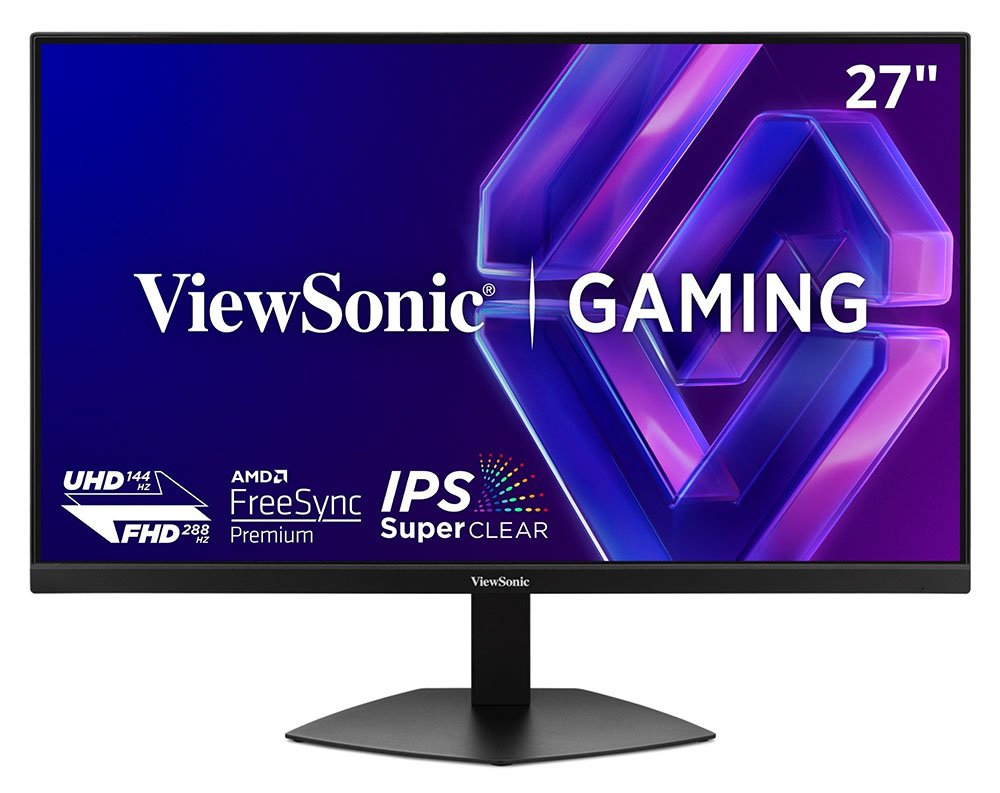
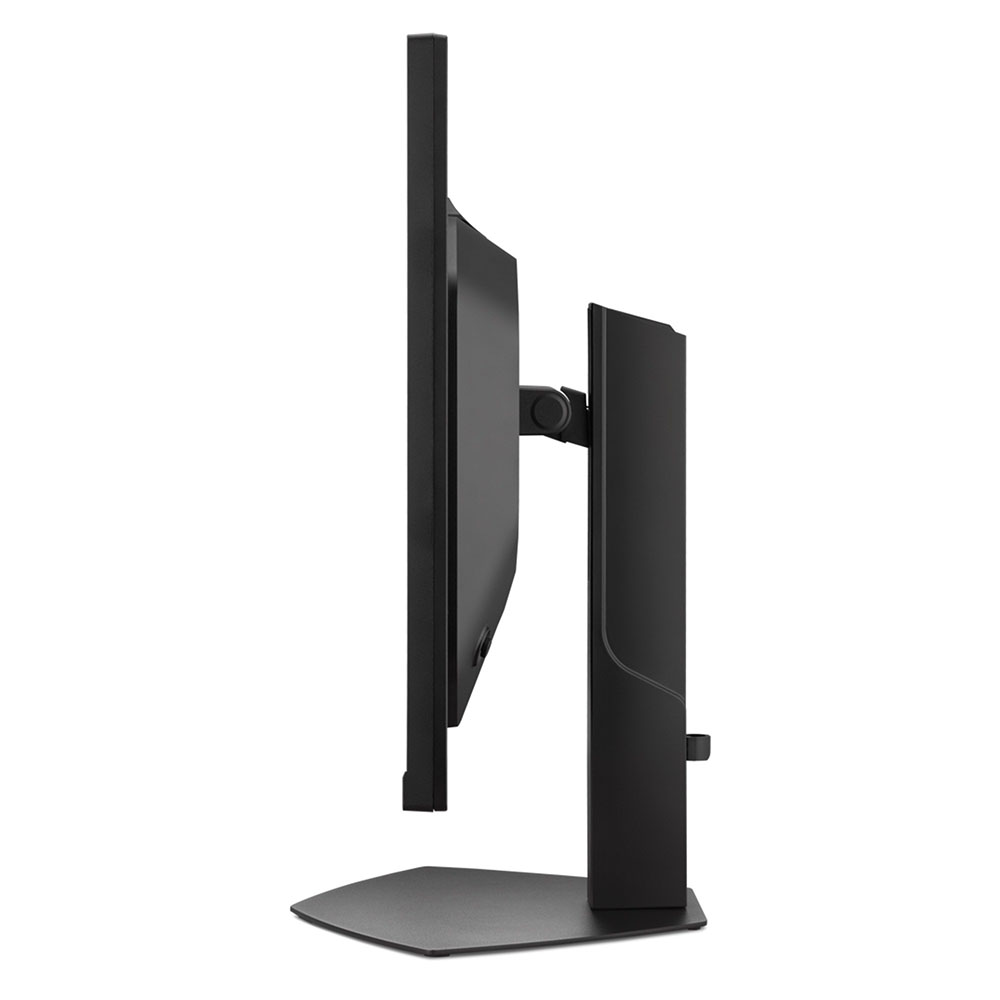
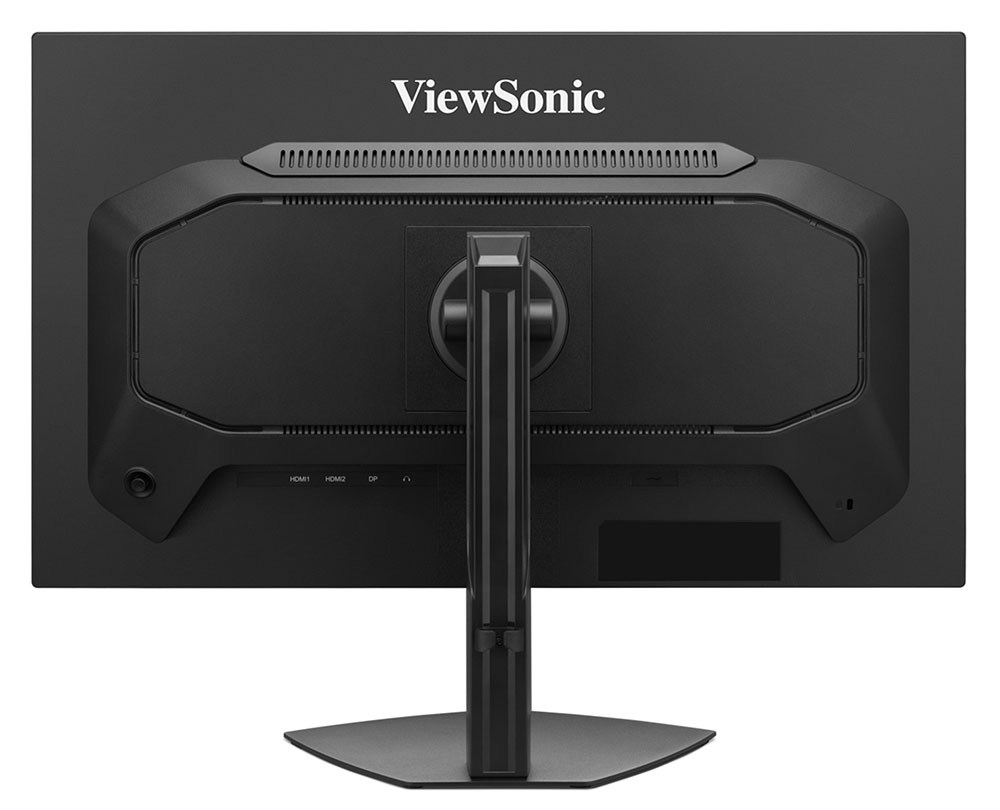

The VX2730D-4K’s styling is minimalist industrial with nothing in front but the screen and its effective anti-glare coating, a ViewSonic logo, and a thin flush bezel. The IPS variant is proclaimed as “Super Clear,” which refers to its higher-than-average contrast. More on that later.
The stand is solid and stable and includes a 4.7-inch height range, 90-degree portrait mode and 5/20 degrees tilt. There is no mechanical swivel, but the metal plate base slides easily on the desktop if you want to turn the panel to either side. The package has decent heft and is very solid in operation. Build quality is well above the norm for a budget display.
In the back, there is purposeful grillwork that provides cooling airflow to the hardworking internals. A larger ViewSonic logo lets others know where your monitor comes from. And there’s a tiny OSD joystick reachable from the front bottom right that controls all functions. The side view shows a relatively slim panel with a component bulge. There’s a small cable hook on the back of the stand.
There are three video inputs in total, one DisplayPort 1.4 and two HDMI 2.1. All support 4K at 144 Hz and FHD at 288 Hz with Adaptive-Sync and HDR. You also get a 3.5mm headphone jack should you wish to forgo the internal speakers, which play politely in the upper mid frequency band.
OSD Features
The VX2730D-4K’s OSD is operated by a joystick, which I found to be a bit different than others. You’d expect that pressing it would bring up the menu, but instead, it’s the dual-mode switch so the screen goes blank for a few seconds, then changes resolutions and refresh rates. There’s no provision to change this, but the dual-mode switch is super quick and convenient.
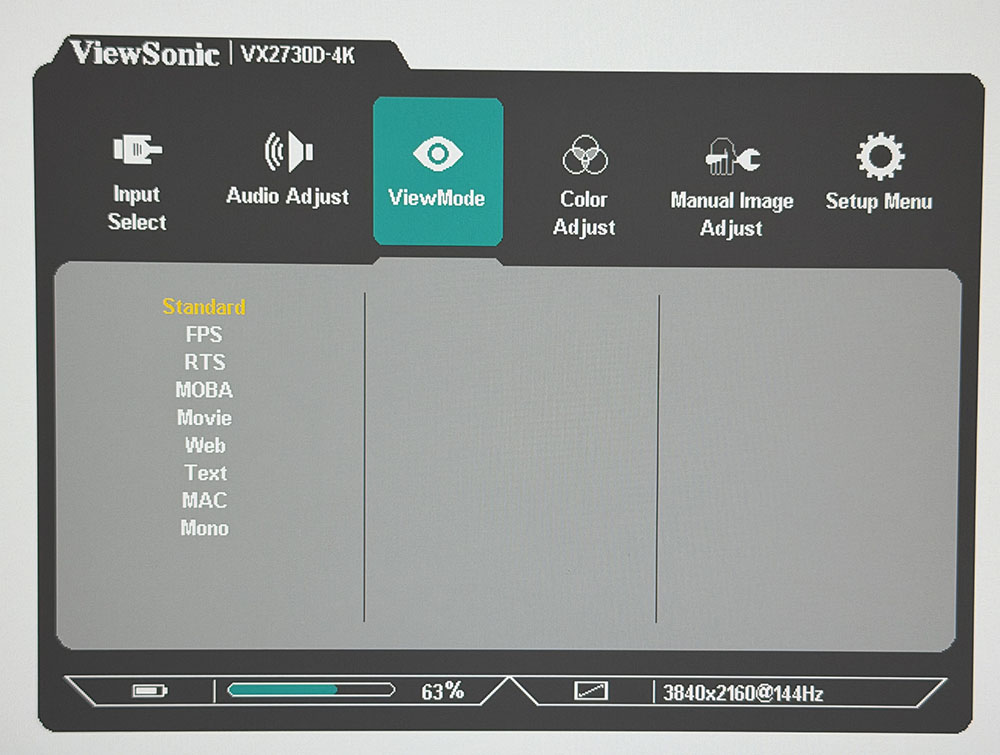
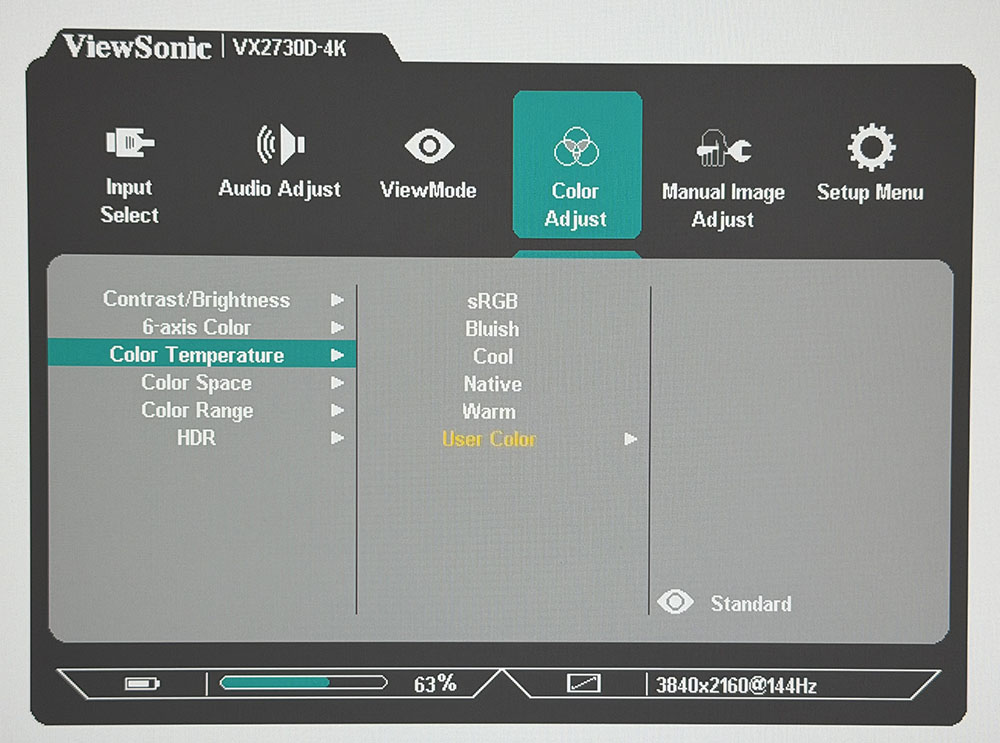
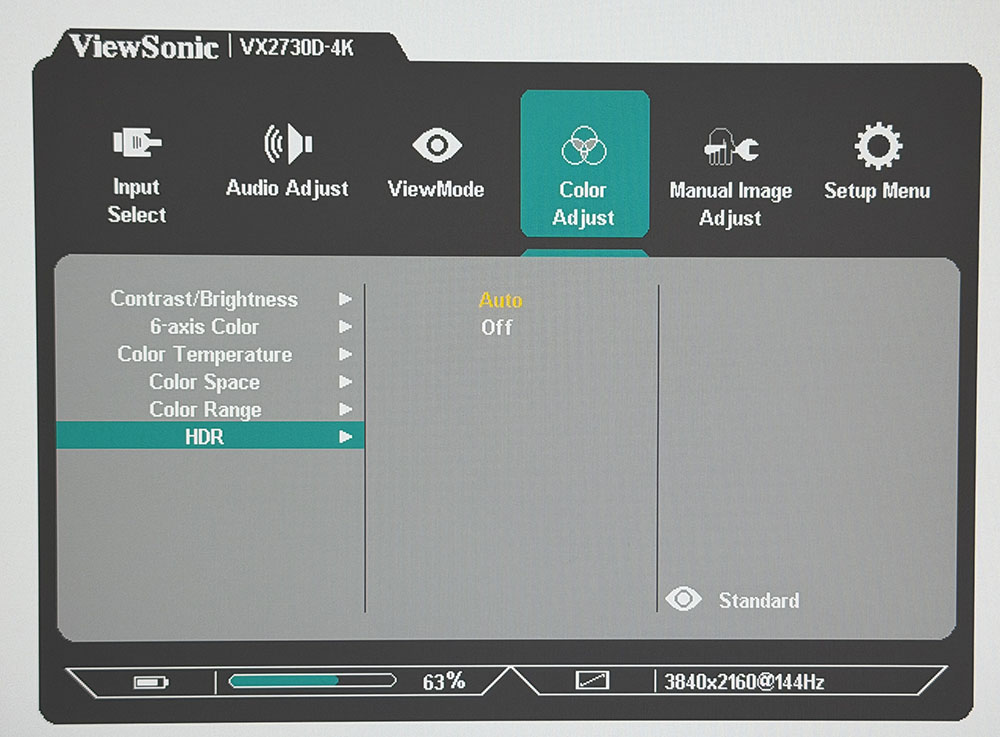
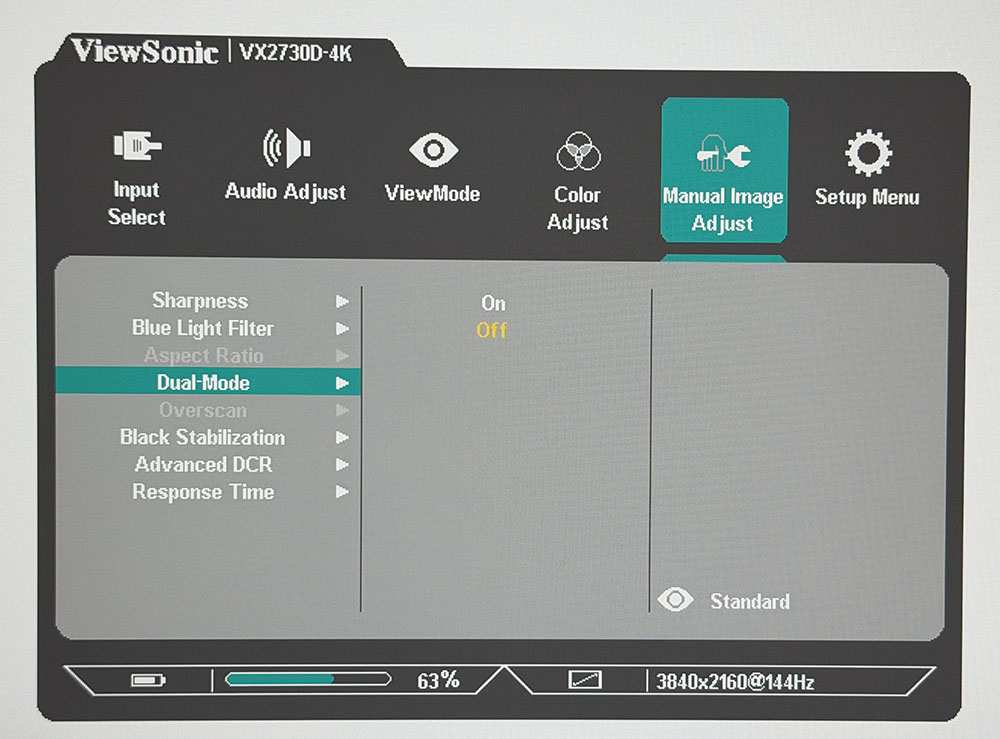
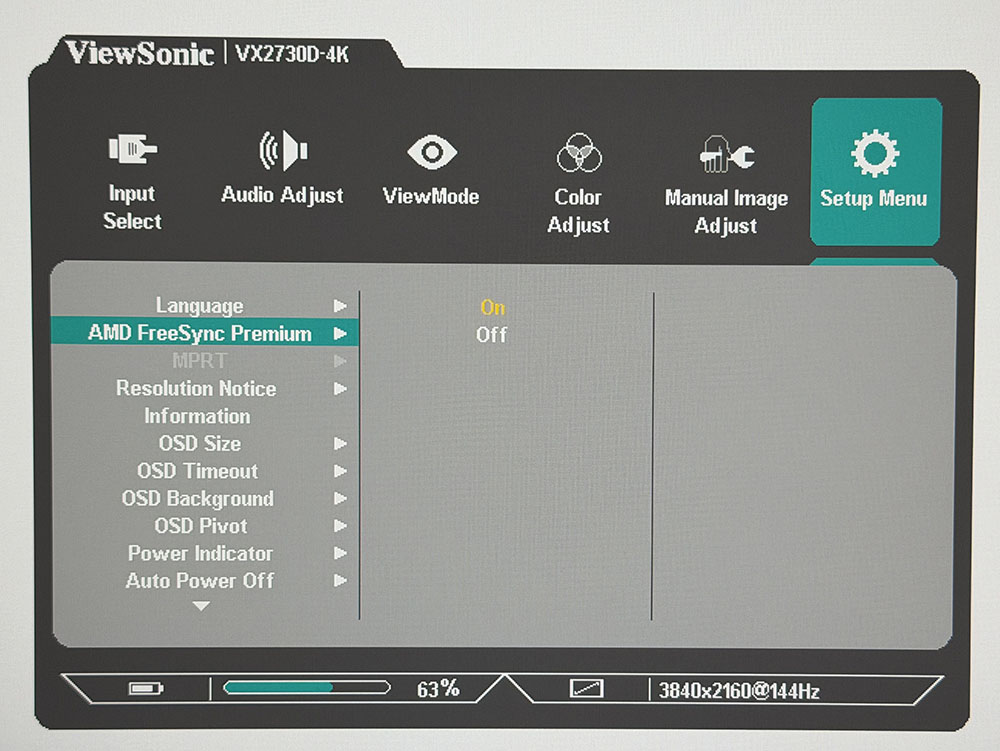
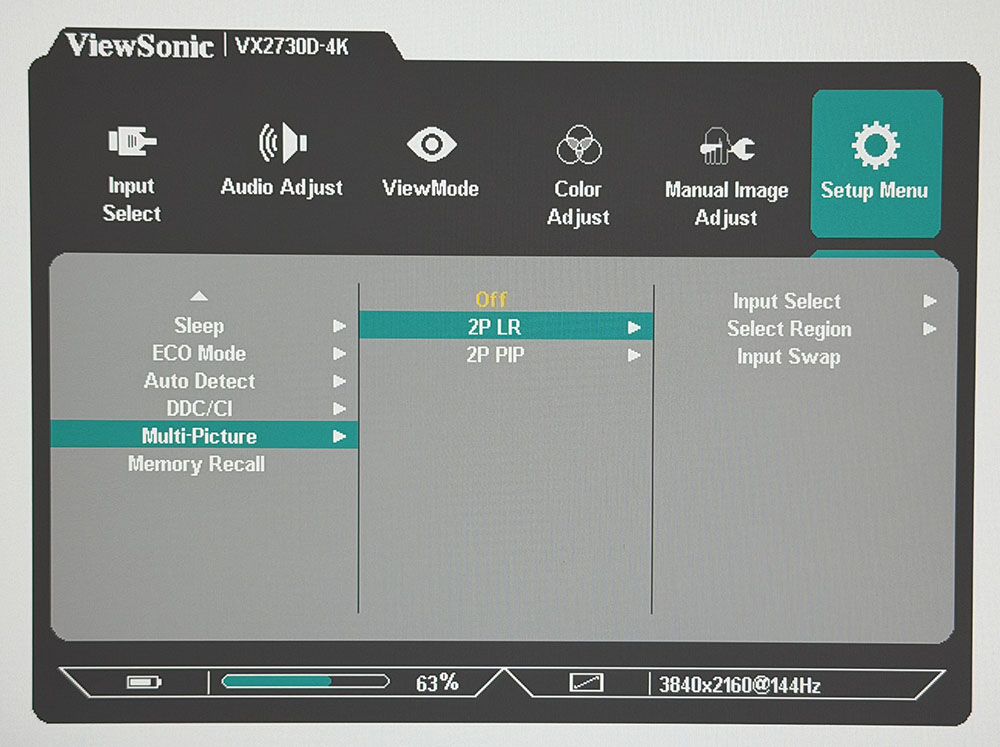
There are nine picture modes aimed at different game types and uses. Standard is the default and best choice. It’s within a whisker of perfect; the VX2730D-4K does not require calibration. But tweaks are available in the Color Adjust menu where you can change the color temp, adjust saturation and hue and panel luminance. HDR is simply Auto or Off, there are no adjustments there. The sRGB choice in the color temp menu does not change the gamut size, so there is in effect, no sRGB picture mode. You get full color all the time, covering just over 98% of DCI-P3.
You can switch resolution/refresh modes in the OSD using the Dual-Mode field if you’d rather. Like any dual-refresh monitor, you must set up the refresh rates in the Nvidia Control Panel once initially before you can toggle back and forth.
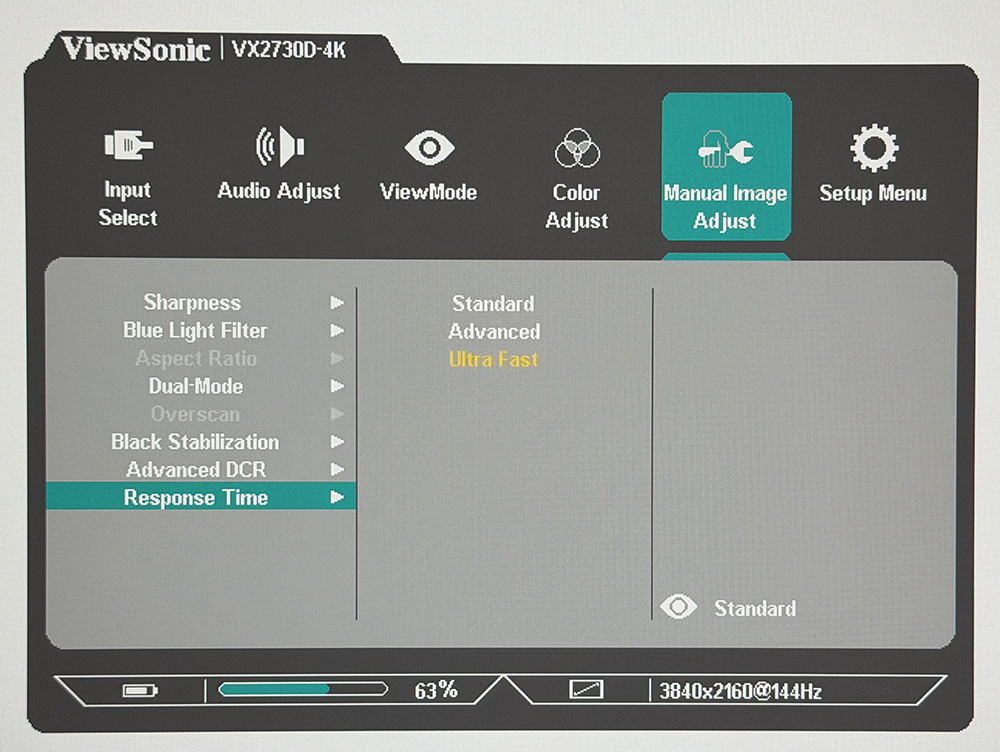
There are three overdrive levels, of which Ultra Fast is the smoothest. I saw no artifacts on any setting. It is reasonably effective, but 144 Hz still has some blur. In the Setup menu, you can turn off Adaptive-Sync in favor of MPRT, which is a backlight strobe. At 144 Hz, the phasing artifact is severe enough that I couldn’t use it. It’s better at 288 Hz where you can only see it slightly. Adaptive-Sync, along with a video card that can maintain max frame rates is the best option. The VX2730D-4K includes PIP and PBP, which is called Multi-Picture. It allows the viewing of two video sources at once.
ViewSonic VX2730D-4K Calibration Settings
The VX2730D-4K measured extremely well out of the box in its Standard picture mode. Grayscale, gamma and gamut tracking were without visual flaws. I found a tiny improvement with a couple of changes to the RGB sliders in the color temp menu. I noted that though there is a choice labeled sRGB, it is not a color space selector. You will see the full native gamut in all scenarios, covering just over 98% of DCI-P3. My recommended SDR settings are below. In HDR mode, there are no options and I noted some issues, which you can read about on page five.
Swipe to scroll horizontally
Picture Mode | Standard |
Brightness 200 nits | 59 |
Brightness 120 nits | 31 |
Brightness 100 nits | 24 |
Brightness 80 nits | 18 |
Brightness 50 nits | 8 (min. 27 nits) |
Contrast | 70 |
Color Temp User | Red 99, Green 99, Blue 100 |
Gaming and Hands-on
The VX2730D-4K’s gameplay experience was excellent in every important way. It is a seriously quick monitor with extremely low input lag on par with many premium screens. Movement and aiming are very precise. Motion blur is well below the level of distraction, even at a relatively pedestrian 144fps when playing in 4K mode. Detail is tack-sharp thanks to that 163ppi pixel density. The panel’s high contrast and saturated color made fine textures pop in both the foreground and the background.
The dual-mode switch worked perfectly once I had set up both resolutions in the Nvidia Control Panel. I found I could switch when paused in Doom Eternal without exiting to the desktop. Playing in FHD/288 Hz mode showed even less motion blur. There is measurably less input lag, but I could not perceive the difference of just 3.1ms. Ultimately, I preferred the sharper detail of 4K even though the frame rate was lower. The overdrive is good enough to keep moving objects sharp, so I could aim precisely at a distance. Lobbing grenades across the icy arena was child’s play as they almost always fell on target.
The only flaw I found was in the VX2730D-4K’s HDR presentation. There is a blue cast to the image, and it is less bright than SDR. You’ll see this confirmed in the tests on page five. The color saturation is there but I ultimately preferred playing in SDR mode because it had more impact.
I’ve noted in the past that dual-mode monitors create a compromise where you get high frame rates but with a sacrifice in resolution. FHD was once a gold standard, but when compared to 27-inch QHD or UHD, it looks soft. There’s no getting around acquired perceptions and after reviewing almost 500 monitors in the past 13 years, I have a few. That said, 27 inches is tolerable for FHD. I can see its appeal to competition gamers who prize response and frame rates above all. The VX2730D-4K is a worthy gaming display for players of all skill levels.
For everyday use, the VX2730D-4K’s high pixel density and accurate color is a real boon. It’s ready to rock out of the box, no calibration needed. I tweaked it to a little higher standard but that’s more to satisfy ego than anything else. It’s colorful and bright and extremely sharp. It has about 60% more contrast than the average IPS panel and that’s a clearly visible difference. The image is cleaner and more textural, almost on the level of a good VA screen. The only thing I missed was an sRGB mode. There’s an sRGB label in the color temp menu, but it doesn’t change the gamut size. You get full DCI-P3 color for all content.
Takeaway: The VX2730D-4K is an extremely capable monitor with just a couple of flaws. HDR doesn’t look any better than SDR thanks to lower brightness and incorrect grayscale tracking. But SDR content is rendered with nearly perfect color accuracy and excellent contrast thanks to low black levels. Gaming is addictive thanks to extremely low input lag and a smooth overdrive. Flaws aside, the VX2730D-4K is a 4K display for $280. That’s about all you actually need to know.
MORE: Best Gaming Monitors
MORE: How We Test PC Monitors
MORE: How to Buy a PC Monitor







 English (US) ·