
 1 week ago
16
1 week ago
16

VRAM usage has become an increasingly unavoidable issue in games as they grow more graphically intensive over time. Pushing the visual fidelity requires more assets to be stored in VRAM, which makes it harder for cards with 8GB (or less) memory to run games smoothly. For Linux at least, Natalie Vock has just proposed a new solution that alleviates this issue, providing a notable performance boost for games by optimizing VRAM usage.
Vock is part of Valve's Linux graphics driver team; she's developed new kernel patches and two specific utilities to address the VRAM usage issue. These fixes basically talk to the OS and let it know that the game currently running in the foreground gets to call dibs on the VRAM. If the VRAM starts to fill up, any VRAM consumed by background tasks needs to spill over into system RAM before the game does.
Article continues below
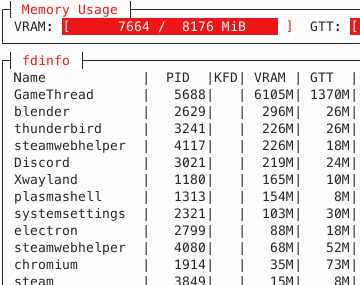
The main solution she developed is called dmemcg-booster (Device Memory Control Groups), which tells Linux what program needs to be "protected" at any given moment, meaning it can't be evicted from the VRAM and thrown into the GTT. If a background task requires VRAM, it will be the one forced to move to slower system memory to ensure the game keeps running without interruption.
This is more about optimizing VRAM usage than outright reducing it. If you had a 12 GB card, for instance, you'd never notice the drawbacks of just 8 GB of VRAM because there's enough buffer for poorly prioritized background programs. Now, even a GPU with less VRAM can run at its full potential. Case in point: with the fixes applied, Cyberpunk 2077 started using almost 7.4GB of VRAM, and GTT dropped to just 650MB.
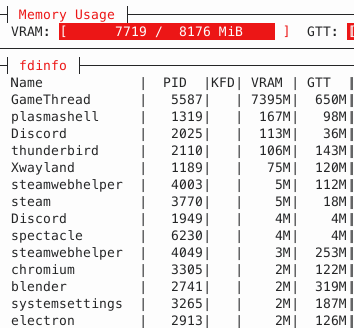
The other component is called plasma-foreground-booster, and it can automatically tell KDE which window is in front so that it can prioritize VRAM usage for that window. These patches are currently being integrated into CatchyOS and are awaiting merge into the main Linux kernel. You can download and use these patches yourself inside any distro, but keep in mind they'll only work on AMD GPUs because Nvidia drivers have closed-source memory management.

Follow Tom's Hardware on Google News, or add us as a preferred source, to get our latest news, analysis, & reviews in your feeds.


 English (US) ·