
 53 minutes ago
7
53 minutes ago
7
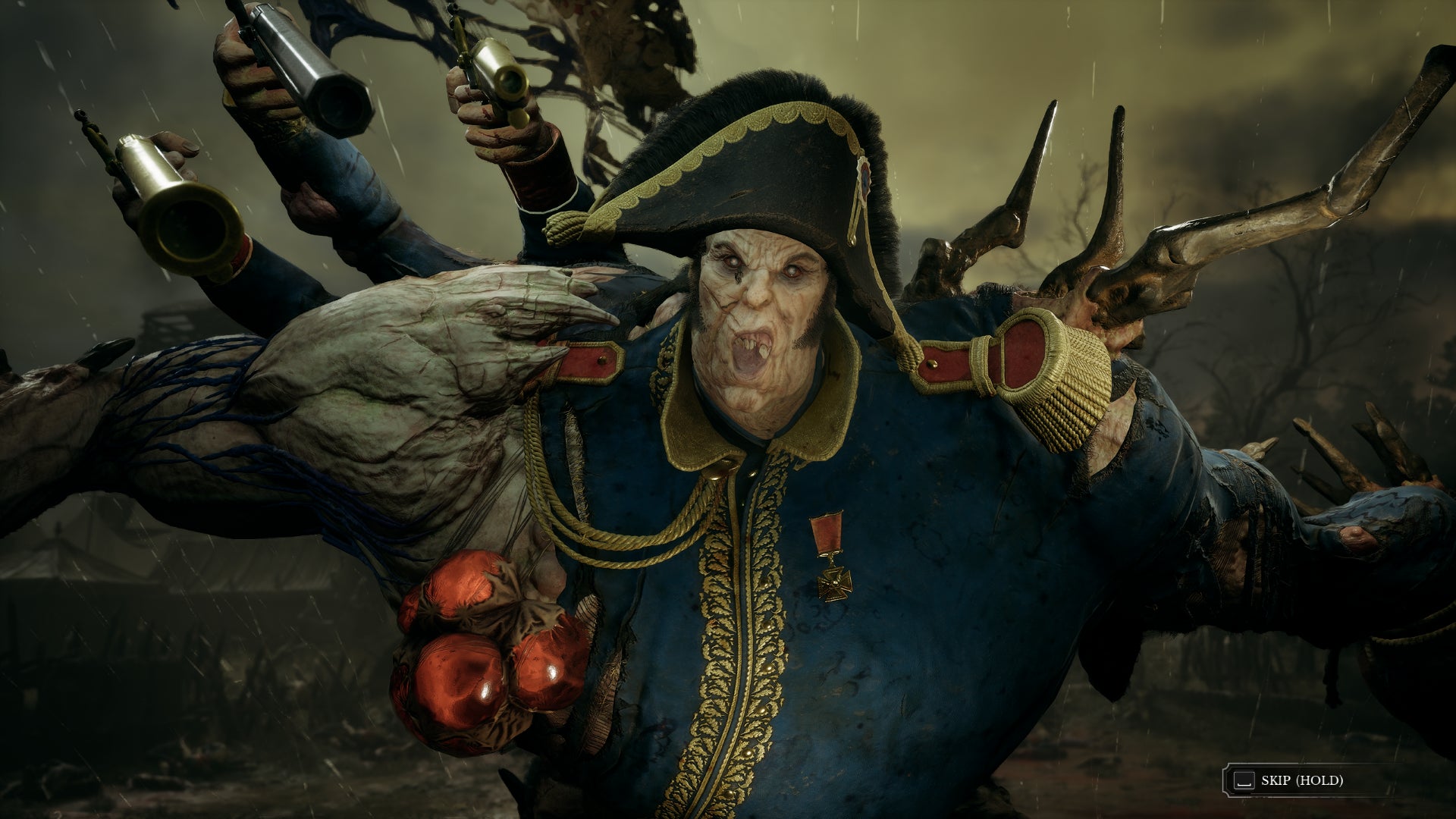
Well, I say "freshest." In its ickily up-close vision of Napoleonic battlefields, swapping the boring old bubonic plague for a fleshy, pustulating necro-blight, Valor Mortis is as horrid and grim as a standard Soulslike rulebook would compel.
At the same time, One More Level’s first-person take on campfires and attack-pattern combat does feel like a game striking out on its own, and not just through its unusual choice of perspective. If anything, there are decisions here that might have FromSoft purists calling for the guillotine. Yet it’s almost all in service of an intentionally tighter, more intimate kind of supernatural action, which – while lacking the immaculate complexity of Souls masterworks – serves up enough tense sabre duels to see the whole thing through.
Also, it begins with a Vincent Cassel-voiced Napoleon forming himself a cape of purple plague meat, which isn’t the dullest way I’ve seen a game start. In Valor Mortis’ history, the Petite Corporal won at Waterloo with the aid of this funky ooze, which reanimates fallen militaires at the acceptable cost of turning them into eternally loyal monsters. You yourself get off lucky – your only real mutations are the ability to unlock BioShock Plasmid-style powers to aid your sword and pistol moves, and a tendency to wake up next to glowing lanterns after carking it once more. The rest of the Grand Armée aren’t so fortunate, becoming hostile drones at best or fused-together bone mountains at worst. Special commiserations to the grenadiers now joined together at the hip, chest and shoulder, the 'Volunteers' who attack in flurries of unnaturally stretched-out limbs, and the cannon operators who melted into their own artillery.
It’s a respectable menagerie of body-horror foes, whose unholy designs contrast nicely with the orderliness of their blue coats and fine fur hats. One of the benefits of the FPSoulslike approach is that you get to admire their revolting visages point-blank, which serves both to make 1-on-1s feel a little more personal – whatever light is left in those eyes, you will see go out – and to give the taller monstrosities even more of a physically imposing gravitas. I also found pre-release fears of the perspective limiting battle effectiveness to be largely unfounded; there are a couple of bosses where getting right up in their undead grills will push their telltale swinging motions offscreen, but Valor Mortis’ emphasis on parrying and posture-breaking means it’s usually smarter to keep a measure of distance anyway. Some astute level design also keeps most encounters head-on, so it’s rare for someone to get behind you for an unseen backstab. I can think of perhaps two or three occasions, throughout the whole game, where I truly needed the (sacrilege!) damage warning indicators for out-of-view attackers.
Not every first-person pitfall is avoided. Literally: I’ve backstepped off cliffs and into unescapable corners far more than I suspect I would have, if I could see my legs. But generally, it works, especially as environments – as well as enemies – have clearly been built around the eyeball view. There are moments of claustrophobic unease here, inside narrow cave tunnels and blindspot-rich villages, that either wouldn’t be possible or wouldn’t present as effectively with a third-person camera. Nor would it be so easy to appreciate, as with Napoleon’s revenants, the grisly detailing of these spaces: agonised faces trapped in petrified deathgunk, scattered belongings left by fleeing peasants, torturous medical implements lying around hidden laboratories. Vividly gruesome stuff, for which you are afforded no distance.
It also helps the sense of danger when a nine-foot-long serrated blade is being swung not at your character, but directly into your face. Parry-offs are becoming an increasingly hard sell in games, both owing to mechanic fatigue and after Onimusha: Way of the Sword got so creative with its deflections. Still, Valor Mortis? Damned good parries, I say. Timings are well-judged, and even the skinniest rapiers clash like an Elgin Marble being hurled into a church bell; a heavy, dramatic clang that would be loud enough to wake the dead, were you not already fighting them.
There is a bit of ranged offense, with the revolver, musket, and hand-flamethrower providing the most reliable options for crowd control or weakpoint-popping. Although none of these are as powerful or, frankly, satisfying as pulling off a parry-parry-finisher combo, they are important in making sure Valor Mortis’ combat isn’t entirely reactive, and juggling these tools can enable some fun violence tricks. One Volunteer variant, for example, lugs around a fuel cannister on his back: a prime target for a pistol shot, followed by a burst of flame to ignite the leak.
A word of warning, though: this is not an action sandbox, with hundreds of weapons and dozens of abilities to experiment with. The tools I’ve mentioned so far, including the standard sabre and nimble rapier sword varieties, account for over half of the complete arsenal, and the already-thin skill tree of unlockable talents is dominated by health and damage upgrades that are just flat-out better than the other options available.
The result is a fairly narrow potential for build diversity, which in fairness, I don’t think makes Valor Mortis actively worse on a first playthrough. I can live with the game favouring a sword-first style based around posture damage, because it’s got – again – damned good parries, I say. Nonetheless, it is a bit of a shame that I can’t go again with a much more powers-focused style, just because the talents and resources can’t get my Franco-magic damage up on par with that of cold steel.
This, and the first-person perspective, are far from the only ways in which Soulslike conventions get shanked. The story – which has you searching for an understanding of your new powers, as well as why Bonaparte himself is playing Eldritch God with his troops – is told through conventional dialogue, cutscenes, and found notes, not cryptic item descriptions or dying apologies. It’s not excessively paced but is no epic either, easily clocking in at sub-20 hours. And, despite both this and the distinctive enemy designs, I did tire a little of tangling with the same handful of minibosses throughout the latter stages.
There aren’t that many true boss fights either, though the ones that do exist range from serviceable to good. With the exception of one gimmick fight, which is actually rather impressive in its audacity, they’re all tight, unbloated, mano-a-mano blade bouts, with steep yet fair learning curves. Any post-loss ire I had tended to focus on my own missed deflects or botched power usages, rather than how any of my opponents were waterfowl-dancing bullshit merchants.
Valor Mortis is also more forgiving of certain mistakes, particularly during platforming sections, where tumbling into the abyss costs you neither souls (or catalysts, as they’re called here) nor a trip back to the nearest lantern. This is almost certainly because it has an awful lot more running and jumping than the average Soulslike, with full-on grapple hooking and wallrunning tricks inspired by One More Level’s previous work on the Ghostrunner duology. I’m not sure that the more segmented parkour sections elevate the game much – they differentiate it, again, and there’s a mildly gratifying sense of momentum to its acrobatics. Still, some parts do seem like random chunks of action-adventure spliced in for the sake of difference alone.
Parkour makes a much better addition when it’s instead blended more thoroughly into the central swordplay. Sometimes, Valor Mortis’ corridors open up into wider arenas, where these movement skills can unlock new sneaking routes and angles of attack. In these moments, it owes as much to Dishonored as it does to Dark Souls, temporarily easing you some slack to scope out an encounter and thin the ranks with some quiet stealth crits. In more classical Soulsy fashion, levels are dense with branching side-paths and activatable shortcuts, usually with some goodies or sidequest item squirreled away to reward your exploratory spirit, but it never feels better to sidle off-track than when it ends up puttings you in a prime ambush position.
Unmarked opportunities like this also help ensure that Valor Mortis, while streamlined in places, rarely feels like it’s compromising much. It’s short, but not excessively linear. It’s lightly equipped, but trusts you enough to learn and experiment with the tools you have. And, yes, the perspective is narrower, but the entire game is intelligently structured around it, with little need for bodges or UI handholding to make up for the reduced vision.
That’s good game-making, not just good Soulslike-making. Which is, probably, why Valor Mortis’ attempt at trying something different – in an increasingly busy, sometimes joyless genre – works as well as it does.




 English (US) ·