
 52 minutes ago
6
52 minutes ago
6
Ghostrunner studio One Level Left returns with a Napoleonic alternative history Soulslike that fuses fluid sword- and gunplay with exhilarating parkour, and it's a delight.
Valor Mortis plays a bit of a sneaky trick. For a while, it keeps it straight. 'Yes', it seems to say; 'I'm definitely a Soulslike. Look at my bonfire equivalents, my healing flasks, my corpse runs, even my early impossi-boss feints. Look at my cautious action, my fog gates, the oppressive air of melancholy that lingers over these fields of mud and blood'. But jumpcut to a few hours later, and there you are: first-person wall-running, grapple-swinging, one-two parry slashing, quick-step-fire-ball-dismembering, slow-mo bullettime high-jump shotgun-blast-to-the-face-ing. This is not your usual Soulslike.
I probably shouldn't have been too surprised, of course. Valor Mortis is the work of One More Level, the studio behind 2020's brilliant, equally frenetic parkour-and-sword adventure Ghostrunner and its 2023 sequel. But as protagonist William Dowsett, a soldier in Napoleon's Grande Armée, wrenches his reanimated body out of the mud at the start of Valor Mortis - his comrades' corpses piled high around him on a nameless European battlefield - early signs suggest a more traditional kind of Soulslike. Admittedly, most Soulslikes don't intermittently interrupt the action so Napoleon's disembodied voice can bellow glories to the Empire directly in your brain, but the rhythms of its first-person swordplay are familiar ones.
For a while at least, your only means of offence and defence is your saber, and combat initially plays out in that classic Soulslike dance of cautious observation and patient trading of blows. You swing your sword to attack and block to limit incoming damage, a successful follow-up restoring any health that might have drained. Some enemies wield powerful, unblockable attacks, demanding a nimble sidestep to avoid; get the timing right and you're rewarded with an opportunistic slow-mo window. Defensive manoeuvres deplete your Endurance, which takes a beat to regain; quietly approaching enemies from behind opens them up to a vicious backstab. And because this is a post-Sekiro world, well-timed parries eventually break an enemy's posture, creating an opening for a powerful riposte strike.
It's familiar stuff, sure, but it's beautifully designed, blending weight and fluidity with satisfyingly visceral follow-ups that cap each successful encounter with gruesome decapitations and cartwheeling limbs. And the novelty doesn't wear off; there isn't a minute in Valor Mortis' 20-ish hour runtime when the fundamental thrill of swordplay falters. Even so, it's a well-rehearsed rhythm for Soulslike fans, and the familiarity is only compounded by the ready presence genre's usual ticks - the bonfires (here hourglass lanterns), the healing flasks, the dropped Souls (here Catalysts) that serve as currency, easily lost, for levelling and upgrades. But then comes the gun.
Valor Mortis' gun-blade combat set-up might suggest a touch of Bloodborne, but once you start to get a handle on things, its pace is a far more furious one. At any time, you can pull up your pistol and free-aim to land a shot without needing to slow your momentum. Headshots are good, but hit an enemy glowing Red Plague pustule (their exact locations are randomised with every respawn so you can't get too complacent) and you'll break their defences, causing significant damage. We're not exactly in traditional FPS territory, given the relative paucity of bullets, but this extra layer of longer-range attack makes for combat with a sometimes breathless sense of fluidity and momentum. Soon enough, you'll find yourself adopting a run-gun rhythm to encounters, landing a few well-aimed approaching shots - perhaps to deal some preliminary damage or to hit rifle-wielding soldiers about to pull the trigger with an interrupt - then follow it up with some fleet-footed close-quarters swordplay.
And One More Level elegantly expands your options over time: shotguns are powerful but their long reload times are risky when an enemy is bearing down for another vicious melee attack, while the rifle is useful for thinning the ranks at long range but leaves you exposed to up-close attack. Sword fans, meanwhile, can trade their starting sabre for a rapier soon enough, trading slower swings for a succession of aggressive jabs. It's also a dream for parrying, causing massive posture damage with every successive deflection, albeit with a catch: it can't block. That makes it a bit of a risk if you aren't confident in your timing, but I found the parry window is generous enough - and the benefits significant enough - that the rapier was my weapon of choice for the bulk of play. And actually, while I wouldn't exactly call Valor Mortis easy, it's more forgiving than you might expect, pitched closer to 'challenging' than 'egregiously punishing' unlike other genre bedfellows.
All this and I haven't even mentioned the small but effective consumables at your disposal - grenades, molotovs, temporary ability boosts - and your Nephtoglobin-powered magic abilities (this, in case you haven't already twigged, is very much an alternate history French Revolutionary War). One transmutation turns your hand into a flame thrower so you can inflict burn status on enemies; another stasis-freezes them to the spot. And the Catalysts you're farming throughout can be exchanged for incremental upgrades - more health, punchier melee, and so on - even a fancy new trick. You can slow time when you draw your gun while airborne, for instance, adding even more cinema to the combat. Together, it makes for an elegant toolkit with powerful combat potential, and it's paired with enemy design that encourages experimentation as you adapt to each one's distinctive rhythms: pitchfork-wielding villagers with erratic thrusts, super-aggressive axemen with a flurry of unblockable attacks, lanky elite soldiers with vicious claymore swings or rapid dual-wielded sabers that really test your parry timing. As it all begins to click, it's surprising how quickly you can cut through enemies with the old headshot, dash-dodge, postule-pop, parry-posture-break trick; stately Soulslike rhythms melting away.
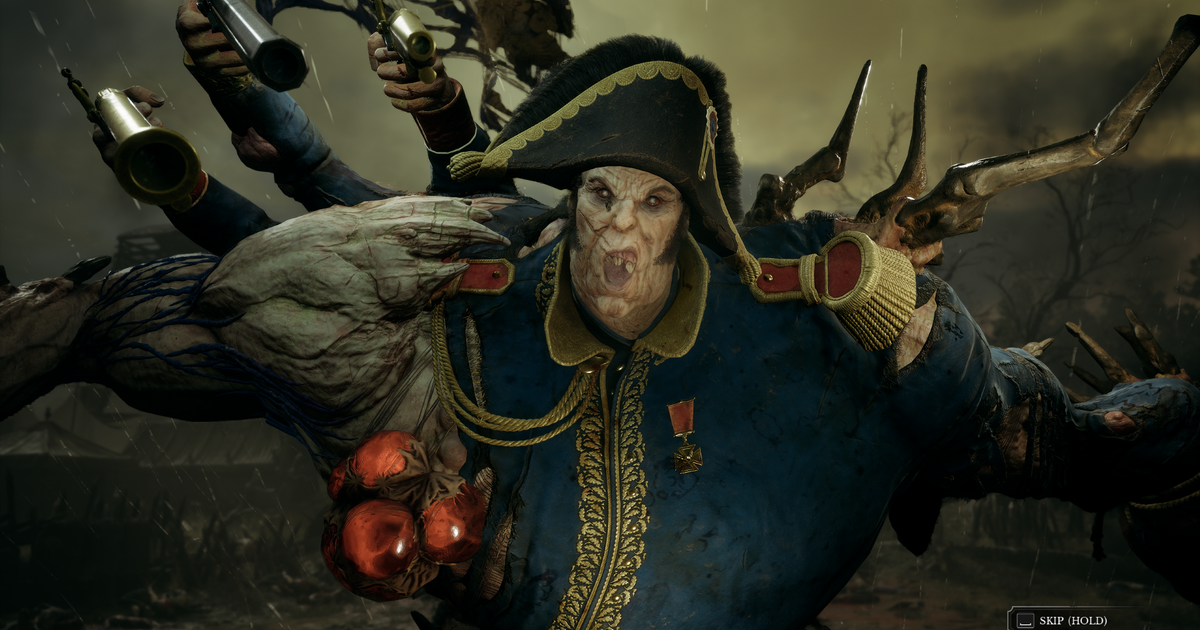
Bosses though, are the real highlight; as wonderfully imaginative as they are a joy to fight. The first - the only one I'll spoil as you meet it early - is a grotesque sight: an army general fused with his battalion; the tortured faces and clasping arms of his men sticking out of lumpen flesh. The bipedal horror still wears the rags of his rank, brandishing a shredded tricolore for brutal close-up swings and a saber he uses to order his subordinates into action, peeling themselves from his flesh and taking unloading rifles. And while there aren't a huge number of bosses, One Level Left makes them count. One leftfield turn amid swirling sand and unexpected geography is a delight, and its follow-up is so wonderfully bizarre - a breathless bit of ludicrous spectacle with a preposterous guitar-chugging parkour-action second half - that Valor Mortis has a hard time following it up. And yes, parkour.
The first hint Valor Mortis might not be your usual Soulslike comes pretty early on, when William - needing to cross a treacherous gap teetering high on the edge of a ravine - launches himself at a jutting treebranch, swinging with all the confidence of a man raised in a circus and then landing with unexpected finesse. Before long, you're springing down ledges to reach the banks of a vast lake at the base of a Nephtoglobin-blasted railway bridge, and, from there, the parkour becomes steadily more pronounced. You'll bound across platforms, dodge to avoid incoming fire, fire off your own devastating rounds as you close the gap, or hurl yourself off ledges to launch a powerful airborne attack. It gets even wilder later on as wallrunning and grapple swings are enthusiastically tossed into the mix, albeit only at fixed locations; and by the time you gain the ability to activate parkour points - conjuring ledges and outcrops with split-second timing to maintain your momentum - Valor Mortis feels as much like a platformer as it does a Soulslike. And levels are built to encourage this sort of play.
Valor Mortis' world - for all its death and decay - is an often breathtaking one. Bucolic cottages sit snugly among lavender fields, vast lakes nuzzle pastoral woodland beneath snow-capped mountains, and misty forest trails wind lazily over felled logs and up into hills. Yes, its beauty is tempered by searing flames and rotting corpses, but it's often gorgeous nonetheless. And while major locations are separated with loading screens, individual areas are huge, full of ingeniously designed routes that snake circuitously around themselves, doubling back to unlock surprise shortcuts in classic Soulslike fashion (a mid-game mine level is a real standout, far more intricate and rich with ideas than it initially suggests). You'll dash across walkways and precarious beams as you navigate a vertiginous quarry of searing white geometric shapes; wind through burning buildings and bound from rooftop to ledge; scurry through fields of wheat where unseen horrors lie in wait as rain falls and mournful birdsong echo across the darkening sky. And yes, there's even a poison swamp.
Progress, too, is routinely punctuated by bigger set-pieces. Some have a platform-puzzly air to them and other encounters are more enemy heavy; usually offering multiple routes around and over a busy confluence of patrolling mobs if you're dedicated enough to look - perhaps bypassing the encounter entirely, or offering a cheeky vantage point. Sometimes too, exploration rewards a proper boon - say, a secluded cannon you can use to thin the ranks in a particularly enemy heavy area - while small secrets and off-the-beaten track side quests provide additional reason to poke around, preventing the otherwise largely linear progress path from feeling too claustrophobic. There's even a light touch of Metroidvania to Valor Mortis' structure, and many levels include routes you can't take until you've gained the necessary abilities later on, often revealing secrets of their own - challenging fights against members of Napoleon's Garde Eternale, perhaps, rewarding skill-granting gems. And throughout it all, you're bounding and slashing and gunning with gleeful abandon.
There does come a point in the latter stages, however, where Valor Mortis' action plateaus, its inventiveness wains, and it begins to show its limits - as the same relatively small selection of enemies return again and again in slightly new configurations, and you realise you're wandering around another area built from the same old shacks. Artfully disguised shacks in beautifully constructed environs, yes, but it starts to feel a little predictable. Its story, too, never quite gets off the ground: while it can muster an evocative turn of phrase and features some strong voice acting from the handful of characters that haunt your journey, it can't quite alleviate the obviousness of it all as it dances through its "are we the baddies?" and "war is bad" motifs. And, honestly, I do kind of wish Valor Mortis wasn't quite so beholden to the all-too-familiar machinations of Souslikes. It's all here, right down to the hub world you'll revisit whenever you want to upgrade, and it's a weight that hangs a bit too heavily, holding it back from truly blossoming into something of its own.
Minor complaints aside, Valor Mortis is a delight; a gloriously entertaining Soulslike whose fluid foundational combat and cleverly designed combat encounters would probably be enough on their own. But then One Level Left goes further: the exhilarating parkour, the thrilling sense of momentum that shapes everything from the intricate level design and memorable bosses to the thrilling sword- and gunplay, alleviating it further. Valor Mortis might not be your usual Soulslike, but it's a bloody good time.
A copy of Valor Mortis was provided for this review by Lyrical Games.




 English (US) ·