
Warner Bros.
We may receive a commission on purchases made from links.
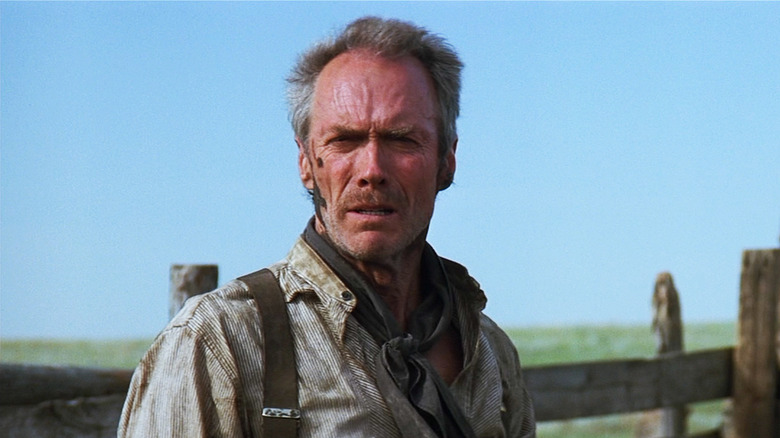
There are many revisionist Westerns everyone should watch at least once, but if you're going to go with one, make it "Unforgiven." Clint Eastwood's 1992 masterpiece remains the quintessential revisionist Western but it's also arguably the actor/director's best film. Of course, that means most of us have seen "Unforgiven," but there's likely a fair few yet to check out 1969's "The Wild Bunch." With its controversial violence and deconstructionist approach to the Old West, the feels very much like a forerunner to "Unforgiven."
The 1960s was the last decade Westerns were truly culturally relevant. The genre had been reliably popular since the beginning of film, falling out of favor in the 1930s only to come galloping back after the success of "Stagecoach." John Ford's seminal Western not only inspired "Citizen Kane" but launched John Wayne to A-list status and revitalized the oater as Hollywood's most popular genre.
By the 1970s, however, the Western was on life support. When the Duke finally shuffled off this mortal coil in 1979, so too did the genre with which he'd made his name become a shadow of its former self. In the years that followed, we got far fewer Westerns, but we also got some of the best examples of the form ever committed to film. In these movies, the simplistic morality of the early Wayne Westerns had been replaced by a more complex, gritty, and often cynical approach which characterized the age of the revisionist Western. Interestingly enough, however, these more realistic, irreverent films had started to emerge long before the Duke kicked the bucket, and "The Wild Bunch" is a prime example.
The Wild Bunch was a brutal Western in the revisionist vein
Warner Bros.
Along with his "Dollars" trilogy director, Sergio Leone, Clint Eastwood was one of, if not the most important figure in the revisionist Western movement. His portrayal of the morally questionable Man with No Name was truly revolutionary in comparison to the plain old good guy archetype represented by John Wayne. Eastwood's antihero first arrived in 1964, and over the course of that decade he would help to usher in the revisionist era that came to dominate the 1970s and beyond. But it wasn't just Eastwood and Leone that did so.
Aside from the fact the seeds of this movement were planted in films like 1952's "High Noon" and 1956's "The Searchers," there was also Sam Peckinpah. The director's 1969 effort, "The Wild Bunch" was pivotal in developing the Western into a more violent and gritty genre, and in its deconstruction of the Old West myth, acted as an early auger for what was to come in successive decades — a spiritual predecessor to "Unforgiven."
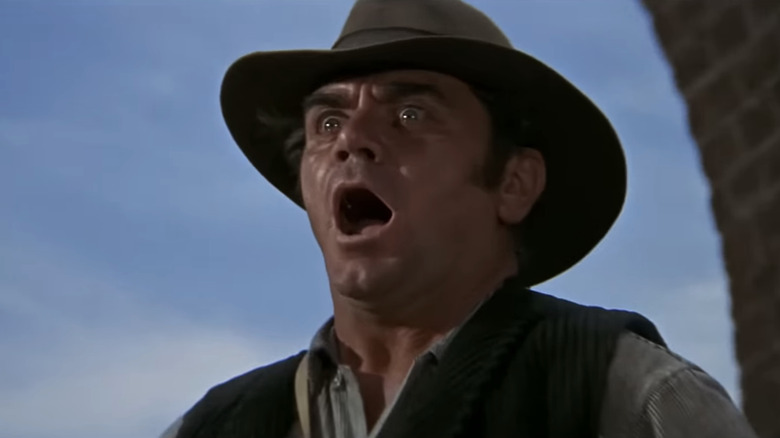
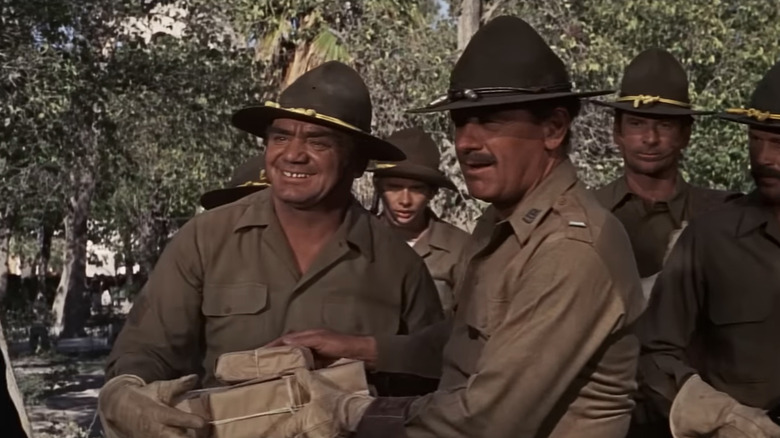
It was also just downright graphic. The film is set in 1913 Texas, during the twilight years of the Old West, in which a group of outlaws led by Pike Bishop (William Holden) plot one final robbery. The gang includes Dutch Engstrom (Ernest Borgnine) and brothers Lyle (Warren Oates) and Tector Gorch (Ben Johnson), all of whom quickly discover that their final crime is actually a setup by Bishop's former partner Deke Thornton (Robert Ryan). Pursued by Thornton, the group hide in Mexican territory where they face off not only against the ruthless bounty hunter but a corrupt Mexican general. "The Wild Bunch" culminates in a gruesome and brutal finale which ensured Peckinpah's film debuted to controversy.
The Wild Bunch is worth watching whether you like Unforgiven or not
Warner Bros.
A major part of the feud between Clint Eastwood and John Wayne stemmed from the former's 1973 film "High Plains Drifter." Evidently, the Duke found Eastwood's Western, which deconstructed the cowboy archetype, to be disagreeable to say the least. But if he disliked "High Plains Drifter," John Wayne absolutely hated "The Wild Bunch."
Sam Peckinpah might have predicted as much. The film shows gunfights not as exciting showdowns between good guys and bad guys but as brutal, bloody slogs. For Peckinpah, however, that was very much the point. In the book "If They Move... Kill 'Em!: The Life and Times of Sam Peckinpah," the director is quoted as saying:
"The point of the film is to take this façade of movie violence and open it up, get people involved in it so that they are starting to go in the Hollywood television predictable reaction syndrome, and then twist it so that it's not fun anymore, just a wave of sickness in the gut ... it's ugly, brutalizing, and bloody awful."
Much like Eastwood's William Munny reckoning with the awful crimes of his past in "Unforgiven," then, "The Wild Bunch" reckons with Hollywood's own sanitizing of violence, and with society's embrace of that violence. In that sense, it was not only a revisionist Western but an attempt to revise cultural norms.
In terms of a more direct connection to Eastwood's 1992 film, however, "The Wild Bunch" similarly depicts aging outlaws struggling to maintain in the dying days of the Old West. Whether you're watching as an "Unforgiven" fan or not, then, "The Wild Bunch" remains hugely important.




 English (US) ·