
 3 weeks ago
30
3 weeks ago
30
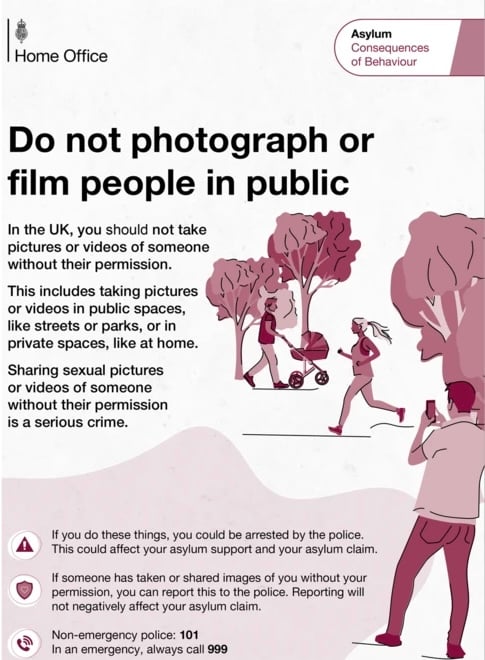 A screenshot of the booklet published by the U.K. Home Office.
The U.K. government has published a “misleading” booklet that suggested people “could be arrested” if they photograph people in public.
As journalism industry news outlet Press Gazette reports, the government booklet, titled Understanding behaviours and expectations in the U.K., suggests that taking photographs of people in public without their consent could result in a prison sentence for the photographer.
“In the U.K., you should not take pictures or video of someone without their permission,” the booklet says in a section titled “Respect in public” and “Taking photographs and videos.”
The booklet adds: “This includes taking pictures and videos in public spaces, like in streets or parks.”
The nine-page booklet was published by the Home Office — the U.K. government department responsible for immigration, visas, policing, and national security — as a guide for asylum seekers.
The U.K.’s National Union of Journalists (NUJ) has condemned the Home Office’s booklet. In a statement, the NUJ says the “misleading blanket” claim that suggests taking pictures of people in public without their consent is wrong could lead to “increased hostility” toward photojournalists.
“The union is very concerned that the spread of inaccurate information around the right to photograph and film people in public without permission could expose our members to increased hostility and harassment as well as wrongful accusations of criminality and unjustifiable stops by the police. This would undermine journalists’ right to report and the public’s right to know,” the NUJ writes.
It adds: “These statements misrepresent the law and risk misleading people on their rights and obligations. Taking photos or videos of people in public without their permission is not inherently unlawful.”
The booklet does correctly explain that taking or sharing sexual images of someone without their consent is a criminal offense. However, it does not clearly distinguish this from the broader act of photographing someone without their consent, potentially giving the impression that taking photographs of people without permission is itself a crime.
The NUJ says its members working in visual journalism are already experiencing increased obstruction and hostility, and routinely deal with people questioning their right to photograph in public. The organization is calling on the Home Office to rectify information it has published and shared with asylum seekers about restrictions on photographing and filming people in public places.
Last summer, the U.K. government suggested that people delete old photos to save water during the country’s drought — prompting ridicule from photographers online.
“Delete old emails and pictures as data centres require vast amounts of water to cool their systems,” the U.K. government explained on an official page.
Affiliate Disclosure PetaPixel articles may include affiliate links; we may earn a commission if you buy through one.



 English (US) ·