
 3 weeks ago
43
3 weeks ago
43
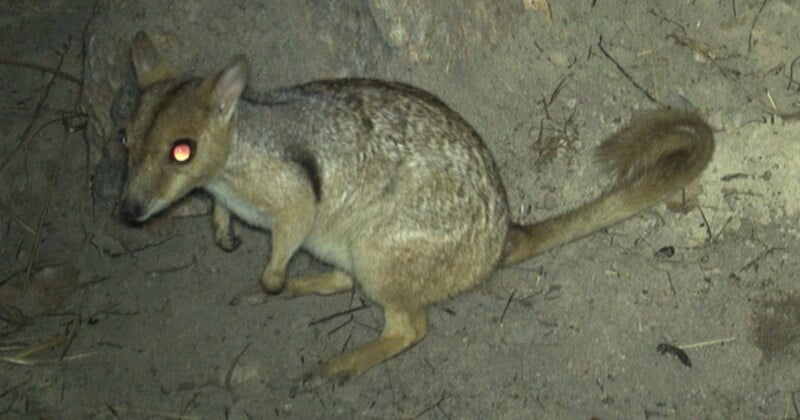 A Narbalek was captured on a camera trap | Image credit: Australian Wildlife Conservancy (AWC)
A trail camera has captured a tiny wallaby known as as “Narbalek” in a remote part of Western Australia where the species had not been detected for more than 50 years.
The Narbalek is Australia’s second-smallest wallaby, but the species is thought to be on the brink of extinction. But its appearance on trail camera at two locations in the country’s Kimberley region has given conservationists a rare opportunity to confirm that the elusive species is still present there.
Australian Wildlife Conservancy (AWC) describe the discovery as the ecological equivalent of finding a needle in a haystack, with the trail-camera detections offering new insight into the Nabarlek’s ecology and suggesting that endangered populations may still be surviving in pockets across northern Australia.
“This is very exciting and great news for the species,” Larissa Potter, a senior field ecologist with the AWC, says in a statement. “Confirming the Nabarlek’s presence at two new sites on mainland Dambeemangaddee Country is a major step forward for our understanding of where the species occurs.”
“It’s also reassuring as it indicates that this threatened wallaby is persisting on the Kimberley mainland in places we didn’t previously know about.”
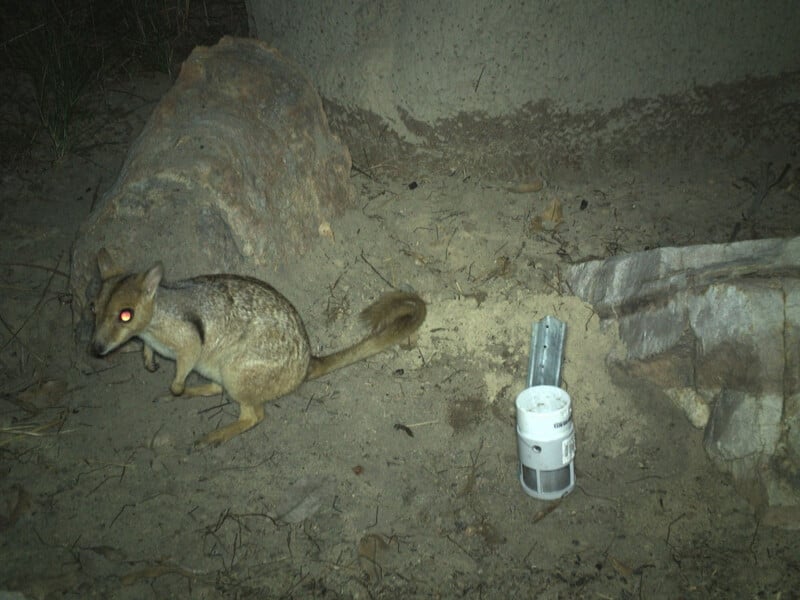 A Nabarlek was captured on a motion sensor camera in the north of Dambeemangaddee Country. It’s one of the first sightings of the species in over 50 years. | Image credit: AWC
According to a report by Smithsonian Magazine, identifying a nabarlek is particularly challenging because two other wallabies could potentially be mistaken for it. The monjon looks almost identical to the nabarlek, while the short-eared rock-wallaby has DNA that is very similar. Researchers therefore needed evidence that would distinguish the animals both visually and genetically.
Smithsonian Magazine reports that the team began by installing five motion-activated cameras at the site. The cameras operated at night and captured images of animals passing through the area. Those photographs showed that short-eared rock-wallabies were not living at the sites, allowing researchers to rule out that species before relying on DNA evidence. The images also provided a straightforward way to distinguish the short-eared rock-wallaby from the nabarlek, since the two do not look alike.
The researchers then had to determine whether the wallabies shown in the photographs were nabarleks or monjons. Since the two species look very similar, photographs alone could not provide a definite identification. The team therefore collected scat samples from the site and analyzed their DNA. The results confirmed that the animals were nabarleks, providing evidence that the species was present at the site.
Image creditsAll photos by Australian Wildlife Conservancy (AWC).
Affiliate Disclosure PetaPixel articles may include affiliate links; we may earn a commission if you buy through one.






 English (US) ·