
 1 hour ago
3
1 hour ago
3
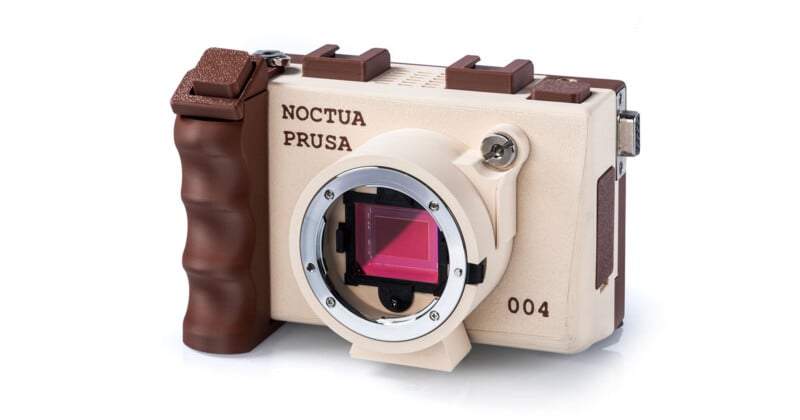
Upstart camera company Caimera has teamed up with Austrian PC fan company Noctua, on a new prototype Micro Four Thirds camera that is all about cryptographic authentication at the time of capture. The CAIM1 camera’s name stands for “Counter Artificial Intelligence Machine 1.” Catchy.
For Noctua, best known for its premium fans for DIY PC builders, to get involved in a camera design is undeniably weird and unexpected. However, when considering what Caimera’s CAIM1 aims to achieve, it starts to make a lot more sense.
The CAIM1 will captures both photos and videos and hardware-secure the files in real time as they are captured. In the case of photography, this may not be a massive computational lift, as there are cameras that already do that now, like 2023’s Leica M11-P, for example. However, with video, the demands are dramatically increased.
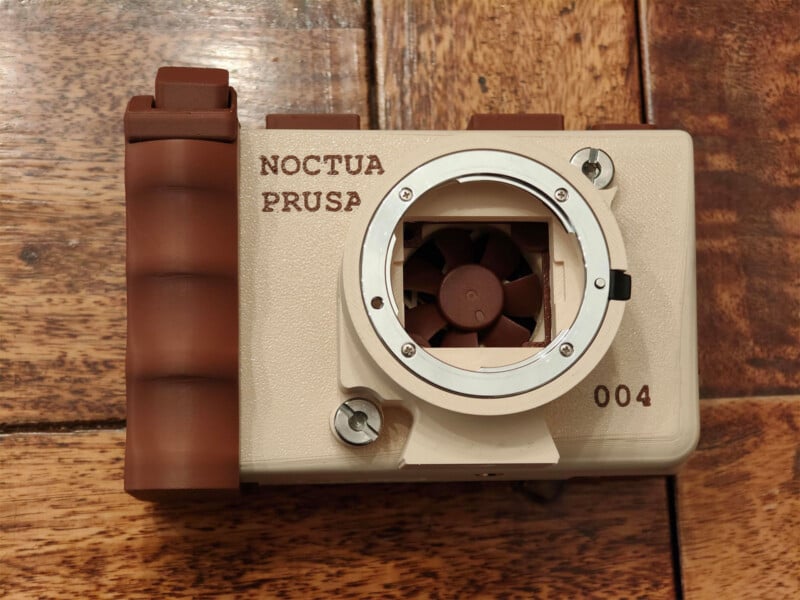
“CAIM1 must capture and process high-bitrate 4K video at 60fps while simultaneously performing the complex cryptographic calculations required to generate verification proofs. Together, these workloads push both the processors and the image sensor to their thermal limits,” Noctua explains.
“In the era of generated reality, authenticity requires proof. [CAIM1] attests human origin of your moments the second you press record and gives physical and open verifiable proof,” Caimera adds.
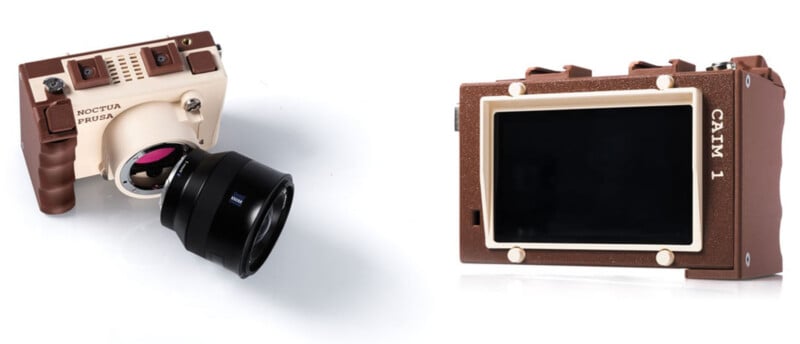
Meanwhile, a camera must also be relatively compact and pleasant to use, so it’s not possible to just stick a huge fan inside. Further, as Noctua says, the fan doesn’t need to always be on either and it must be quiet so as not to disturb audio capture during video recording.
“Cooling performance, power consumption, acoustics, and running smoothness therefore all had to be considered at once,” Noctua says.
So the company elected to use its NF-A4x10 5V PWM, which measures 40 x 40 x 10 millimeters and has precise speed control and quiet operation. The CAIM1 team didn’t want to use a 12V fan, as it could power a 5V one via the camera’s main board. In fact, the CAIM1 team wanted to use this particular Noctua fan so much that it redesigned the CAIM1’s entire main circuit board to accommodate the fan, which required redesigning critical components.
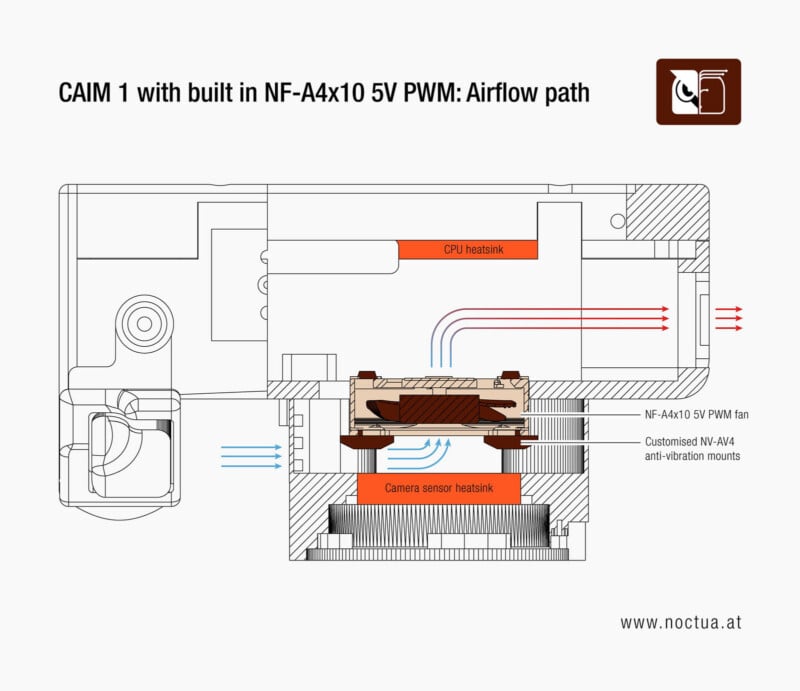
This single fan is located directly behind the image sensor and is decoupled from the camera’s main chassis using special anti-vibration mounts. It cools both the sensor and the board at the same time.
“When designing the CAIM1, our biggest hurdle was balancing the immense thermal output of a high performance edge compute board while keeping it trapped inside a portable, protective shell,” says Josh Cowell, the creator of CAIM1.
“We chose Noctua because they provided the absolute best ratio of airflow to physical footprint, enabling us to prolong battery life without thermal throttling. Their fans are so quiet and vibration free that they keep our processors at peak performance without interfering with our audio or image capture at all,” Cowell adds.
The CAIM1 is still in the prototype stage, but the team expects to begin shipping units in early 2027. As of yet, Caimera hasn’t shared detailed specs about the camera, but it will incorporate a Micro Four Thirds sensor and a Sony E-mount design.
“We don’t dictate your glass; we empower it. The core of our camera features a breathtakingly sharp Micro Four Thirds sensor optimized for flawless 4K video recording with an inbuilt anti-reflective 650nm IR filter,” Caimera says.
Image creditsCaimera, Noctua
Affiliate Disclosure PetaPixel articles may include affiliate links; we may earn a commission if you buy through one.






 English (US) ·