
 2 hours ago
4
2 hours ago
4
Bird Photographer of the Year has announced the winners of the 2026 edition of the competition. This year drew more than 24,000 entries from around the world, with organizers describer it as the largest bird photography contest.
More than 24,000 images entered the world’s largest bird photography competition. Here are some of the standout winners.
 Henley Spiers
The contest features eight categories in the adult competition: Best Portrait, Birds in the Environment, Bird Behavior, Birds in Flight, Black and White, Urban Birds, Conservation (Single Image) and Creative Perspectives. Additionally, there was a Conservation Award, Portfolio Award and Video Award and three youth competition categories.
“In a world where AI-generated imagery is becoming increasingly common, this year’s winners are a powerful reminder of the value of authenticity,” says Will Nicholls, Director of Bird Photographer of the Year. “Every image in the competition represents a real moment in the wild, earned through patience, dedication and a genuine connection with nature. People will always value real stories told by real people, and this year’s extraordinary photographs celebrate the beauty, wonder and authenticity of our natural world.”
The competition awards a £3,000 grand prize, and all winning images will be featured in a hardback coffee-table book published by Graffeg. The competition also donated more than £5,000 to its partner charity, Birds on the Brink.
You can see a small collection of the winning images below, or head to the competition website to see the full 2026 winners gallery. The next competition cycle, BPOTY 12, is now open for entries at birdpoty.com.
Bird Photographer of the Year 2026
 Henley Spiers
Photographer: Henley Spiers, United Kingdom
Award(s): Birds in the Environment — Gold Award; Overall Winner, Bird Photographer of the Year 2026
Image title: Sunball Rocket
Bird: Northern Gannet (Morus bassanus)
Image location: Shetland, Scotland, United Kingdom
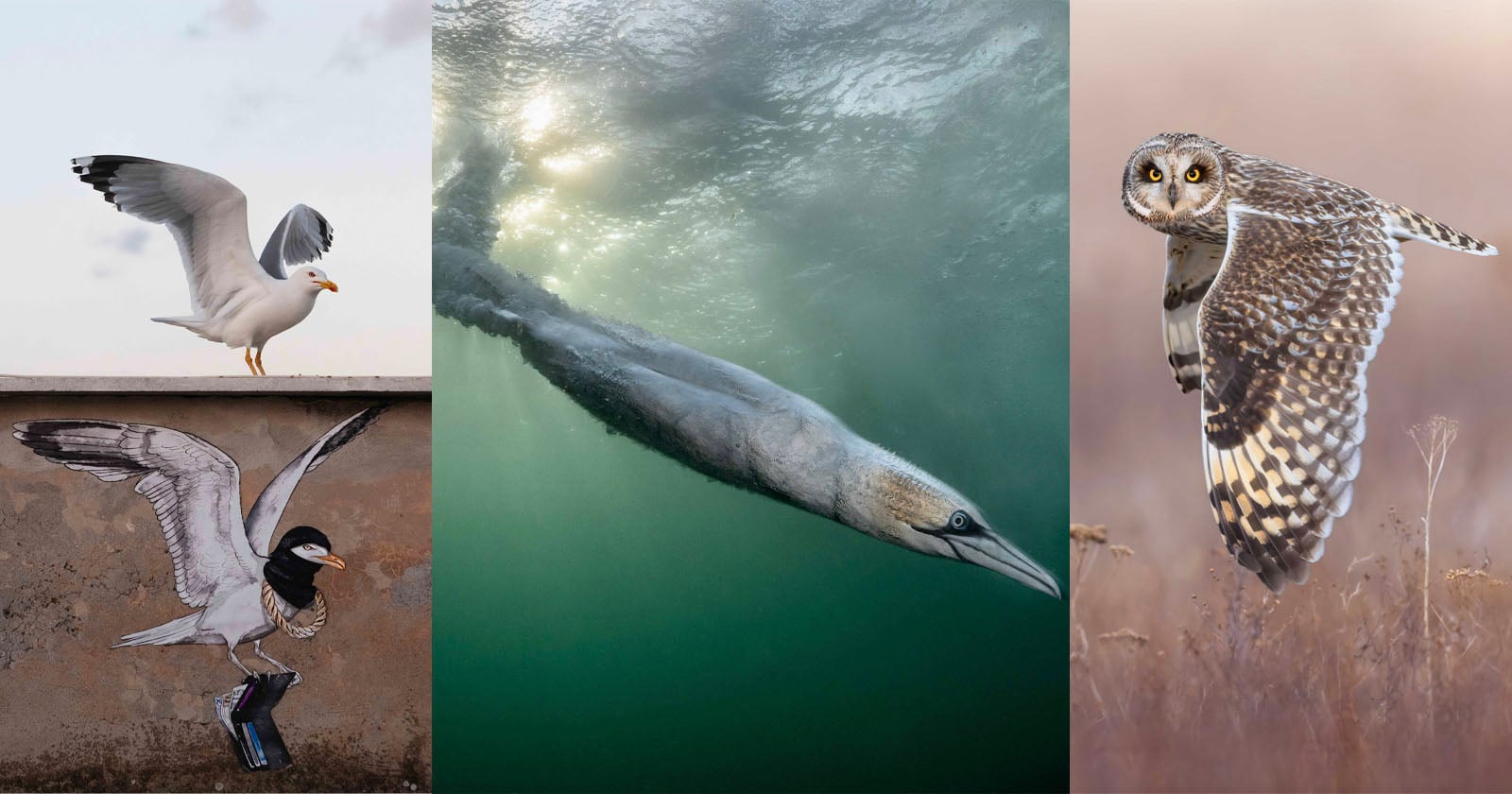
Caption: A northern gannet seems to burst through the sun as it pierces down through the water. The handsome northern gannets lead a dualistic existence. In the nest, their newborn is carefully nurtured, and a couple’s bond is reinforced by pointing sharp beaks to the sky as they tenderly stroke their white necks together. In flight, hunting mode takes over, and piercing yellow eyes, fringed with blue circles, scour the sea for prey. Their long wingspan and streamlined bodies make flying look effortless, gliding along with just the occasional pulse of their wings. When fish are spotted, the gannets fly into the wind and stretch out their wings as brakes, precisely adjusting their position in relation to their quarry. Moments later, with wings tucked in tightly, the gannet shape-shifts into a pointed torpedo, diving into the water at speeds of up to 86 km/ph. Even Olympic divers will not exceed 60km/ph, and these seabirds are specially adapted for the impact: muscles along the neck lock their vertebrae into place and air sacs in the face and chest act as airbags. Even their nostrils are evolved for this aquatic existence, located internally to prevent water ingress during fishing dives.
Technical details: Nikon Z 8 | Nikon 8-15mm F3.5-4.5E @ 15mm | F11 | 1/200 sec | ISO 500
Young Bird Photographer of the Year 2026
 Parham Pourahmad
Photographer: Parham Pourahmad, United States
Award(s): 15–17 Years — Gold Award; Young Bird Photographer of the Year 2026
Image title: Moonlit Night
Bird: Great Horned Owl (Bubo virginianus)
Image location: Los Gatos, California, United States
Caption: One bird I found a pair of Great Horned Owls nesting in a park next to my house. I headed out at dusk, hoping to capture a strong portrait of the owls. However, my aim shifted when I saw the full moon rising on the horizon. One of the owls flew down to a pine tree, and I quickly moved into position to frame it against the moon.
Technical details: Canon EOS Rebel T5i | Sigma 150-600mm F5-6.3 DG OS HSM Contemporary @ 275mm | F5.6 | 1/500 sec | ISO 6400
Video Award – Winner
Videographer: Liron Gertsman
Details: Bald Eagles are incredibly opportunistic predators and scavengers, gathering wherever there is an abundant food source. One such eagle feasting event involves hake, a fish in the cod family. Near Vancouver Island, Canada, hake are rapidly forced to the surface by naturally occurring tidal currents passing through narrow ocean channels. This sudden movement from the depths to the top of the water column causes their buoyancy-regulating swim bladder to overinflate, leaving the fish stuck at the surface where they are vulnerable to predators. Bald Eagles (and a multitude of other wildlife) gather by the hundreds to take advantage of the easy prey. As the tidal current picks up each day, more and more eagles gather, until the feeding frenzy begins. After photographing the annual event for several years, I dedicated some time to filming, and put together this short video to highlight this remarkable phenomenon.
Best Portrait — Gold Award
 Thomas DeLiberto
Photographer: Thomas Deliberto, United States
Award(s): Best Portrait — Gold Award
Image title: Radiant
Bird: Greater Sage-Grouse (Centrocercus urophasianus)
Image location: Utah, United States
Caption: A male greater sage-grouse during its courtship display. As the sun was rising over the shadowed sagebrush hill behind him, it illuminated the bird’s tail feathers such that they appeared to radiate light. I was fortunate to visit a sage-grouse lek, an area in which the birds congregate to mate. Arriving at the lek before sunrise, I crouched behind some rocks, facing east to get a backlit photo of a male. As the sun rose above the hill behind the lek, I was able to capture this male in full display. Greater Sage-Grouse are the largest native grouse in North America. As their name implies, these birds are intimately tied to the sagebrush ecosystems of the Intermountain West. Their populations in recent years have declined precipitously due to a loss of habitat.
Technical details: Nikon Z 9 | Nikon Z 400mm F2.8 TC VR S | F5.6 | 1/160 sec | ISO 64 | 1.4x teleconverter
Best Portrait — Silver Award
 Volker Widmann
Photographer: Volker Widmann, Germany
Award(s): Best Portrait — Silver Award
Image title: Sunset Puffin
Bird: Atlantic Puffin (Fratercula arctica)
Image location: Skomer Island, United Kingdom
Caption: I spent several days on Skomer to photograph the Atlantic Puffins in the early morning and late evening, when the day tourists had left the island and you had the birds almost to yourself. This evening, I waited at the puffin colony until the sun went down and photographed this bird against the reflections in the ocean.
Technical details: Canon EOS R5 | Canon EF 500mm F4L IS II USM | F4 | 1/400 sec | ISO 100
Bird Behavior — Gold Award
 Donald Chin
Photographer: Donald Chin, Australia
Award(s): Bird Behavior — Gold Award
Image title: I’m Keeping Everyone Dry
Bird: Tawny Frogmouth (Podargus strigoides)
Image location: Perth, Australia
Caption: Rain threads through the forest. Camouflaged against bark and shadow, a fledgling tawny frogmouth stretches its wings in what looks like covering its other siblings from the water droplets. Stillness is its field, with patience its inheritance. In the hush between falling drops, resilience becomes a form of quiet strength. His big round eyes and open mouth make it a cute capture.
Technical details: Sony a9 III | Sony FE 600mm F4 GM OSS | F5.6 | 1/200 sec | ISO 4,000 | 1.4x teleconverter
Bird Behavior — Silver Award
 Mark Carwardine
Photographer: Mark Carwardine, United Kingdom
Award(s): Bird Behavior — Silver Award
Image title: Spread Eagle
Bird: Bald Eagle (Haliaeetus leucocephalus)
Image location: Great Bear Rainforest, Canada
Caption: The Great Bear Rainforest on the west coast of Canada, as its name suggests, is a wet place, and on this particular day, it had been raining nonstop. I was on a Zodiac slowly meandering along an inlet in the forest when I spotted this magnificent juvenile bald eagle with its wings spread open. This behaviour is usually associated with either cooling down or drying feathers, but it seemed an almost impossible task in such relentless rain. Still, the eagle held its posture with determination.
Technical details: Canon EOS R5 | Canon RF 100-300mm F2.8 L IS USM @ 280mm | F4 | 1/200 sec | ISO 800 | 1.4x teleconverter; 280mm
Birds in Flight — Gold Award
 Ivan Sjögren
Photographer: Ivan Sjögren, Sweden
Award(s): Birds in Flight — Gold Award
Image title: Eye-to-Eye with a Short-Eared Owl
Bird: Short-Eared Owl (Asio flammeus)
Image location: British Columbia, Canada
Caption: A short-eared owl courses over the salt marshes of British Columbia’s Fraser River Delta. This was a magical evening, with five owls feeding around me as dusk fell. I witnessed both fights between owls and, later, displays in which they clapped their wings together. I took this photo by positioning myself strategically, hunkering down in the grass after anticipating the owls’ hunting routes. I was lucky that the owl turned its head to look at me as it passed silently by.
Technical details: Canon EOS R5 | Canon EF 500mm F4L IS II USM | F5.6 | 1/2500 sec | ISO 5000 | 1.4x teleconverter
Birds in Flight — Silver Award
 Alex Pansier
Photographer: Alex Pansier, Netherlands
Award(s): Birds in Flight — Silver Award
Image title: Patterns
Bird: Guillemot (Uria aalge)
Image location: Hornøya, Norway
Caption: Captured in March 2025 on Hornøya, this image reveals a mesmerizing swarm of guillemots in flight. What first appears as an Escher-like illusion is nature’s own design, organized chaos in motion. The sky becomes a canvas of repetition and rhythm, where the boundaries between order and disorder dissolve before your eyes.
Technical details: Sony a1 II | Sony FE 24-70mm F2.8 GM II @ 37mm | F5.6 | 1/1250 sec | ISO 3200
Birds in the Environment — Silver Award
 Åsmund Keilen
Photographer: Åsmund Keilen, Norway
Award(s): Birds in the Environment — Silver Award
Image title: Majesty
Bird: Golden Eagle (Aquila chrysaetos)
Image location: Urke, Ørsta, Norway
Caption: A majestic golden eagle drifts in dark silhouette across the face of the moon, its outstretched wings cutting a powerful shape through silver light. Below, winter-clad peaks rise in quiet stillness, their frozen ridges layered through in-camera multiple exposure to shape the visual expression I envisioned. The composition feels both graphic and atmospheric—a meeting of shadow and glow, strength and silence. Suspended against the luminous moon, the eagle becomes a timeless presence in the cold, breathless vastness of the alpine night.
Technical details: Canon EOS 5DS R | Canon EF 100-400mm F4.5-5.6L IS II USM @ 360mm | F5.6 | 1/8000 sec | ISO 400 | In-camera multiple exposure
Black and White — Gold Award
 Rahul Sachdev
Photographer: Rahul Sachdev, India
Award(s): Black and White — Gold Award
Image title: An Ostrich Horizon
Bird: Ostrich (Struthio camelus)
Image location: Amboseli, Kenya
Caption: An ostrich makes its way towards the dry lake bed of Amboseli. In black and white, the stark landscape emphasizes the bird’s solitary journey across the dust and heat.
Technical details: Canon EOS R5 | Canon RF 100-500mm F4.5-7.1 IS USM @ 300mm | F11 | 1/800 sec | ISO 250
Black and White — Silver Award
 Raoul Slater
Photographer: Raoul Slater, Australia
Award(s): Black and White — Silver Award
Image title: Grass Tree
Bird: Little Wattlebird (Anthochaera chrysoptera)
Image location: Pomona, Queensland, Australia
Caption: At our neighbor’s gate is a grass tree, also known as a Xanthorrhoea. These slow-growing succulents are native to Australia, and there are 30 species. They produce spectacular flower spikes that drip with nectar, attracting birds like this little wattlebird, butterflies and native bees. I’ve photographed this tree for a decade, but with never more than two spikes. This year was a great one for rain, and the tree responded with 5 spikes. As I drove out our gate each morning, I passed an exact point where they lined up beautifully. The car, with a towel draped across the window, provided a perfect hide. What you can’t see just below the edge of the photo is the house of the next neighbor along. It took some explanation to convince him that I hadn’t set up covert surveillance on his front door.
Technical details: Canon EOS R5 | Sigma 150-600mm F5-6.3 DG OS HSM Contemporary @ 347mm | F14 | 1/1600 sec | ISO 1600
Creative Perspectives — Gold Award
 Åsmund Keilen
Photographer: Åsmund Keilen, Norway
Award(s): Creative Perspectives — Gold Award
Image title: Sundance
Bird: Common Swift (Apus apus)
Image location: Oslo, Norway
Caption: On a blazing summer day, a common swift slices through the air, captured in an in-camera multiple exposure reflected in the glossy roof of our blue car. The sun burns at the center of the frame, radiating heat and brilliance, while drifting birch seeds scatter across the reflection like a fleeting flock echoing the swift’s movement. Sky, light, and motion blend into one shimmering composition, transforming an ordinary surface into a stage for midsummer energy—weightless, restless, and alive with warmth.
Technical details: Canon EOS 5DS R | Canon 100-400mm F4.5-5.6L IS II USM | Aperture not provided | 1/8000 sec | ISO 640 | In-camera multiple exposure
Creative Perspectives — Silver Award
 Henley Spiers
Photographer: Henley Spiers, United Kingdom
Award(s): Creative Perspectives — Silver Award
Image title: Turbulence
Bird: Northern Gannet (Morus bassanus)
Image location: Shetland, Scotland, United Kingdom
Caption: What if the most impressive animal you could encounter in British waters wasn’t a fish or a whale, but a bird? That was exactly how it felt to me in the frigid sea at Britain’s northernmost point. The dark water was repeatedly shattered by the dives of dozens of northern gannets, plunging after their prey. Visibility vanished as the birds hit the surface with astonishing precision, streaking underwater in cascades of bubbles. My heart pounded with adrenaline as I scanned the turbid water, until the gaze of a gannet met mine—its blue-yellow eyes unmistakable even through the haze. The aim was to convey the explosive movement of the hunt using a slow shutter and intentional camera movement. I understood the technical settings required, but the gannets’ speed and unpredictability made success elusive. After many failed frames, this image emerged as the one that best captured the energy and intensity of the moment.
Technical details: Nikon D850 | Nikon 28-70mm F3.5-4.5 @ 31mm | F22 | 1/8 sec | ISO 80 | Intentional camera movement
Urban Birds — Gold Award
 Gianluca Damiani
Photographer: Gianluca Damiani, Italy
Award(s): Urban Birds — Gold Award
Image title: Alter Ego
Bird: Yellow-Legged Gull (Larus michahellis)
Image location: Rome, Italy
Caption: In Rome, tall buildings function for yellow-legged gulls much like coastal cliffs, offering nesting, roosts and perches to survive within the city. This individual was photographed on a rooftop where a small colony had settled. The dry pet food visible on the windowsill reflects a routine practice by local residents of feeding urban birds, especially since COVID-19. I did not place or add any food, but a small, removable sticker was temporarily applied to the wall as a neutral visual element, without altering resources or influencing the bird’s behavior. As a researcher studying urban birds for my PhD project, I observed and recorded this scene without interfering with the animals, and encouraged people to stop feeding birds without awareness. The image highlights the bold and assertive behavior that enables gulls to thrive in close proximity to people.
Technical details: Nikon Z 9 | Nikon VR 70-200mm F2.8G @ 112mm | F5 | 1/1250 sec | ISO 2200
Urban Birds — Silver Award
 Romain Barats
Photographer: Romain Barats, France
Award(s): Urban Birds — Silver Award
Image title: Deception’s Hope
Bird: Gentoo Penguin (Pygoscelis papua)
Image location: Deception Island, Antarctica
Caption: This picture was taken on Deception Island, near the Antarctic Peninsula. Many disasters happen on Deception Island. Home of a fur seal trade leading to an almost extinction of seals, a whaling station, and then many volcanic eruptions leading to the destruction of scientific stations, this island looks like it is cursed. But since then, Nature has taken back its rights, like these gentoo penguins posing in front of a rusty whale blubber warehouse like guards. It gives a bit of Hope in Deception. I took the picture during a sailboat expedition to Antarctica.
Technical details: Canon EOS R5 Mark II | Canon RF 100-300mm F2.8 L IS USM @ 237mm | F14 | 1/200 sec | ISO 2000 | 1.4x teleconverter
Conservation (Single Image) — Gold Award
 Kent Stuart
Photographer: Kent Stuart, United States
Award(s): Conservation (Single Image) — Gold Award
Image title: Not a Good Day Fishing
Bird: Great Blue Heron (Ardea herodias)
Image location: Washington, Warren County, New Jersey, United States
Caption: This image was taken at a local pond that I frequent. It has limited access, so I hike in from a cornfield on the back side. I was wearing chest waders and worked my way out to a mud flat. I used a ground pod with a gimbal and had a camouflage net covering me. I was attempting to get shots of wood ducks, sandpipers and killdeer when this great blue heron (with a bobber and fishing line around his beak) flew in and landed right next to me. He was so close I could only get a head shot.
Technical details: Nikon Z 9 | Nikon Z 800mm F6.3 VR S | F6.3 | 1/800 sec | ISO 500
Conservation (Single Image) — Silver Award
 Yann Bigant
Photographer: Yann Bigant, France
Award(s): Conservation (Single Image) — Silver Award
Image title: Birds in the Red
Bird: Egret and Bittern species
Image location: Phnom Penh, Cambodia
Caption: Yellow bitterns and other waterbirds for sale in downtown Phnom Penh, Cambodia. An investigation into bird hunting and trade, during which this photo was taken, found wild birds sold illegally throughout the country, including in several markets of the capital. This seller often has different species of birds—weavers, egrets, watercocks and even larger openbill storks—occasionally sold alongside snakes, bats and cats. Catching birds is common across Southeast Asia, especially in unprotected farmland. Up to 500 species have been found hunted in recent years in the region, endangering several rare species. Already known for its ‘empty forests’, bird conservationists now fear that the region will soon face ‘empty wetlands and farmlands’.
Technical details: Canon EOS 5D Mark IV | Canon EF 24mm F2.8 IS USM lens | F5.6 | 1/40 sec | ISO 800
12–14 Years — Gold Award
 Paula Czaeczine
Photographer: Paula Czaeczine, Germany
Award(s): 12–14 Years — Gold Award
Image title: Acrobat of the Skies
Bird: Red-Necked Phalarope (Phalaropus lobatus)
Image location: Rost, Lofoten, Norway
Caption: On a small island in Norway, I observed Red-Necked Phalaropes foraging for food. One bird was swimming on a pond, pecking insects from the surface. Suddenly, it raised its head, stretched upwards, spread its wings, and fluttered into the air. Luckily, I had selected a high frame rate and was able to capture this fascinating moment, as well as the small moth the bird had caught.
Technical details: Nikon Z 8 | Nikon Z 600mm F6.3 VR S lens | F6.3 | 1/2000 sec | ISO 1100
11 and Under — Gold Award
 Alberto Román Gómez
Photographer: Alberto Román Gómez, Spain
Award(s): 11 and Under — Gold Award
Image title: Emerald Eye
Bird: Great Cormorant (Phalacrocorax carbo)
Image location: London, United Kingdom
Caption: The Great Cormorants in the area where I live are elusive and do not easily allow themselves to be photographed. However, in London, they were far more trusting and allowed people to approach within a few metres. I was able to observe them calmly and see that they are beautiful black birds with a metallic sheen. What really caught my attention, though, were their emerald-green eyes, so I decided to take a close portrait of the bird’s head.
Technical details: OM System OM-1 | OM System 100-400mm F5-6.3 @ 321mm | F6.3 | 1/80 sec | ISO 2000
Want to stay up to date on the latest product news and releases? Add DPReview as a preferred source to ensure our independent journalism makes it to the top of your Google search results.
View 0 comments



 English (US) ·