
 5 hours ago
5
5 hours ago
5
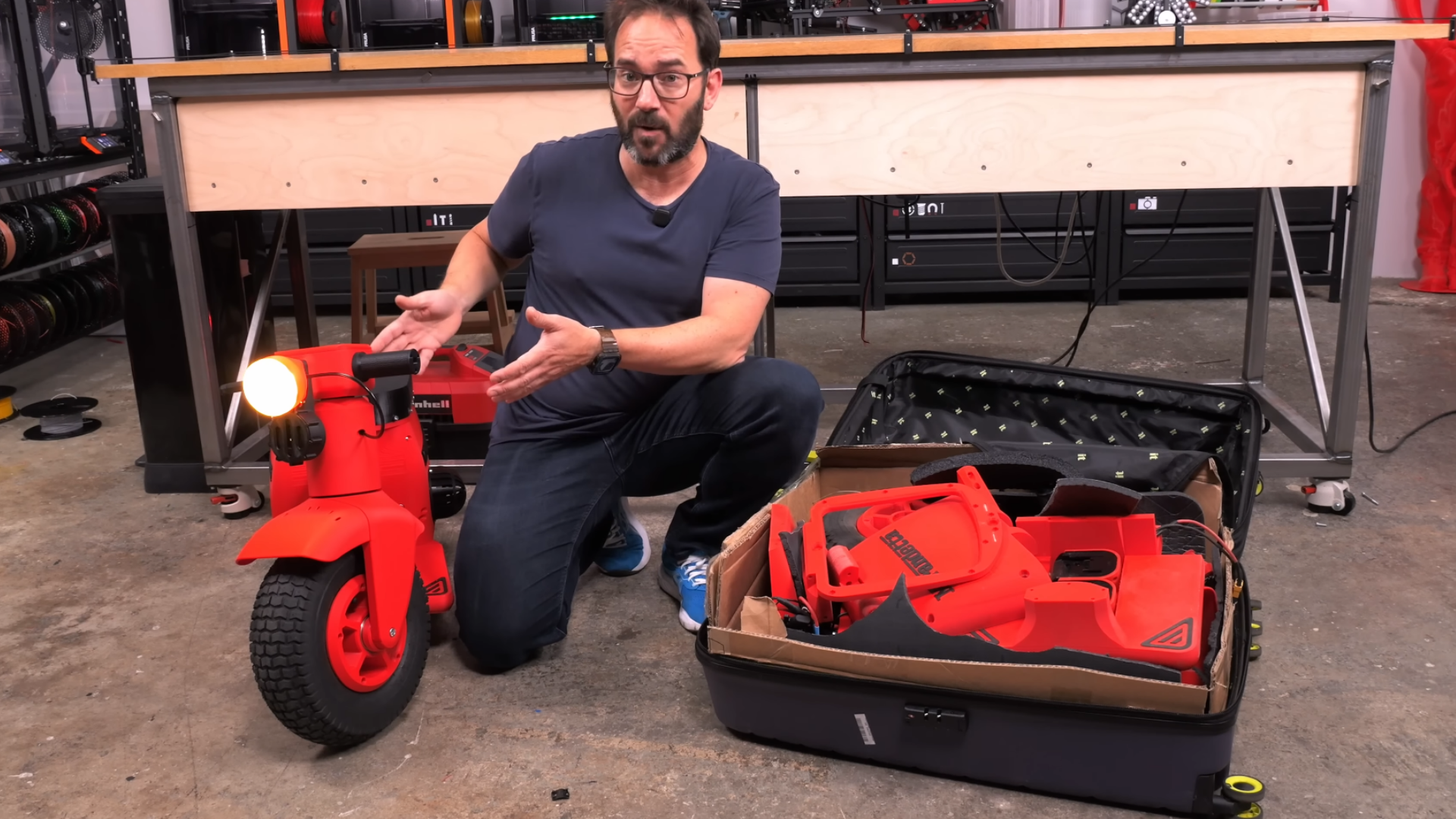
Ivan Miranda has released the design files for the Mirandetta, a 3D-printed electric motorbike that breaks down to fit inside a suitcase. He has re-engineered the vehicle so that every part prints on a single 300mm x 300mm bed. The files cost $40 through his website, ivanmiranda.com, and the redesign targets makers who want to build their own rather than admire the one-off he rode at Prague Maker Faire.
Miranda built the original in roughly 10 days as a "travel hack" — the smallest motorbike an adult could ride that still packed into checked luggage. To achieve this, he relied on aluminum wheel axles and an all-metal steering column assembly, and now the released design replaces both with printed parts.
Miranda also standardized the lighting on off-the-shelf T10 automotive sockets and bulbs instead of the salvaged components in the original, cut the number of distinct screws, and constrained every part to a 300mm x 300mm build volume. He says the redesign took more work than building the first bike from scratch. The reference printer is the Prusa CORE One L, a 300mm x 300mm x 330mm machine that we've reviewed previously. Anything smaller, including the standard 250mm-class CORE One, can't fit the largest parts in one piece.
I built a 3D printed Motorbike - YouTube
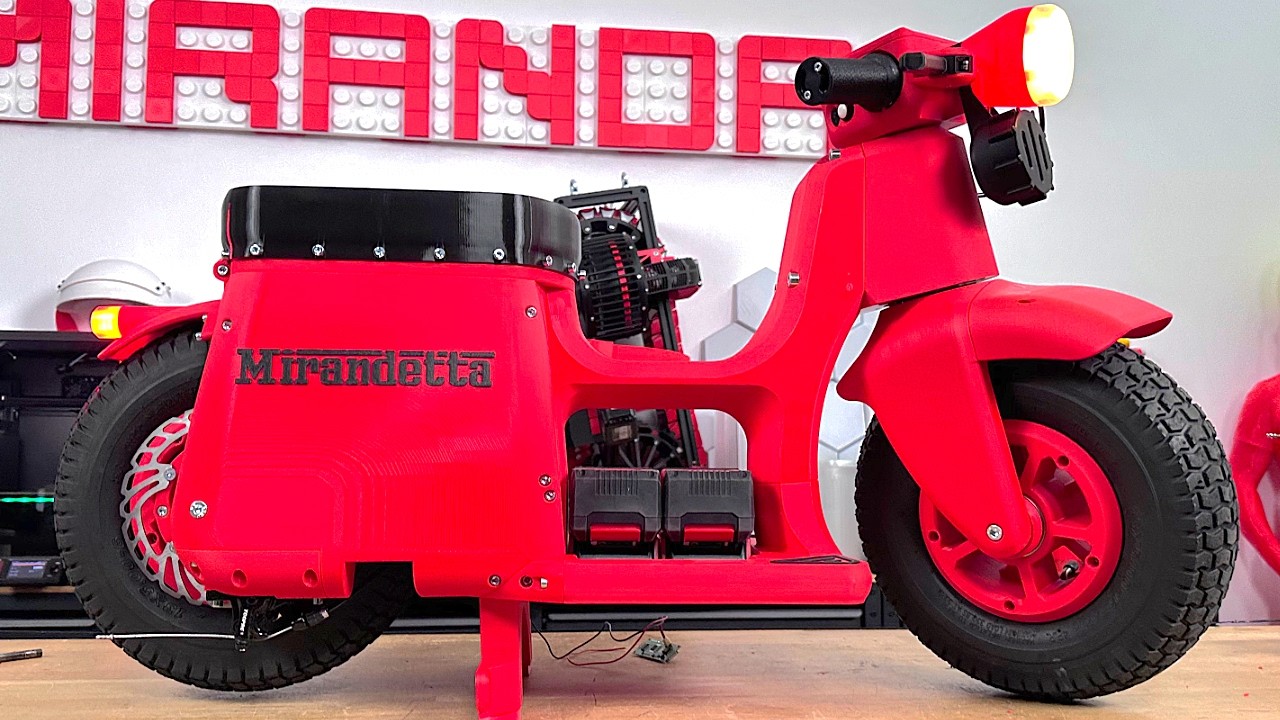
The wheels use lawnmower tires, which are normally too flat-profiled to lean on, and Miranda printed the rims narrower than standard so the tire's internal bead rings sit closer together; once inflated, the sidewalls can't splay outward and the tread rounds into a profile usable for cornering.
Braking uses floating motorcycle discs rather than the bicycle discs because the floating discs can be deriveted to open up a wider center bore that a printed axle passes through without shearing. Meanwhile, a belt drives the rear wheel, and the throttle is a 10K linear potentiometer mapped through an Arduino to the motor's electronic speed controller.
Power comes from two 36V cordless tool battery packs, making them hot-swappable and simpler to carry through airport security, while a DC-DC converter steps the 36V down to 12V for the horn and lights. Without the batteries fitted, the finished bike weighs a little over 14kg.
Users won't be folding up the assembled scooter and packing it away, though; that's only possible when the bike is fully assembled. Regardless, Miranda won the suitcase-build contest at Prague Maker Faire with the machine and plans to show it at Open Sauce. Miranda is selling the files as-is with no support, and the bike isn't intended as a production design; Miranda describes it as a "complicated hobby build."

Follow Tom's Hardware on Google News, or add us as a preferred source, to get our latest news, analysis, & reviews in your feeds.





 English (US) ·